

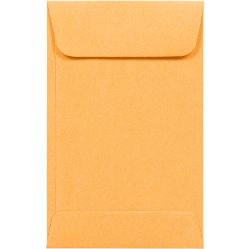
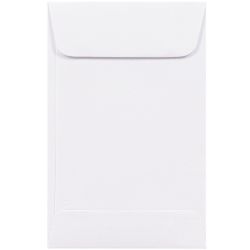
#1 Coin Envelopes
The #1 coin envelope is the smallest standard size in the U.S. commercial envelope system. At 2 1/4 x 3 1/2 inches, it's purpose-built for single-item containment and cataloging. One coin, one stamp, one gemstone, one watch component, one seed, one fastener. The format is simple: a short-side gum flap opens on the narrow edge, you drop the item in, seal it, and write or stamp the identifier directly on the face. Nothing gets lost. Nothing gets mixed up. This category carries the #1 in two stock options: brown kraft gum flap and white wove gum flap. Both ship same or next business day from Business Envelopes. Free shipping, no minimums.
1 Coin Envelope Dimensions and Specifications
The #1 is the entry point in the numbered coin envelope series. Here are the full specifications:
- Envelope size: 2 1/4 x 3 1/2 inches (2.25 x 3.5 inches)
- Metric equivalent: approximately 57 x 89 mm
- Opening: Short-side flap on the 2 1/4-inch (narrow) edge
- Paper stock: 28 lb (110 gsm) in both brown kraft and white wove
- Closure: Moistenable gum flap
- Face: Writable, accepts handwriting, stamps, and adhesive labels
- Custom printing: Organization name, logo, or department identifier printable on the face
The short-side flap is the design feature that defines the coin envelope format across every size. Opening on the narrow edge rather than the long edge keeps small items from sliding out when the envelope is handled, makes them easy to drop in and retrieve cleanly, and leaves the full wide face available for labeling. At the #1 size, that combination of compact footprint and reliable short-side closure is exactly what makes it useful for single-item cataloging workflows.
What "No 1 Coin Envelopes" Means
"No 1 coin envelopes" uses the same "no" prefix as "no 10 envelope" or "no 9 envelope," where "no" is shorthand for "number." It refers to the #1 coin envelope, 2 1/4 x 3 1/2 inches. The #1 designation comes from the position in the commercial coin envelope numbering hierarchy, not from any measurement. In everyday use, the #1 is the smallest envelope most supply programs stock, and it's what buyers are looking for when they search any variation of "1 coin envelope," "#1 coin envelope," or "no 1 coin envelopes."
#1 Coin Envelopes: Brown Kraft vs White
#1 Brown Kraft Gum Flap
Brown kraft is the traditional coin envelope material. The 28 lb kraft fiber construction is more resistant to tearing and puncture than white wove at the same weight, which matters for an envelope that gets handled frequently and may hold items with edges or sharp profiles. The kraft surface holds handwritten labels, ink stamps, and adhesive stickers without bleeding. In storage environments where both white envelopes and brown coin envelopes are in use, the color difference creates an instant visual category that reduces handling errors. Standard choice for banking counters, pharmacy dispensing, archival programs, and hardware part sorting.
#1 White Wove Gum Flap
White wove is the right choice when presentation matters or when the environment requires it. A gemstone or small specimen shows clearly against a white background when the envelope is opened for inspection or photographed for documentation. Medical, pharmaceutical, and laboratory workflows standardize on white because everything else in the environment is white and the color consistency matters. Printed labels have higher contrast on white than on kraft, which helps in any system using barcode scanners or printed label stock. The white surface also photographs cleaner for inventory and insurance documentation.
Where 1 Coin Envelopes Get Used
The #1 coin envelope appears in more industries than most buyers expect. Its usefulness is specific: it's the right container for any single small item that needs to be held, labeled, and retrieved without loss or confusion. Here are the most consistent applications across professional environments:
- Numismatics and coin dealers: Individual coin storage and cataloging, estate inventory, grading submission packaging
- Philately and postal history: Single stamp storage, first-day covers, small philatelic items
- Jewelry and gemology: Single-stone storage at appraisal counters, diamond melee sorting, repair shop part holding
- Watchmaking and small parts repair: Component holding during service, crown and stem storage, crown tube sorting
- Pharmacy and medical: Sample containment, single-dose packaging, specimen labeling
- Seed saving and botany: Individual variety storage, botanical specimen cataloging
- Hardware and manufacturing: Small fastener sorting, screw and pin holding, kitting for assembly
- Photography and electronics: SIM card storage, memory card holding, small accessory packaging
Why the Smallest Envelope in Your Supply Closet Deserves the Same Standard as the Largest
There's a tendency to treat small-format supply items as interchangeable commodities where quality is irrelevant because the item is inexpensive and low-stakes. The #1 coin envelope proves that logic wrong every time it fails. The gum flap that activates in the drawer before you've sealed anything. The paper that tears when the item inside has any edge to it. The face that won't hold an ink stamp cleanly, so two weeks later you open the envelope without knowing what's inside. None of those failures are dramatic. They're just consistent, quiet friction in a workflow that should have none.
We carry the #1 coin envelope in 28 lb stock for exactly this reason. It's not the lightest stock available at this size. It's the right stock. The kraft version holds up under repeated handling and sharp-edged contents. The white version photographs clean and holds labels firmly. Both seal consistently with a properly moistened gum flap and identify their contents reliably on a surface that takes ink the way it should. That's the standard we've applied to every envelope in this catalog since 1997, and the #1 coin is not an exception to it. No minimums, free shipping, same or next day on blank stock. For quantity pricing on larger programs, request a quote here. Browse the full coin envelope range for all sizes from #1 through the larger 4 5/8 x 6 3/4 format.
Frequently Asked Questions About #1 Coin Envelopes
Q: What size is a #1 coin envelope?
A #1 coin envelope measures 2 1/4 x 3 1/2 inches (approximately 57 x 89 mm). It's the smallest standard size in the U.S. coin envelope numbering system.
Q: What does "no 1 coin envelope" mean?
"No" is shorthand for "number." No 1 coin envelope means the #1 size at 2 1/4 x 3 1/2 inches, same as "no 10 envelope" for the #10 format.
Q: Should I choose brown kraft or white for #1 coin envelopes?
Brown kraft is more tear-resistant and better for ink stamps. White wove is better for label printing, photography, and clinical or retail environments where white surfaces are standard.
Q: What is a short-side flap on a coin envelope?
The flap opens on the narrow (short) edge of the envelope. This keeps small items from sliding out during handling and leaves the full wide face available for labeling.
Q: Is there a minimum order on #1 coin envelopes?
No minimums. Order any quantity. Blank stock ships same or next business day. Free ground shipping on every order across the contiguous 48 states.
Q: Can I get #1 coin envelopes printed with my logo?
Yes. Custom printing on both brown and white stock: logo, organization name, or department identifier on the face. PDF proof before production. Ships in 7 to 10 business days.
Q: How does the #1 coin envelope compare to the #7?
The #1 is 2 1/4 x 3 1/2 inches. The #7 is 2 7/8 x 4 7/8 inches for multiple coins and small parts. The #7 is more versatile.
Q: Where can I find larger coin envelope sizes?
Larger formats include the #7 (2 7/8 x 4 7/8 inches) and 4 5/8 x 6 3/4, both in brown or white with gum flap or peel-and-seal closures.