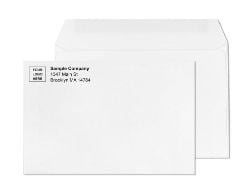
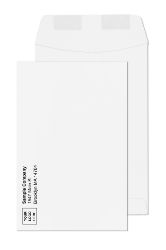
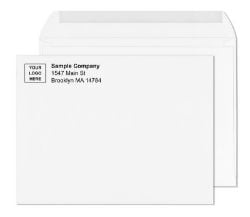
The remittance envelope is the physical mechanism that makes mail-based fundraising and payment collection work. You send the outgoing piece in a #10 with the remittance envelope tucked inside, unsealed. Your donor or customer fills in their information on the back flap, puts their check or cash inside, seals it, and mails it back. No additional envelope needed, no address to look up, no friction. That frictionless return path is exactly why nonprofits, churches, alumni associations, political campaigns, and subscription businesses keep remittance envelopes in their mailing programs. This version is #6 3/4 size, 24 lb bright white wove, with a moistenable gum flap and a large back flap with printable surface. Available blank or with custom printing from Business Envelopes. Free shipping, no minimums.
Remittance Envelope Specifications
- Envelope size: 3 5/8 x 6 1/2 inches (3.625 x 6.5 inches)
- Distinctive feature: Oversized back flap with printable interior surface for donor forms, order blanks, or personal information fields
- Paper stock: 24 lb bright white wove
- Closure: Moistenable gum flap
- Face: Windowless, clean white surface for printed return address and logo
- Fits inside: #9 and #10 outgoing envelopes as a return enclosure
- USPS classification: First-Class letter rate on return contents under 3.5 oz
- Ships: Same or next business day on blank stock
What Makes a Remittance Envelope Different From a Regular Return Envelope
A standard return envelope is just a small envelope with a pre-printed return address. The recipient seals it and drops it back in the mail. A remittance envelope has a large oversized flap on the back that, before the envelope is sealed, functions as a writable or printable form. That's the key distinction. Fundraising organizations print their donor fields directly on the inside of that back flap: name, address, donation amount, gift designation, payment method checkboxes. The donor fills it in, folds the flap closed, seals it, and mails it. The return trip is the data collection trip.
This is why "donation remittance envelopes" and "remittance envelope printing" searches land here. The custom printing on remittance envelopes isn't just a return address on the face. It's the donor form on the back flap. That's what gets printed, proofed, and produced before these ship.
Donation Envelope Printing: What Goes on Each Surface
The face of the envelope carries your organization's name, return address, and logo, same as any outgoing envelope. The large back flap is where the real work happens. That's where you print your donor form layout: name and address fields, giving level checkboxes, gift designation lines, payment method options, and any specific campaign messaging. The donor fills in the flap, folds it down, seals it, and your completed response comes back in the same envelope they received. For organizations running recurring annual appeal mailings, capital campaigns, or monthly giving renewal programs, the remittance envelope with a printed back flap eliminates a separate insert step and keeps the response piece integrated with the envelope itself.
Printing goes directly on the stock. PDF proof before production. Nothing runs until you've approved the layout for both the face and the back flap. Artwork on file for reorders, so annual programs don't require re-uploading files every cycle. Custom printed orders ship in 7 to 10 business days from proof approval. Blank stock ships same or next day.
For the same #6 3/4 size in a plain format without the oversized remittance flap, see the #6 3/4 White Gum Flap. For the tinted security version that conceals contents from outside view, see the #6 3/4 White Tinted Gum Flap. For the standard #9 return envelope that fits inside a #10 outgoing piece, see the #9 White Gum Flap. For volume pricing on remittance envelopes across a full annual appeal or campaign program, request a bulk quote here.
 Free shipping