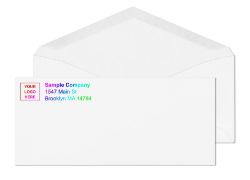
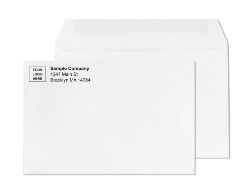
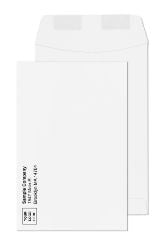
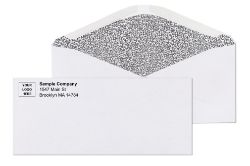
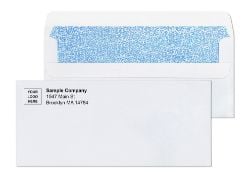
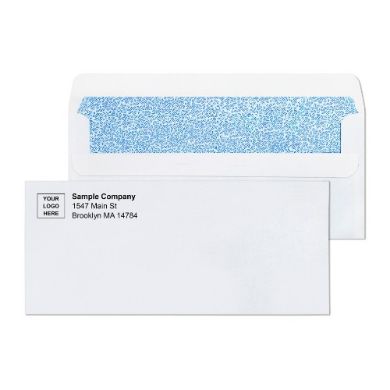

Every outgoing piece of business mail needs two addresses on the outer envelope. The delivery address tells the postal system where the piece is going. The return address tells it where to send the piece back if it cannot be delivered. Most businesses think carefully about the delivery address and treat the return address as an afterthought. That is the wrong priority order, because the return address has real operational consequences that the delivery address does not.
A missing return address is not just an etiquette issue. When a piece of First-Class Mail cannot be delivered, USPS sends it to the Mail Recovery Center in Atlanta rather than back to the sender. Without a return address, you have no way of knowing the piece failed to deliver, no way to correct the address, and no way to resend. For a single personal letter, that is a minor inconvenience. For a batch of 200 invoices sent to a partially outdated mailing list, undeliverable pieces with no business envelope return address represent a billing gap that compounds every month.
USPS does not technically require a return address on all mail classes, but the practical case for including one on every outgoing piece of business mail is clear. The cost of omitting it, in lost payments, missed deadlines, and gaps in your own mailing list data, is far higher than the effort of making sure it appears on every piece.
Not all methods are equal. Each one has a different cost structure, a different effect on the first impression, and a different failure mode worth understanding before you commit to any volume program.
The most basic option. Suitable for very low volume personal correspondence, but not appropriate for any professional business mailing. Handwritten return addresses look inconsistent, cannot scale, and communicate to recipients that the organization does not have basic mailing infrastructure. For any business sending recurring outgoing mail, this is where the comparison starts, not where it ends.
The most common workaround for business envelopes is with a return address. A label sheet with your organization's name and address printed on small adhesive labels, applied to the upper-left corner of each envelope before mailing. Labels are faster than handwriting and can carry a small logo alongside the address text. However, labels introduce the most operational failure modes of any method. Labels shift during application and can end up crooked. Adhesive releases in warm storage environments, leaving labels that peel in transit before the envelope reaches its destination. On premium or colored envelope stock with a non-standard surface finish, adhesive compatibility can be a real issue. At any meaningful volume, applying a label to each piece adds time to every mailing run without adding anything the recipient values.
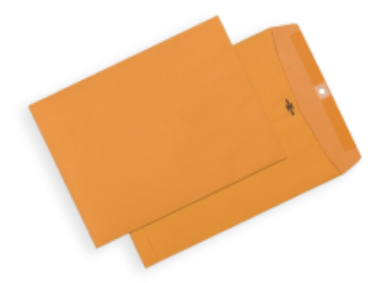
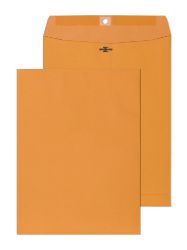
A self-inking return address stamp sits between labels and custom printing in effort and consistency. You press it to the upper-left corner of each envelope, and it delivers a crisp impression of your organization's name and address, typically in a format around 7/8 by 2-3/8 inches. A replacement ink pad comes with most stamp units, giving useful life across tens of thousands of impressions. The practical case for a self-inking stamp is organizations that mail at low to moderate volume across a variety of envelope types that do not justify a dedicated custom print run. The return address stamp applies equally to a number 10, a 9x12 kraft mailer, or a clasp envelope without a separate production order for each. The limitation is that a stamp impression is text only. It does not carry a logo. For any program where brand identity on the outer envelope matters as much as the address itself, custom printing on the envelope stock remains the correct end state.
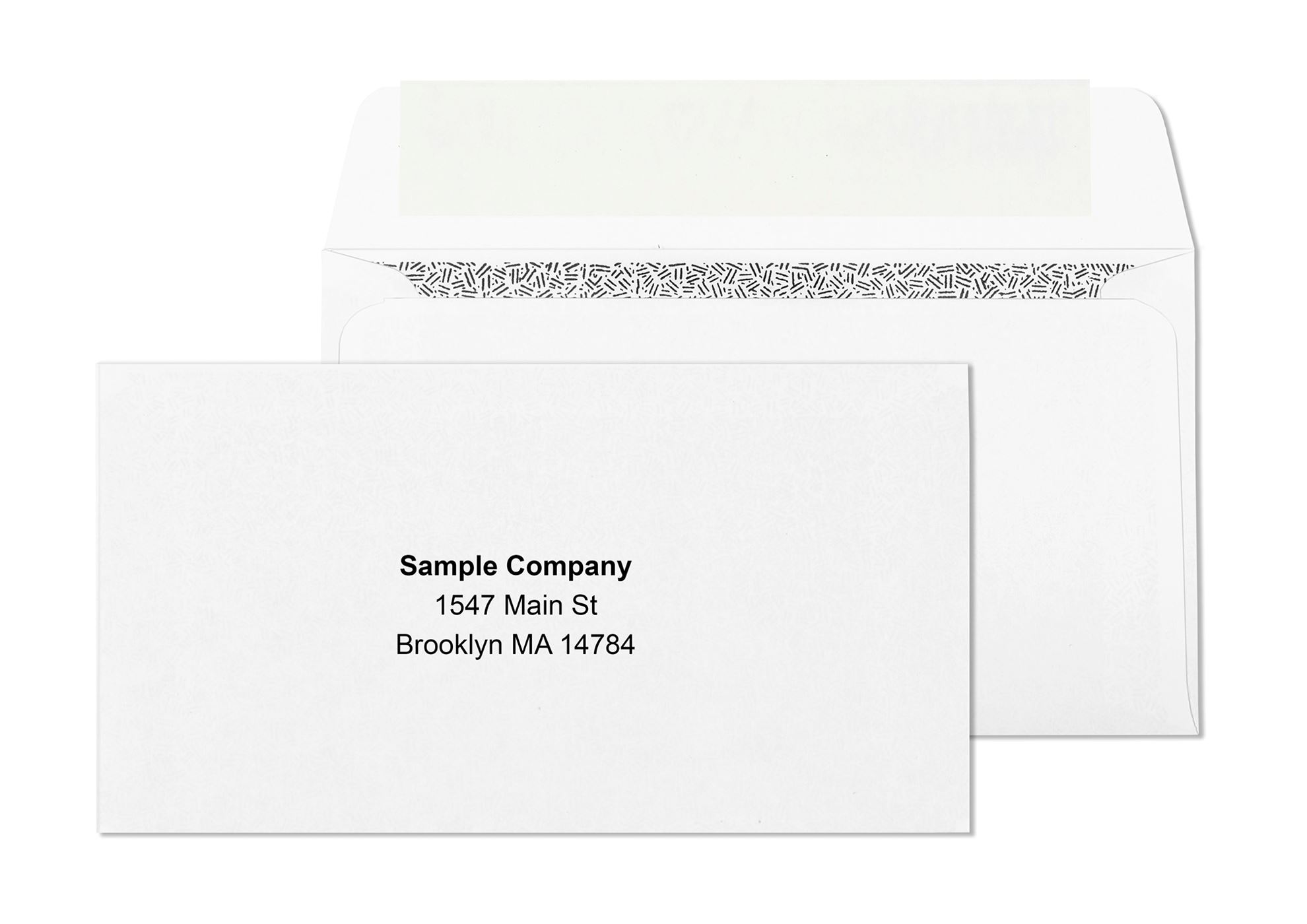
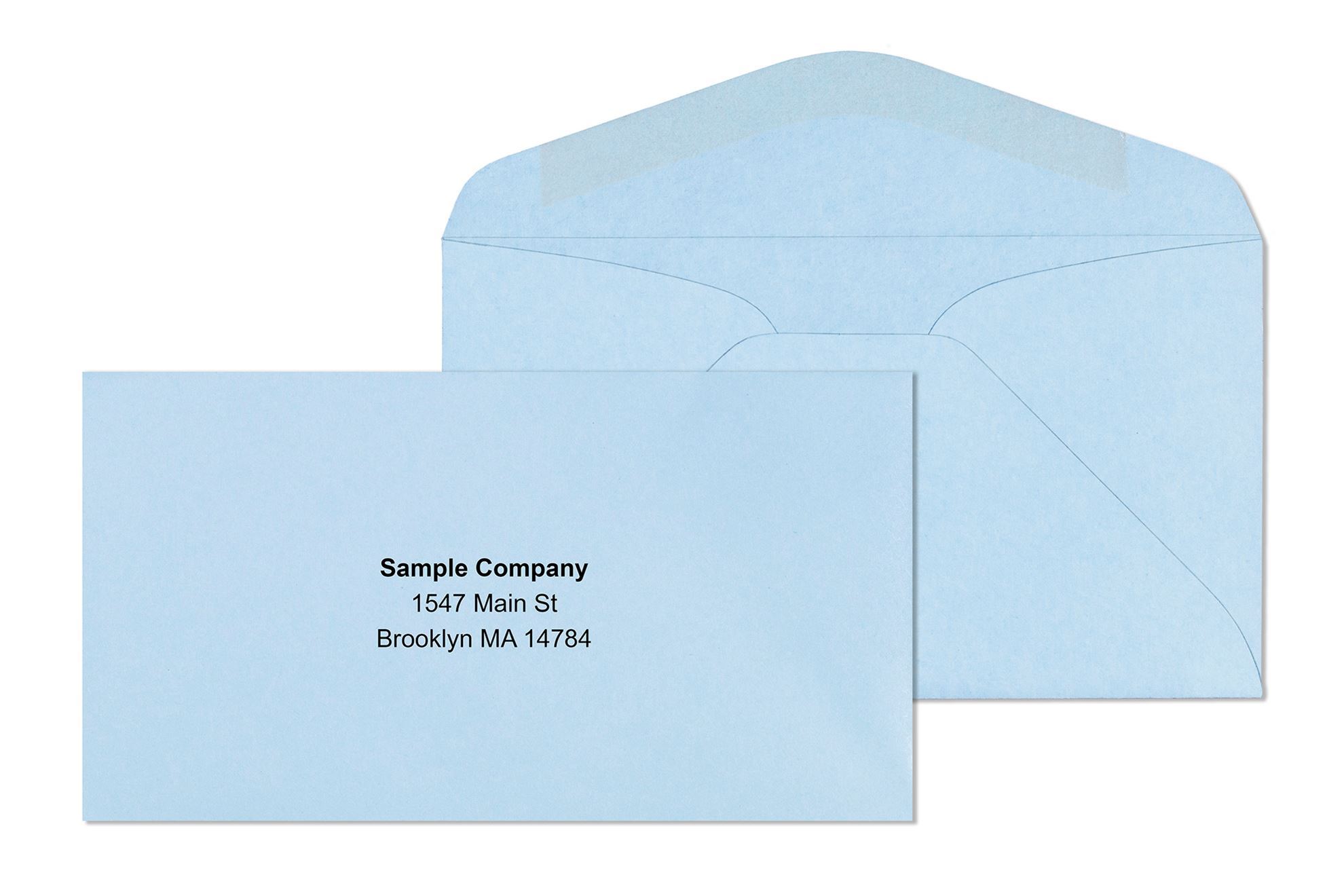
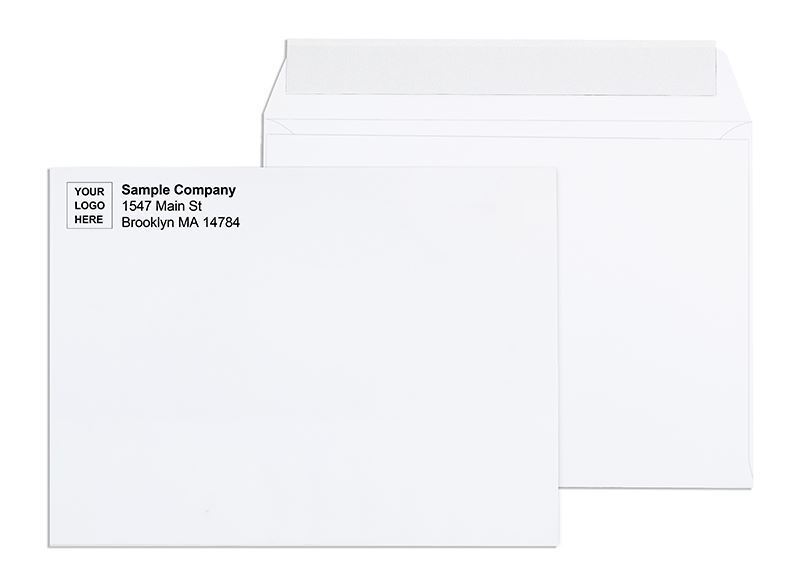
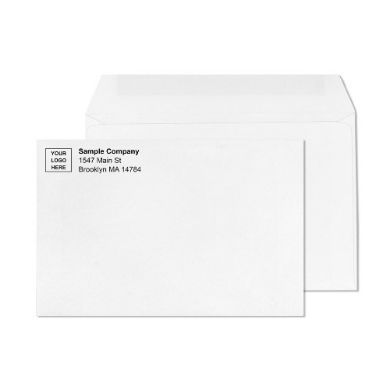
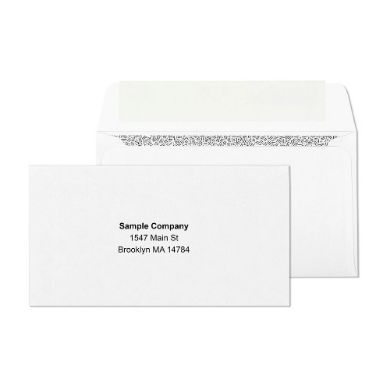
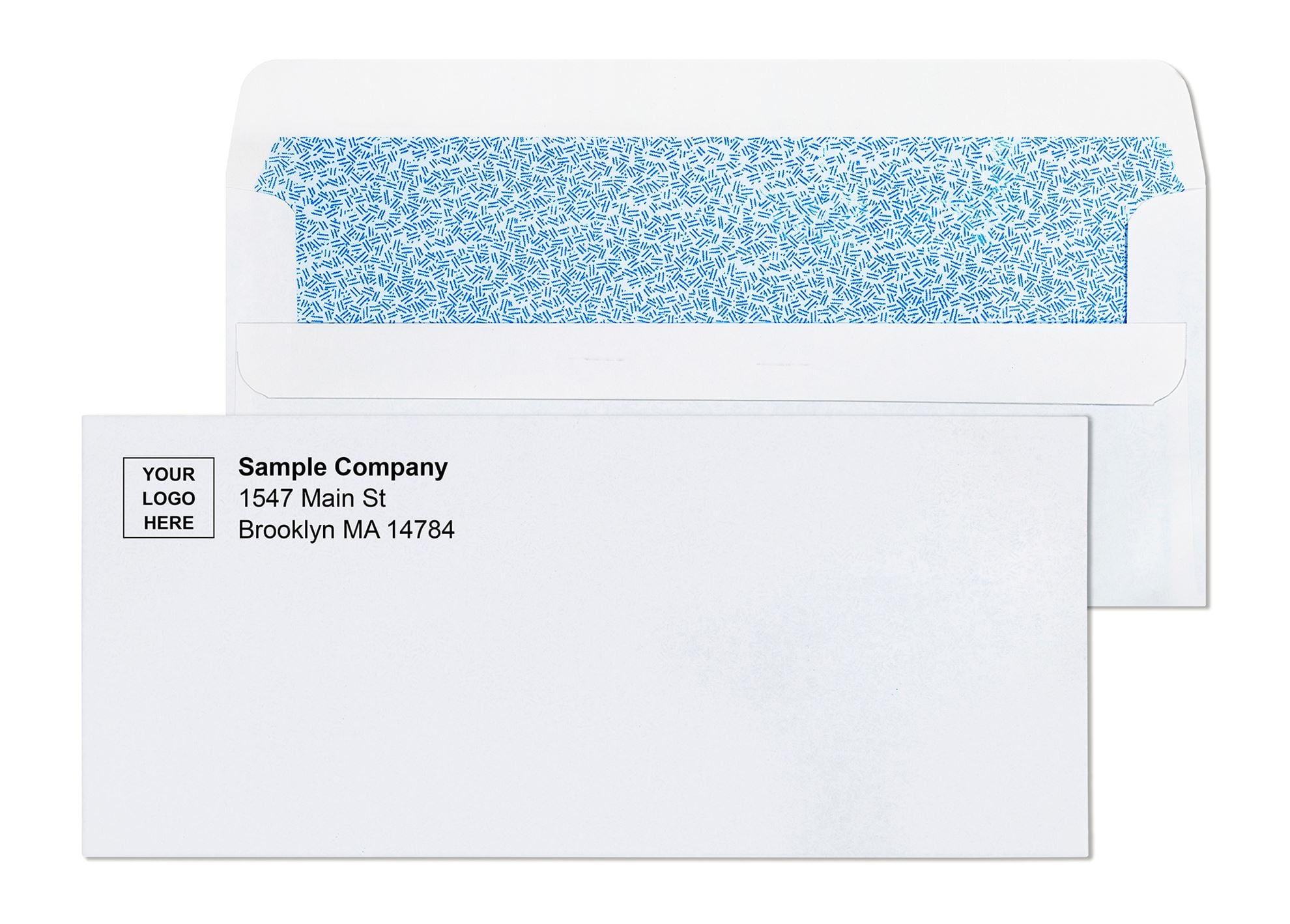
The professional standard for business envelopes with a return address at any recurring mailing volume. Your organization name, street address, city, state, and ZIP code, along with your logo if the program calls for it, are printed directly on the envelope face during production. The print is part of the envelope itself rather than something added separately. It does not shift, peel, or vary between mailing runs.
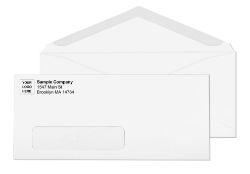
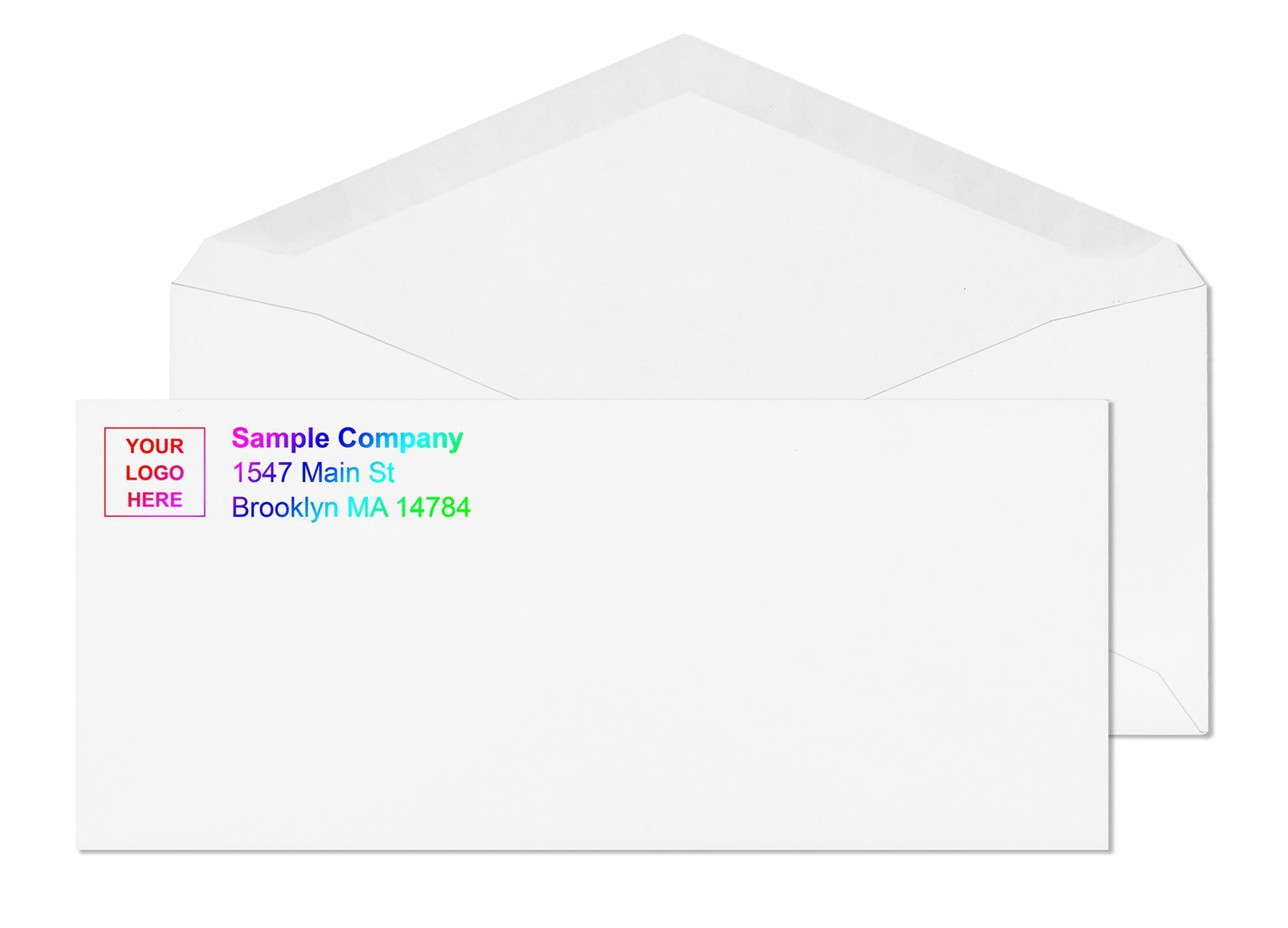
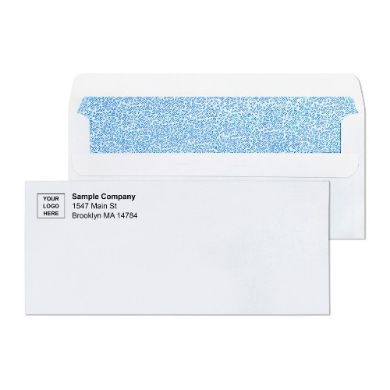
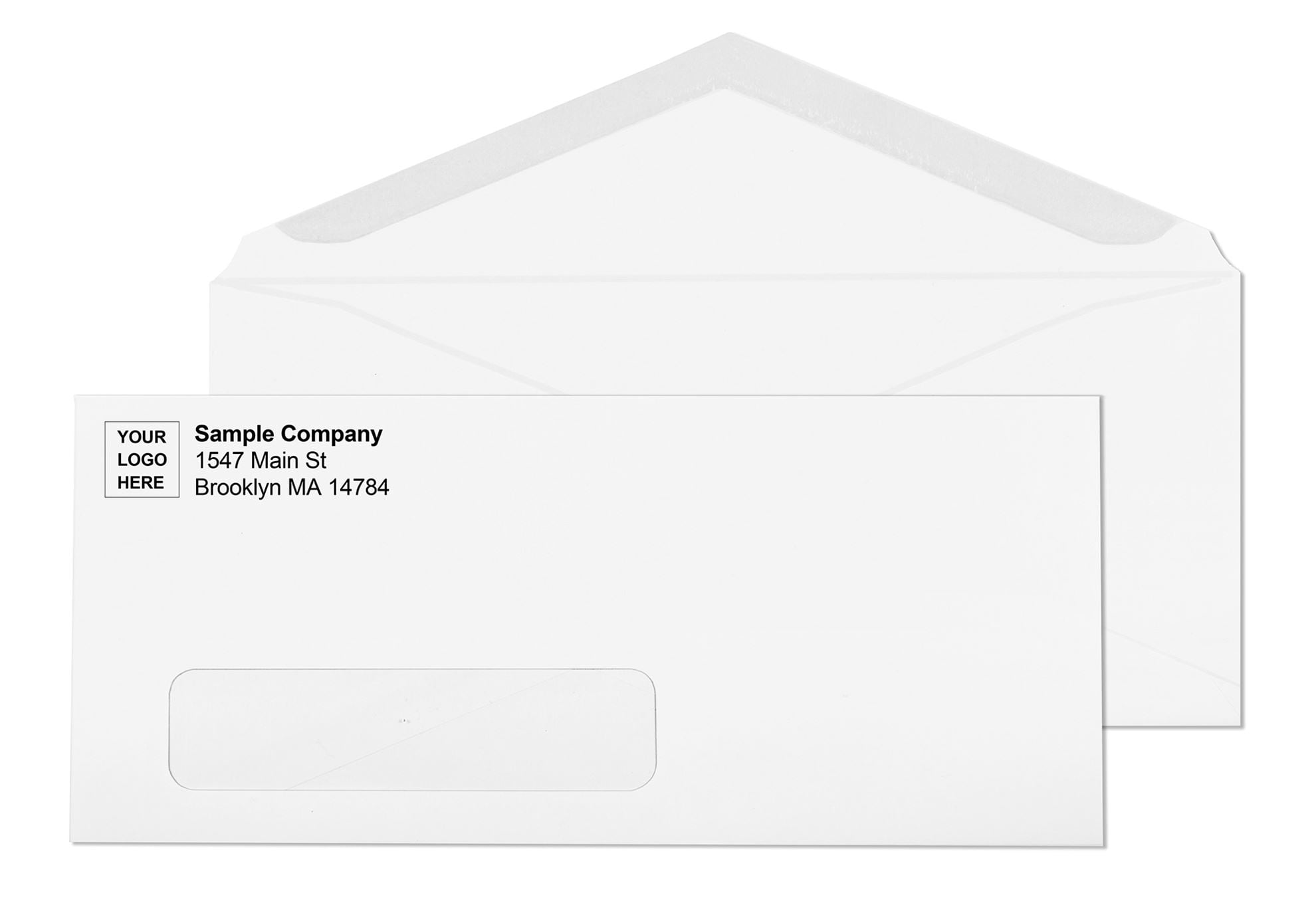
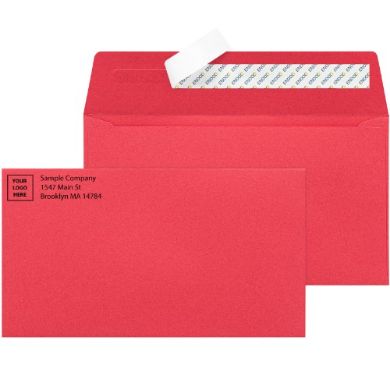
The term corner card refers specifically to the combination of company name, logo, and return address pre-printed in the upper-left zone of the envelope face. It is the industry-standard name for this element and what print buyers use when specifying this feature with envelope suppliers. Every piece that leaves your building carries an identical, legible, permanently applied corner card without anyone applying anything by hand.
Custom printed envelopes at Business Envelopes apply the corner card to the upper-left zone of the envelope face across every size and format in the catalogue. PDF proof before production, artwork on file for reorders, no minimum order on any format.
USPS specifies that the return address should occupy the upper-left corner of the envelope face. The standard position is at least one-half inch from the left edge and one-half inch from the top edge. The address block extends downward from there. It should not drift toward the center of the face. The full address block should also stay at least one half inch from the right edge to maintain adequate clearance across the face.
USPS automated sorting equipment reads the delivery address in the OCR read area, which runs roughly one-half inch up from the bottom edge across most of the face. A return address drifting into that zone can interfere with automated scanning. There is also a barcode clear zone at the bottom of the face where USPS equipment prints a Delivery Point Barcode after reading the delivery address. Nothing, no labels, no printed content, no design elements, should occupy the bottom two and three-quarters inches of the envelope face. Keeping the return address cleanly in the upper-left corner satisfies both requirements simultaneously.
The return address on business envelopes needs to be legible to both automated equipment and human sorters. USPS optical character recognition scans the envelope face at high speed. A return address in a decorative script font, a very small point size, or low-contrast ink on a colored envelope stock can register poorly or fail.
The practical standard: use a clean sans-serif or serif font at no smaller than 8 points, in high-contrast dark ink on light envelope stock. Standard black or dark blue ink on white wove is universally legible. On colored envelope stock, confirm the ink colour provides clear contrast against the specific stock colour before ordering a full custom print run. A navy logo on a royal blue envelope is a real production problem that a PDF proof on screen does not always catch, since screen colours do not precisely reproduce print output.
Many organizations treat the return address as the only element on the outer envelope face. The face of a standard number 10 envelope offers meaningful surface area, and businesses that think more carefully about their outgoing mail use that space with intention.
A tagline or campaign message positioned below the corner card turns every outgoing piece into a branded touchpoint before the recipient opens it. A short phrase, a value statement, or a campaign identifier printed beneath the return address adds zero mailing cost and is present on every single piece the organization sends.
A website URL alongside or beneath the return address gives recipients a direct reference point for follow-up. A QR code printed in the corner card area bridges the physical envelope to a digital landing page or payment portal. This is increasingly common in direct mail programs where response tracking matters.
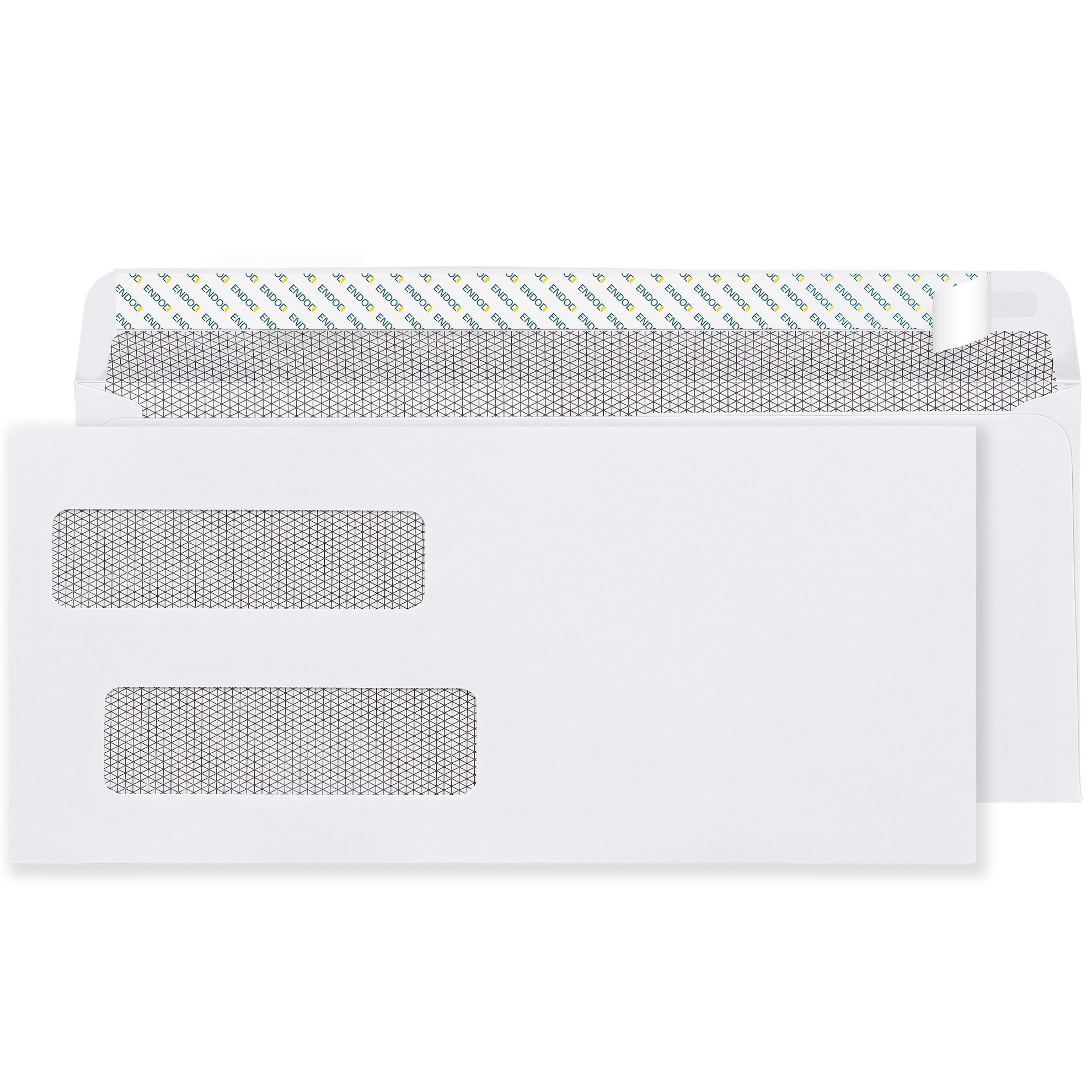
For organizations running recurring billing, invoice, or statement programs, the return address question has a more efficient answer than labels or custom printing alone. A custom-printed window envelope handles both addresses from a single envelope. The window in the lower-left of the face displays the recipient's delivery address from the document inside. The custom-printed corner card occupies the upper-left zone permanently. Both functions operate on the same face in separate, non-overlapping zones.
The result is an envelope that arrives fully addressed and fully branded without anyone writing, printing, or applying anything to the outer envelope. For monthly billing cycles of any meaningful size, this combination eliminates the two most repetitive manual steps in the entire mailing workflow at once. The delivery address comes from the document. The return address is part of the envelope. Nothing is added by hand.
For programs that include a reply envelope inside the outgoing piece, a number 9 envelope with a pre-printed return address creates the complete return path. The recipient does not need to address anything themselves. They insert their payment, form, or response, seal it, and mail it back.
Custom printing on a number 9 is available at Business Envelopes with no minimum order, across plain, tinted, and window variants. The same artwork file used for the outgoing number 10 adapts to the number 9 format. Visual consistency stays intact across both the outgoing and return pieces.
For under 20 pieces per month, return address labels or a self-inking stamp applied to regular envelopes are both practical options. The volume does not justify a custom-printed production run. For 50 to 200 pieces per month, custom-printed envelopes with the corner card applied during production become worth the setup. The label or stamp application step alone adds meaningful time at this volume, and the professional appearance improvement persists on every piece for every mailing cycle going forward.
At 200 pieces per month and above, the conversation shifts from whether to use custom printed envelopes to which format makes the workflow most efficient. Window formats for billing and invoice programs. Pre-printed corner card formats for correspondence programs. Self-seal closures for any format where sealing speed matters. At Business Envelopes, no minimum order applies to any format, which means custom printing is accessible at any volume, not just at the quantities where a commercial print run becomes economical.
Ordering envelopes in volume without testing a sample first is one of those decisions that feels efficient until it isn't. The window position doesn't align with your invoice template. The paper weight is lighter than expected, and the security tinting doesn't block the check amounts from showing through properly. The peel-and-seal strip activates before you've finished inserting the contents. None of these problems is obvious from a product description or a photograph. They show up when you hold the actual envelope and run it through your actual workflow.
This guide covers what a business envelope sample should tell you, the specific properties worth checking before you commit to any volume order, and the mistakes that consistently catch buyers who skipped the sample step.
A sample is a physical example of the specific envelope you're considering ordering, in the exact size, weight, closure type, and configuration you plan to buy, before the full order is placed. Not a photograph. Not a specification sheet. The actual envelope.
The purpose is verification, not preview. You already know what you want from the product description. The sample confirms whether the physical reality matches that description and whether the envelope performs correctly in your specific use case, which the description cannot tell you on its own.
Envelopes interact with more variables than almost any other supply category in a mailing operation. The paper weight determines whether your printer feeds it cleanly. The window position determines whether your document's address block lands behind the window correctly. The adhesive formulation determines whether the gum flap activates with the moisture application method your team uses. The security tinting determines whether it actually blocks your specific document's content from showing through under your office lighting conditions. The peel-and-seal liner determines whether it holds during storage when envelopes are pre-stuffed before sealing.
Every one of those properties is specific to your situation. The same envelope that works perfectly for one billing operation might have a window position that sits 0.25 inches too low for a different organization's invoice template. That 0.25-inch difference is invisible in a product listing and immediately obvious the moment you fold a live document and hold the envelope up to the light.
Paper weight and feel
Hold the sample in your hand and compare it to a piece of your standard 24 lb letterhead stock. The envelope should feel comparable, not noticeably flimsier. For any regular envelope used in client-facing correspondence, 24 lb white wove is the professional standard. For heavier document packages, 28 lb provides additional structural rigidity. If the sample feels thin relative to the contents it's meant to carry, the mismatch will communicate itself to the recipient before they open the envelope.
Window position alignment
If you're ordering any window envelope format, print a live copy of the document it will carry, fold it exactly as it will be folded in production, insert it into the sample envelope, and hold the sealed envelope up to a light source. The complete delivery address must show through the window with clear margins on all four sides. The address must not be cut off by the window frame on any edge. If any part of the address is obscured, either the window position doesn't match your document template or the fold depth needs adjustment before a full run.
This test takes under two minutes and it's the single most important check for any window format because USPS requires the full address to be visible through the window for automated processing. A misaligned window means your batch goes to manual sorting, which slows delivery and can generate non-compliance notices on high-volume presort programs.
Security tinting coverage
For check envelopes and security tinted formats, insert the most sensitive document type you'll be mailing through this program, a live check with account numbers or a statement with financial account data. Seal the envelope. Hold it against a bright light source at an angle. No content from the document should be readable through the envelope wall. If numbers, names, or account references show through the tinting, the tinting pattern on that specific envelope is insufficient for the sensitivity level of your contents. This test matters because tinting quality varies between manufacturers and the standard that protects a generic form letter is not always the standard that protects a payroll check.
Closure function and feel
For gum flap closures, moisten the flap using the same method your team will use in production and press firmly. Hold the sealed envelope for 30 seconds and then try to open the flap. A properly activated gum flap should not release without tearing. For self-seal peel and seal closures, peel the liner strip and press the flap down. The adhesive should bond immediately and hold against a firm tug without releasing. For flip and stick variants, flip the flap over and press. Bond should be immediate and consistent. Any closure that feels weak on a sample will fail at a measurably higher rate in production, particularly on high-speed runs where pressure application is less consistent than careful hand-testing.
Printer compatibility
If your operation prints addresses directly on the envelope face rather than using labels or window formats, feed the sample through your specific office laser or inkjet printer at your current envelope print settings. Confirm that the feed is clean with no jamming or misalignment, that the printed address sits in the correct position relative to the envelope face, and that the toner adheres cleanly without smearing when you run your thumb across it 30 seconds after printing. Standard 24 lb white wove envelopes feed through most laser printers reliably, but paper path differences between printer models mean that compatibility is always worth confirming on the actual unit that will handle production runs rather than assuming based on the weight specification alone.
Interior capacity and insertion feel
For any envelope where contents will be inserted by hand or by insertion equipment, fold your actual intended contents to the production fold, insert them into the sample, and assess the fit. Contents should slide in cleanly without forcing or catching on the flap seam. For stuffed pieces with multiple inserts, such as a cover letter plus a response card plus a pre-stamped return envelope, insert the complete package and confirm that the outer flap seats and seals cleanly. A sample that's comfortable with a single folded sheet but binds up with a full multi-insert suite will cause consistent jams and sealing failures in production.
The most common mistake that sample testing prevents
The mistake that shows up most often in volume envelope orders that go wrong is a window position mismatch on invoice and billing programs. An organization switches from a plain envelope plus label workflow to a window envelope workflow, places a volume order based on a manufacturer's standard window position spec, and discovers during the first billing run that their accounting software's invoice template puts the delivery address approximately half an inch higher than where the window sits. The entire batch of envelopes is unusable for the intended program until the invoice template is adjusted or a different window position is sourced.
Catching this with a sample before placing a volume order takes five minutes. Catching it after the order has arrived and the billing cycle is already running is an operational disruption of a different scale entirely.
What Business Envelopes offers before you commit
Business Envelopes carries every standard commercial envelope format across its full size and configuration range, with no minimum order on any product. This means the sample question has a practical answer that not every supplier can offer: rather than committing to a minimum quantity to test a format, you can order a small quantity of the exact product you want to evaluate before scaling to the volume your program requires.
For custom printed programs with your logo and return address, the PDF proof process serves a parallel function to a physical sample for the print side of the decision. A PDF proof shows exactly how your artwork will be positioned on the envelope face, in the correct proportions, before production begins. Nothing goes to press without your approval.
For blank stock across every size and format, including window envelopes, check envelopes, Tyvek envelopes, clasp envelopes, and self-seal formats, same or next-day production applies. Artwork on file for custom printed reorders means the production-to-delivery cycle for recurring programs is as short as the shipping transit time.
The gum flap on a standard envelope requires moisture to activate. That requirement is not a problem for sealing one envelope. It becomes a bottleneck, a consistency problem, and a quality control issue on any mailing run over 50 pieces. Someone has to moisten every flap, ensure the adhesive activates fully, hold each flap in contact until the bond forms, and not stack pieces prematurely before the gum has set. Inconsistent moisture produces inconsistent seals and the result is envelopes arriving partially open, or pieces that need to be resealed before they can go into the mail.
Self seal envelopes remove moisture from the equation. The adhesive is already active. Two formats deliver this differently: peel-and-seal, where a protected liner covers the adhesive until you intentionally remove it, and flip-and-stick, where a short tab folds onto an already-exposed adhesive panel. This guide explains how each works, which one is right for which situation, the mailing machine compatibility question that most buyers get wrong, and the honest labor cost math that explains why high-volume operations standardize on self-seal.
A peel-and-seal envelope has a pressure-sensitive adhesive strip on the flap, covered by a paper release liner until the moment of use. Peel away the liner to expose the adhesive, press the flap against the envelope body, and the adhesive bonds on contact under firm pressure. No moisture required. The bond forms through mechanical compression.
The release liner is what makes peel-and-seal the technically superior choice for pre-stocked inventory. The liner protects the adhesive strip from ambient humidity, heat, and accidental contact for the full shelf life of the stock. Envelopes stored in a supply room through summer months, stacked under other supplies, or left in a closed box for weeks or months will have identical adhesive performance when used as when they were manufactured. The liner maintains this.
Flip-and-stick does not have a release liner. The adhesive panel on the envelope body is exposed. In normal office conditions this is fine. In high-humidity environments, in envelopes stored loosely rather than boxed, or when the adhesive panel contacts other surfaces during handling, there is a meaningfully higher risk of partial pre-activation compared to a liner-protected strip. If your operation stocks envelopes for more than a few weeks before use, peel-and-seal is the safer inventory choice.
One thing no supplier explains: peel-and-seal closures are tamper-evident. When a sealed peel-and-seal envelope is reopened after the adhesive has fully bonded, the flap does not release cleanly it tears along the bond line. The result is visible physical damage to the flap that a recipient can identify before opening. For any mailing where envelope integrity on arrival is part of the professional standard (legal correspondence, financial documents, confidential HR communications), the tamper-evident property of peel-and-seal closures provides a basic chain-of-custody signal that gum flap envelopes do not.
Flip-and-stick closures do not have this tamper-evident property to the same degree. The bonded flap on a flip-and-stick envelope can sometimes be carefully opened and reclosed, depending on bond strength and how long since sealing. For correspondence where tamper evidence matters, peel-and-seal is the correct closure specification.
Standard commercial mailing machine inserters the mechanical systems that automatically fold, stuff, and seal envelopes in high-volume mailing operations are designed around moistenable gum flap envelopes. The inserter applies water to activate the gum adhesive during the automated sealing cycle. Peel-and-seal and flip-and-stick closures cannot be processed by standard mailing machine inserters.
This is not a minor technical note. If your operation uses a mailing machine inserter (Pitney Bowes, Hasler, Francotyp-Postalia, Neopost, or similar), you need gum flap envelopes, not self-seal. If you switch to self-seal format without checking equipment compatibility, the inserter will not seal the envelopes, and you will have 500 stuffed but unsealed pieces to process by hand. Check your inserter's specifications before ordering.
Self-seal closures are for hand-sealing operations. That covers the majority of small to mid-sized businesses and many billing departments that process mailings by hand. But it does not cover high-volume operations running mechanical insertion lines. Know which category your operation falls into before specifying a closure type.
Peel-and-seal and flip-and-stick envelopes cost slightly more per unit than gum flap. Here is why the premium is almost always justified for hand-sealing operations above a threshold volume.
Sealing 500 gum flap envelopes by hand with a sponge or bottle moistener takes approximately 2.0 to 2.5 hours at a consistent quality-conscious pace. At $18 per hour for mailroom labor, that is $36 to $45 in labor cost for the sealing step alone.
Sealing 500 self-seal envelopes (peel-and-seal or flip-and-stick) with a consistent one-step motion takes approximately 1.0 to 1.25 hours. The labor cost drops to $18 to $22.50.
Labor savings per 500-piece run: $18 to $22. Per-unit premium for self-seal over gum flap: typically $0.02 to $0.04 per envelope, or $10 to $20 per 500. The labor savings meet or exceed the per-unit premium within one to two runs. For any operation doing monthly billing runs of 200 or more pieces, self-seal total cost of ownership is lower than gum flap when labor is included in the calculation.
| Factor | Peel-and-Seal | Flip-and-Stick |
|---|---|---|
| Storage stability | Better liner protects adhesive from humidity and heat | Good exposed panel can partially pre-activate in high humidity |
| Per-piece sealing speed | Good peel then press | Slightly faster fold and press, no liner step |
| Tamper evidence | Yes flap tears visibly if reopened after bonding | Less reliable may reopen without clear damage |
| Mailing machine compatible | No | No |
| Best for | Envelopes stocked in advance, sensitive correspondence | Immediate-process high-volume hand-sealing runs |
Even protected peel-and-seal adhesive has limits. Store self-seal envelopes flat in a cool, dry environment. The recommended storage conditions are 65 to 75 degrees Fahrenheit and 40 to 55 percent relative humidity. High temperature and high humidity are the two conditions that reduce adhesive performance even through a release liner.
Do not store self-seal envelopes near heating vents, in direct sun exposure, or in attic or basement environments with temperature extremes. Do not compress large stacks of envelopes under heavy weight sustained compression can partially pre-activate the adhesive strip even through the liner. Store in original packaging, which is designed for the correct flat storage orientation, until the day of use.
The most ordered format in the self-seal category at Business Envelopes is the #10 window tinted self-seal. This format provides three efficiency improvements simultaneously: the window eliminates the addressing step by showing the recipient's address from the document inside, the security tint interior blocks sensitive document contents from transmitted light, and the self-seal closure removes the moisture activation step. For a billing department processing monthly statements, this single format eliminates the three most time-consuming per-piece manual steps: label application, envelope addressing, and moisture sealing. Browse all window options at window envelopes.
Self-seal formats are available across the full commercial range: #6 3/4 peel-and-seal for reply and donation response pieces; #9 peel-and-seal (plain, tinted, window, double window) for return mail nested inside #10 outgoing pieces; #10 peel-and-seal and flip-and-stick (plain, tinted, window, double window) for all standard business correspondence and billing; 6x9 peel-and-seal for flat-document mailing at letter rate; 9x12 peel-and-seal for flat-document programs; and Tyvek peel-and-seal in 6x9, 9x12, 10x13, and 10x15 through Tyvek envelopes. Browse the full self-seal range at businessenvelopes.com/self-seal-envelopes.
Business Envelopes carries peel-and-seal and flip-and-stick formats across every commercial envelope size, in plain, security tinted, window, and double window configurations all in one place with no minimums and free ground shipping. Our self-seal adhesive is calibrated for consistent bonding across the humidity and temperature range of normal US office environments. We have supplied self-seal envelopes to billing departments, accounting firms, healthcare offices, and direct mail operations since 1997. Custom printing is available on all self-seal styles. Blank stock ships same or next business day. For the complete range, see #10 envelopes, custom printed envelopes, and the full catalog.
Peel-and-seal has a release liner protecting the adhesive on the flap until you peel it away. Better for stocked inventory and sensitive correspondence (tamper-evident). Flip-and-stick has an exposed adhesive panel that the flap tab presses onto. Slightly faster for immediate-process high-volume sealing. Both seal without moisture.
No. Standard commercial mailing machine inserters are designed for moistenable gum flap envelopes and apply water during the automated sealing cycle. Peel-and-seal and flip-and-stick closures are incompatible with inserting equipment. If you run a mechanical inserter, you need gum flap envelopes.
Yes. Once a peel-and-seal envelope is sealed and the adhesive has fully bonded, reopening the flap tears it visibly along the bond line. This physical damage is apparent to the recipient before opening, providing a basic tamper-evident indicator. Flip-and-stick does not reliably provide the same tamper-evident property.
Peel-and-seal envelopes are unlikely to pre-seal because the release liner protects the adhesive from ambient contact until intentionally removed. Flip-and-stick envelopes have exposed adhesive panels and carry a higher risk of partial pre-activation in high-humidity or high-temperature storage environments. Store all self-seal envelopes flat, cool (65-75°F), and dry (40-55% RH) in original packaging.
Business Envelopes carries self-seal formats in #6 3/4, #9, #10, 6x9, 9x12, 10x13, and 10x15. Plus double window check and invoice formats. Tyvek peel-and-seal in 6x9, 9x12, 10x13, and 10x15.
At approximately 200 or more pieces per mailing session. The labor savings from self-seal sealing speed (roughly half the time of gum flap for the same volume) offset the per-unit premium within one to two mailing runs. At 500 pieces per month, self-seal saves approximately $18 to $22 in labor per run while costing $10 to $20 more per run in envelope premium.
Yes. All self-seal envelope styles support custom printing: logo, return address, and tagline. PDF proof before production. Ships in 7 to 10 business days from proof approval. Free shipping, no minimums.
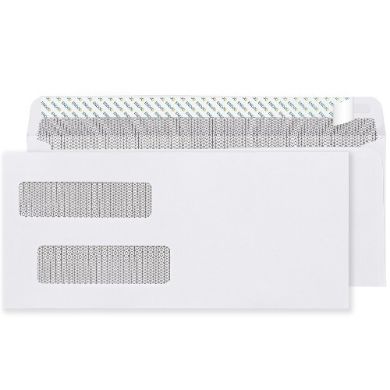
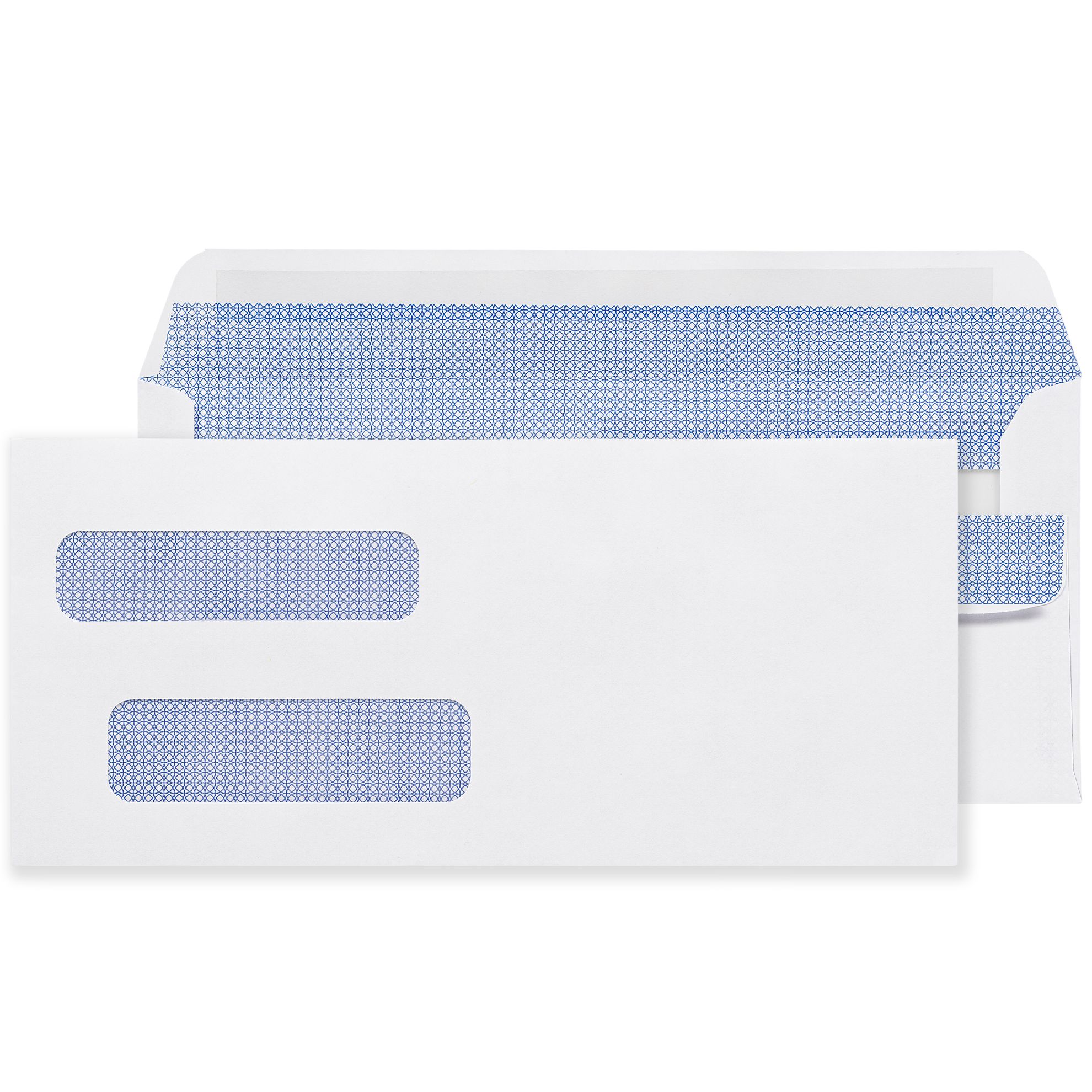
A single window envelope eliminates the delivery address step by showing the recipient's address from the document inside. Your return address still needs to be printed, labeled, or pre-printed on the envelope face. A double window envelope eliminates both address steps simultaneously. Two precisely positioned poly-film panels display both the return address and the delivery address directly from the printed document inside. The envelope face carries no printing at all no labels, no addresses, no manual preparation of any kind.
For operations running recurring check mailing, payroll distribution, vendor payments, or monthly invoice programs, eliminating both addressing steps on every piece is a real operational improvement. This guide covers exactly how double window envelopes work, the critical format difference between check-style and invoice-style configurations, compatibility with every major US accounting platform, the security tinting requirement that is not optional for check mailing, and the test that prevents a batch run from producing 500 misaligned pieces.
The two windows are positioned on the envelope face to align with two specific zones on a standard printed document: the sender's return address in the upper portion and the recipient's delivery address in the lower portion. When the document is folded correctly and inserted, both address fields land directly behind the corresponding windows. Both display from the outside. Neither requires any additional printing or labeling on the envelope.
For check mailing specifically, the lower window is positioned to show the payee address from the check's payee line. The check amount, routing number, account number, MICR line, and memo field are all behind the opaque envelope body visible to no one before the envelope is opened. The upper window shows the payer's company name and return address from the check's header zone. Both addresses display through the windows; all financial data is hidden. This is a deliberate security architecture.
This is where most buyers make their first and most costly mistake. Check-format double window envelopes and invoice-format double window envelopes look nearly identical from the outside. They are not interchangeable.
Check-format double window envelopes are sized for the physical dimensions of a printed business check. The standard check size is 8-7/8 x 3-7/8 inches (the standard check strip on a voucher check page). The lower window on a check-format envelope is positioned to show the payee address from the check face while the upper window shows the payer return address from the check header. For voucher checks (where the check occupies the top third or bottom third of an 8.5 x 11 sheet with stubs above or below), the window positions on the double window envelope are calibrated to the specific voucher format. The check-format double window in the double window configuration (8-7/8 x 3-7/8") is a different physical size than a standard #10 invoice envelope.
Invoice-format double window envelopes use the standard #10 size (4-1/8 x 9-1/2 inches) and are windowed to align with the address block positions on standard invoice and statement layouts output by billing software. The upper window shows the company name and address from the invoice header. The lower window shows the customer's address from the invoice address block. This is the format for billing programs, not check programs.
Using an invoice-format envelope for check mailing: the windows will not align with the check's address fields. One window will show a portion of the check face that is not the address. Using a check-format envelope for invoices: similar misalignment. Verify the document type you are mailing before ordering. If you are unsure which format you need, order a small quantity of each and run the 10-sample test described below before committing to volume quantities.
Standard double window check envelopes align with the default check layout in QuickBooks Desktop, QuickBooks Online, Quicken, ADP, Intuit Full Service Payroll, and Sage 50. When checks are printed from these platforms on standard pre-printed check stock and inserted correctly into the envelope, both address fields land in the corresponding windows without any formatting adjustment. This compatibility is not accidental the double window check envelope format was specifically calibrated to the address block positions that US accounting software standardized around.
For invoice and statement mailing from QuickBooks, Xero, Sage, or similar platforms, the #10 invoice double window format aligns with the default invoice address block positions used by these platforms. When the invoice is printed and tri-folded, both company address (upper window) and customer address (lower window) land correctly.
Software updates can occasionally shift address block positions, and custom invoice templates may not match the standard positions. Always confirm compatibility when software is updated or when a new template is introduced. See all formats at double window envelopes and window envelopes.
Before any batch run with double window envelopes, run this test with ten fully assembled pieces. Print ten documents exactly as they will appear in production. Insert each one using the same fold method. Seal each one. Hold each to a bright light source and check all of the following: Is the complete delivery address visible through the lower window, with no characters cut off? Is the complete return address visible through the upper window? Is there at least 1/8-inch clearance between any address text and all four sides of each window? Is any financial data visible through either window or through the envelope body?
Ten samples catches variance that one sample misses. Slight differences in how the check is folded, minor paper curl from the printer, or a template that is marginally off all show up inconsistently across a small sample. If any of the ten samples shows a misalignment or visible financial data, fix the issue before the full run. A 500-piece batch of misaligned check envelopes is a full day's work to correct and a potential check security incident to manage.
All check-format double window envelopes carry security tint as a standard feature, not an optional upgrade, because the document inside a check mailing envelope contains routing numbers, account numbers, and check amounts. Any of these visible through the envelope body in postal transit creates a fraud risk that no organization should accept.
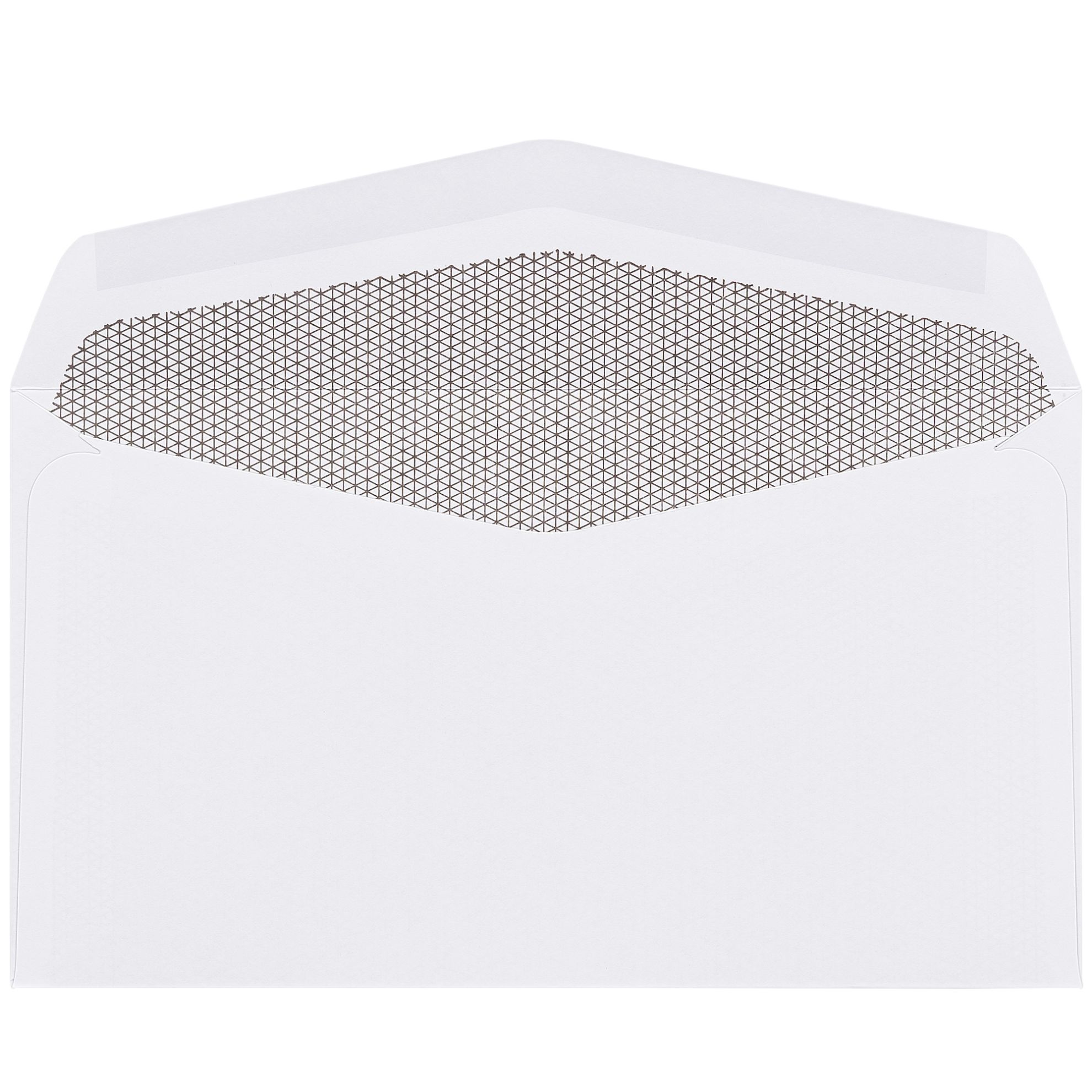
The security tint pattern is printed on the interior of the envelope body. The pattern blocks transmitted light through the paper, making the document contents unreadable when the envelope is held to a light source. The two window panels remain completely clear. The tinted body hides everything except what is deliberately positioned in a window panel.
For invoice double window envelopes, security tinting is strongly recommended when the invoice displays account balances, payment history, or personally identifiable information on the face. The same privacy principle applies: what a window displays is visible by design; what the envelope body hides should stay hidden.
Note that security tint is not standardized across the industry in pattern density or fold-zone coverage. Cheap security-tinted envelopes leave gaps in the tint pattern at the fold zones where the paper overlaps the exact zones where a light source can most easily transmit through multiple layers. Our security-tinted double window envelopes provide full interior coverage including fold zones.
Gum flap (moistenable) is required for mailing machine inserters. If your operation uses a mechanical inserter, gum flap is the only compatible format. For hand-sealing at any volume, choose peel-and-seal or flip-and-stick.
Peel-and-seal bonds on contact after the release liner is removed. Better when envelopes are stocked in advance, because the liner protects the adhesive from humidity during storage. Tamper-evident: if a sealed peel-and-seal envelope is reopened, the flap tears visibly.
Flip-and-stick folds a short tab onto an adhesive panel. No liner to remove, slightly faster per piece when processing immediately. Not compatible with mailing machine inserters. Browse all self-seal formats at self seal envelopes.
The #9 double window envelope (3-7/8 x 8-7/8 inches) is designed as a return piece nested inside an outgoing #10 invoice mailing. Used in billing programs where the customer's payment return envelope needs to carry both address fields (the customer's address showing through one window, the company's remittance address through the other) from the enclosed coupon or return document. The result: every piece in the mailing outgoing envelope, invoice, and return envelope is fully addressed from printed documents with no labels or manual addressing anywhere in the stack.
Business Envelopes has supplied double window check and invoice envelopes to US accounting departments, payroll operations, accounts payable teams, and billing departments since 1997. Our check-format double window envelopes are window-positioned to the industry standard calibrated to QuickBooks, Quicken, ADP, and Intuit formats. Our security tint provides full interior coverage including fold zones. Our invoice-format #10 double window envelopes align to the default address block positions of every major US billing platform.
No minimums, free ground shipping, same or next day on blank stock, 7 to 10 business days on custom printed orders. For the complete range of commercial envelopes for billing and accounts payable programs, see #10 envelopes, window envelopes, and custom printed envelopes.
A double window envelope has two clear poly-film panels on the front face. The upper panel shows the sender's return address and the lower panel shows the recipient's delivery address, both from the printed document inside. No labels or addressing needed on the envelope face.
Check-format double window envelopes are sized for printed business checks, with windows positioned to show the payee address while keeping all financial data hidden behind the opaque body. Invoice-format double window envelopes are standard #10 size with windows aligned to billing software address block positions. They are not interchangeable.
Yes. Both check and invoice double window formats are calibrated to the default check and invoice address block positions in QuickBooks, Quicken, ADP, and Sage. Always run the 10-sample test before any batch run to confirm alignment with your specific template and paper stock.
Checks contain routing numbers, account numbers, and dollar amounts. Security tinting blocks these from showing through the envelope body when held to light. The windows remain clear; the tinted body protects everything not deliberately positioned in a window panel. Full fold-zone coverage matters cheaper security patterns leave gaps at fold overlaps.
Print ten documents as they will appear in production, insert them, seal them, and hold each to a bright light. Confirm that both address fields display fully in their respective windows with 1/8-inch clearance on all sides, and that no financial data is visible through either window or the envelope body. Fix any alignment issues before the full batch run.
Yes. All double window styles support custom printing on the envelope face. PDF proof before production. Ships in 7 to 10 business days from proof approval. Free shipping, no minimums.
The #9 double window (3-7/8 x 8-7/8 inches) is used as a return reply piece nested inside a #10 outgoing mailing. It shows both the customer's address and the company's remittance address from the enclosed return document fully addressed with no labels anywhere in the mailing package.
Most envelopes fail the same ways. A corner tears under pressure from postal sorting equipment. Paper softens in humidity and loses structural integrity. An edge punctures under compression in a mail tray. Standard paper envelopes are strong enough for everyday domestic mail under normal conditions. They are not strong enough for every document, every route, or every environment and when they fail, the document they were carrying fails with them.
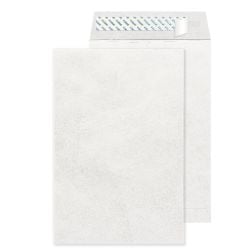
Tyvek envelopes are built from DuPont high-density polyethylene fiber, and the failure modes that affect paper do not apply to polyethylene. This guide explains why at the material level, covers every size available, provides the quantified postage savings math against kraft, addresses the DuPont recycling program that most suppliers do not mention, and identifies which documents and industries use Tyvek as their default rather than as a specialty upgrade.
Tyvek is manufactured by DuPont using a proprietary process called flash spinning. High-density polyethylene is dissolved in a solvent and then flash-spun extruded at high pressure and temperature through a spinneret, causing the solvent to instantly vaporize and the polyethylene to solidify into very fine fibers. These fibers are deposited randomly in all directions onto a moving belt and bonded together by heat and pressure into a continuous sheet structure. No adhesives. No additional binders. The sheet is purely polyethylene fiber.
The random fiber deposition is the key to Tyvek's tear resistance. Paper is made from cellulose fibers that align in a dominant direction during wet-sheet manufacturing. That alignment creates a grain direction, and paper tears most easily parallel to that grain. Every paper envelope has a structural weak axis. Tyvek's flash-spun fiber deposition is omnidirectional there is no dominant fiber alignment, therefore no preferred tear direction. Industry testing places Tyvek at approximately 10 times the tear strength of standard paper in the same weight range.
Polyethylene is a hydrophobic polymer water molecules cannot bond to the polyethylene molecular chain the way they bond to cellulose in paper. This is structural, not a surface treatment. A paper envelope exposed to rain, high humidity, or a wet sorting conveyor absorbs moisture, which softens the cellulose fibers, reduces tear strength, and can cause the gum seal to partially release. Tyvek does not absorb moisture in any of these conditions. The structural integrity is identical whether the envelope is dry or rain-soaked.
| Property | Tyvek (14 lb) | Brown Kraft (28 lb) |
|---|---|---|
| Tear resistance | Approximately 10x stronger than paper; no grain direction | Adequate for normal domestic mail; tears at corners under sustained pressure |
| Moisture resistance | Structural polyethylene does not absorb water | Softens and weakens when wet or in sustained humidity |
| Puncture resistance | High fibers flex and distribute force laterally | Moderate punctures at sharp-impact concentration points |
| Envelope weight (9x12) | ~0.3 oz | ~0.6 oz |
| Postage impact | 0.3 oz lighter per piece; meaningful at volume bracket margins | Heavier envelope contributes to total piece weight |
| Laser printer compatible | No polyethylene softens at laser print temperatures | Yes |
| Custom printing | Inkjet-compatible labels applied to face; not direct printing | Direct custom printing available |
| Recyclability | DuPont Tyvek recycling program; single-material polyethylene | Standard paper recycling |
| Post-industrial recycled content | Average 10% post-industrial waste content | Varies by manufacturer |
The compact Tyvek format. Holds a half-folded 8.5 x 11 sheet, 5x7 photos, small booklets, and multi-page packets. At exactly 6 inches tall, this format qualifies for USPS letter-rate postage on contents under 3.5 oz and under 1/4 inch thick the same letter-rate advantage as the paper 6x9, combined with Tyvek's tear and moisture resistance. For organizations mailing small documents that must arrive intact regardless of weather conditions.
The most widely ordered Tyvek format. Holds a standard 8.5 x 11 sheet completely flat with approximately 1/4-inch clearance on each side. Used by law offices for executed agreements, healthcare facilities for patient records, financial advisors for client account summaries, government agencies for benefit and identification correspondence, and tax preparers mailing completed returns. The 9x12 Tyvek at 14 lb runs approximately 0.3 oz lighter per piece than a 28 lb kraft 9x12 at 500 pieces, that is 150 oz or about 9.4 lbs of envelope weight saved, which translates to postage bracket savings on any pieces sitting at an ounce threshold.
For thicker document packets, legal-size 8.5 x 14 sheets mailed flat, and any content stack that would create seam stress in a 9x12. Architecture firms routing drawings at reduced scale, accounting firms sending audit packages, legal practices handling multi-document client submissions. The extra inch on each dimension reduces seam stress on thick stacks and makes reliable sealing easier on heavy packets the same logic that makes 10x13 correct for thick content in kraft applies equally in Tyvek.
The largest Tyvek size. For oversized documents, multi-page bound reports, large certificates, and folded posters laid flat. Design studios, marketing agencies sending printed materials, and organizations delivering awards where presentation on arrival is part of the communication. When 10x13 Tyvek is not quite large enough, this is the correct format.
Every mailing piece has a total weight: envelope plus contents. USPS charges postage on total piece weight. A Tyvek 9x12 envelope weighs approximately 0.3 oz. A brown kraft 9x12 weighs approximately 0.6 oz. On a document mailing where the contents weigh 0.7 oz, the total piece weight is 1.0 oz in Tyvek (one-ounce bracket) and 1.3 oz in kraft (second-ounce bracket, adding $0.24 in postage).
If 30 percent of your monthly mailing volume sits in this zone contents that land in the second ounce bracket because of the kraft envelope weight but would land in the first with Tyvek switching to Tyvek saves $0.24 per affected piece. At 200 affected pieces per month, that is $48/month or $576/year in postage savings from one material change that also improves document protection. Weigh your standard assembled mailing in both envelope formats before making the decision. The savings are only real if your pieces actually cross a bracket boundary.
Every Tyvek envelope we carry uses the Kwik-Tak closure system. The peel-and-seal format is the correct closure for Tyvek for a structural reason that most suppliers do not explain: standard moistenable gum adhesives are water-activated, and polyethylene's moisture resistance means that water-activated adhesive applied to a Tyvek surface does not bond with the same reliability as on paper. Kwik-Tak is a pressure-sensitive adhesive that bonds on contact through mechanical compression rather than moisture chemistry. No water required, consistent bond strength on the polyethylene surface, calibrated to match the tear resistance of the Tyvek material so the seal does not fail before the envelope does.
If sealing failures occur on Tyvek envelopes, the cause is almost always overstuffing. When the envelope contents are pushing against the seam from the inside, the Kwik-Tak adhesive is under constant tension from the moment it closes. The seal holds the contents rather than the flap, and eventually the tension exceeds the bond strength. The solution is to size up use 10x13 instead of 9x12 for the thick packets not to change the closure type.
Tyvek cannot be run through a standard laser printer. Laser printers operate at fusing temperatures of 150 to 200 degrees Celsius, which is sufficient to soften polyethylene and cause the material to deform, jam the printer, or bond to the fuser roller. For addressing Tyvek envelopes, use inkjet-compatible adhesive address labels printed on a standard inkjet printer and applied to the envelope face.
Before any volume labeling run on Tyvek, test for ink smearing and drying time. Tyvek's non-absorbent surface means inkjet ink sits on the surface rather than absorbing into the fibers as it would on paper. Some inkjet inks take longer to dry on Tyvek and smear if stacked immediately after printing. Run a small test batch (10 to 15 pieces), allow standard drying time, then test for smearing before committing to a full production run.
Tyvek is a single-material polyethylene product with no mixed materials, laminates, or adhesive layers which makes it technically straightforward to recycle compared to multi-layer packaging materials. DuPont operates a Tyvek recycling program that collects used Tyvek envelopes and mailers for reprocessing into new polyethylene products. The average Tyvek envelope contains approximately 10 percent post-industrial recycled content. For organizations tracking sustainability metrics, the DuPont recycling program provides a disposal pathway that standard curbside paper recycling does not cover (Tyvek is not accepted in paper recycling streams because it is not paper).
Business Envelopes carries Tyvek mailing envelopes in 6x9, 9x12, 10x13, and 10x15 inches. All are bright white with Kwik-Tak peel-and-seal closure. Free ground shipping on every order, no minimums, serving US businesses since 1997. Browse all at businessenvelopes.com/tyvek-envelopes. For flat-document mailing where Tyvek durability is not required, see 9x12 envelopes and clasp envelopes. For the full size catalog, see all items.
Business Envelopes has supplied Tyvek envelopes to US law offices, healthcare facilities, financial services firms, government agencies, and document-critical mailing programs since 1997. We carry genuine DuPont Tyvek in all four standard sizes with Kwik-Tak peel-and-seal closure not a substitute polyethylene material marketed under a generic "synthetic" label. The material specification matters because knock-off synthetic envelopes vary significantly in fiber bonding density, tear resistance, and closure adhesive compatibility. With Business Envelopes, you get the material that US postal and legal standards are written around.
No minimums, free shipping, same or next business day on all stock. For related document-mailing formats, see self seal envelopes and for organizations needing custom printed flat-document envelopes, see custom printed envelopes.
DuPont high-density polyethylene fiber, flash-spun into a continuous omnidirectional bonded sheet structure. No adhesives, no laminates, purely polyethylene. The process produces a material approximately 10 times stronger in tear resistance than standard paper.
Yes, structurally. Polyethylene does not absorb moisture the resistance is built into the molecular structure of the material, not applied as a coating. Rain exposure, sustained humidity, and wet handling conditions that weaken paper do not affect Tyvek.
6x9, 9x12, 10x13, and 10x15 inches. All are bright white with Kwik-Tak peel-and-seal closure. The 9x12 is the most widely ordered size for standard 8.5 x 11 flat-document mailing.
No. Laser printer fusing temperatures (150 to 200 degrees Celsius) soften polyethylene and can damage the printer. Use inkjet-compatible adhesive address labels applied to the face. Test for ink drying time on Tyvek before a volume run ink sits on the surface rather than absorbing.
A Tyvek 9x12 weighs approximately 0.3 oz vs 0.6 oz for kraft. On pieces where the kraft envelope weight pushes total piece weight over an ounce threshold, switching to Tyvek saves the additional-ounce postage charge ($0.24 at current rates) on every affected piece. Measure your assembled pieces in both envelope formats to determine if your program crosses a bracket boundary.
Yes, through the DuPont Tyvek recycling program. Tyvek is single-material polyethylene with approximately 10% post-industrial recycled content. It is not accepted in standard paper recycling streams because it is not paper.
Law offices (executed contracts, title documents), healthcare facilities (patient records, lab reports), financial services firms (audit packages, signed agreements), government agencies (benefit correspondence), tax preparers, and any organization where document arrival condition is legally or operationally non-negotiable.
A white envelope in a mail pile disappears. A colored envelope does not. That is the entire argument for colored envelopes in one sentence but it is not the complete picture. Color does not guarantee opens. It creates visual distinction at the moment the recipient is sorting mail, before they have engaged with anything you wrote. In programs where that moment determines whether the piece gets opened or set aside, the envelope color is a real variable. In programs where the recipient opens the piece regardless (utility bills, payroll, transaction confirmations), color adds cost with no return.
This guide covers exactly when color earns its premium: the difference between wove and starburst formats, every size we carry, the testing methodology that tells you whether color improves your specific program's results, the USPS OCR compliance rules that most suppliers omit, and the seasonal timing that nonprofit fundraisers should understand before planning their year-end appeal envelopes.
Wove envelopes are made from dyed paper stock where the color runs through the material during manufacturing not printed on the surface, not coated. The surface is smooth (wove refers to the papermaking process, not the color), and the finish is comparable in texture to standard white wove business envelopes. Wove colored envelopes accept custom printing cleanly because the smooth dyed surface provides the same print reception as white stock.
Wove colored envelopes are the choice when color is part of organizational identity when the envelope is supposed to signal "this is from us" rather than "open this immediately." Membership organizations with brand colors, nonprofits with institutional color programs, schools with team colors, professional associations. The color reinforces the sender's identity before the envelope is opened. The presentation reads as professional and deliberate rather than urgent or commercial.
Starburst envelopes are white or light stock with a bold multicolor starburst pattern printed across the face. The visual effect is deliberately aggressive. It does not signal brand identity it signals urgency and attention. This format is not appropriate for all audiences or all mailings. It is specifically designed for direct mail programs and fundraiser appeals where standing out in a pile of white envelopes is the primary objective and the recipient relationship tolerates a high-energy visual approach.
The starburst format performs best in year-end fundraiser appeal seasons (October through December), when competition in the mailbox is highest and nonprofits with strong donor relationships can afford the visual assertiveness. It also performs well in direct mail acquisition campaigns where the piece is competing for attention against an unknown number of other pieces from unknown senders. In that context, any piece that generates a visual pause before sorting is a piece with a higher probability of being opened.
| Size | Dimensions | Formats | Primary Use |
|---|---|---|---|
| #6 3/4 | 3-5/8 x 6-1/2" | Wove gum flap, starburst peel-and-seal | Reply envelopes, short correspondence, donation response inside larger outgoing piece |
| #9 | 3-7/8 x 8-7/8" | Wove gum flap, starburst peel-and-seal | Return reply envelope nested inside #10 outgoing; return envelope with matching colored outer |
| #10 | 4-1/8 x 9-1/2" | Wove gum flap, wove window gum flap, starburst peel-and-seal | Outgoing appeal letters, fundraiser campaigns, branded business correspondence |
| 6 x 9 | 6 x 9" | Starburst peel-and-seal | Larger-format direct mail campaigns at letter rate on qualifying contents |
| 9 x 12 | 9 x 12" | Starburst gum seal | Full-size flat-document campaigns, catalog mailers, full-face visual impact |
One of the most effective mailing configurations for nonprofit fundraiser programs is a starburst #10 outgoing envelope with a matching starburst or wove colored #9 reply envelope enclosed inside. The outer piece stands out in the mailbox. When the recipient opens it and finds a matching colored reply envelope already inside, the visual consistency signals that this is a complete, designed communication not a form letter assembled by whoever was available. The #9 (3-7/8 x 8-7/8 inches) fits inside a standard #10 with approximately 1/4-inch clearance, alongside the appeal letter and response card.
For organizations that track reply card return rates, the matched colored outer and return envelope consistently outperforms mismatched or plain white return envelopes in programs with warm donor bases. The color on the return piece makes it visually distinct from other envelopes in the donor's home, which functions as a subtle ongoing call to action for the day or two between when they open the appeal and when they actually respond.
The wove colored #10 window envelope combines the addressing efficiency of the standard window format with the visual distinction of colored stock. Used by membership organizations and professional associations for monthly billing and renewal statements where they want the billing piece to look less transactional and more connected to the brand. The window still shows the recipient's address from the document inside. The colored body signals organizational identity rather than generic billing. Available at window envelopes.
USPS automated sorting equipment reads delivery addresses using optical character recognition (OCR) scanning. The scanner requires sufficient contrast between the address text and the envelope background to read the characters reliably. On white envelopes, dark ink provides clear contrast and creates no compliance issues. On colored envelopes, the background color reduces the contrast margin.
The USPS minimum reflectance differential between print and background is approximately 40 percent. Most commercial ink-on-colored-wove combinations clear this threshold without adjustment. Where compliance becomes an issue is when you use light-colored ink on a medium-colored wove background, or when a starburst pattern runs through the address zone and creates a patterned rather than solid background behind the address text.
Practical guidance: on wove colored envelopes, use dark ink (black or very dark navy) for any address printed directly on the envelope face. On starburst envelopes, the pattern on the face makes in-house inkjet or laser printing on the envelope face impractical for address printing use labels for addressing on starburst envelopes, or use the enclosed document's address block with a window format. Before any large run of addressed colored envelopes, take one sample to your post office counter and have a postal clerk confirm barcode placement and OCR readability. Five minutes at the counter before a 5,000-piece run prevents a 5,000-piece rejection.
Color does not automatically improve open rates. Whether it does in your specific program depends on your audience, your offer, and your current baseline. The only way to know is to test with a proper control structure.
Split your mailing list into two equal groups randomly. Everything about the mailing is identical: the letter copy, the offer, the response mechanism, the postage class, the mailing date. The only difference is the outer envelope: white for the control group, colored or starburst for the test group. Measure response rate (not open rate, which is unmeasurable in physical mail) for both groups. If the colored group's response rate is statistically meaningfully higher, the per-unit premium on colored envelopes is justified. If it is not, stay with white.
The test needs to be large enough to detect a meaningful difference. For a program with a 2 percent baseline response rate, detecting a 0.5 percentage point improvement (25 percent relative lift) requires approximately 2,000 pieces per group at 95 percent confidence. For a program with a 5 percent baseline, detecting the same absolute improvement requires about 800 per group. If your mailing volume does not support a properly sized test, borrow results from similar-audience programs rather than guessing.
Color earns its premium in high-competition mailing environments where the recipient's attention in the sorting moment determines whether the piece gets opened. Nonprofit year-end fundraiser appeals, cold direct mail acquisition campaigns, renewal reminders competing with high mailbox volume, and any program where open rate is tracked and valued.
Color does not earn its premium when the recipient opens the piece regardless of appearance (utility bills, required tax correspondence, payroll), when the organizational relationship is such that the sender's name alone drives opens (trusted advisors, established suppliers), or when the audience is professional and interprets a starburst envelope as low-credibility rather than attention-worthy. The starburst format specifically can reduce credibility in B2B correspondence where the recipient expects professional restraint. Know your audience before the format decision.
Wove #6 3/4 gum flap: Solid color in the smallest commercial size for reply and donation response pieces. Wove #9 gum flap: Solid color in standard return-envelope size for nested mailing configurations. Wove #10 gum flap: Solid color in standard commercial size for outgoing branded correspondence. Wove #10 window gum flap: Solid color with standard address window for billing and membership programs. Starburst #6 3/4 peel-and-seal: Bold pattern on reply-size envelope. Starburst #9 peel-and-seal: Bold pattern on standard return-envelope size for matched campaign packages. Starburst #10 peel-and-seal: Bold pattern on standard commercial size for fundraiser appeals and direct mail. Starburst 6x9 peel-and-seal booklet: Bold pattern on 6x9 for campaigns that qualify for letter rate. Starburst 9x12 gum seal: Bold pattern on full-size flat-document format. All formats support custom printing for return address and organizational branding. Browse at businessenvelopes.com/colored-envelopes.
Business Envelopes carries wove and starburst colored envelopes across five sizes with no minimums and free ground shipping on every order. We have supplied colored envelopes to US nonprofits, direct mail operations, membership organizations, and professional associations since 1997. Our wove stock is commercially dyed stock, not surface-coated white paper the color is consistent through the paper body, which matters for any cutting or finishing operation. Custom printing on wove stock produces the same clean output as custom printing on white wove, with the same 7 to 10 business day turnaround from proof approval.
For the full range of commercial envelope formats that work alongside colored envelopes in a complete mailing program, see #10 envelopes, self seal envelopes, and window envelopes. For larger flat-document mailing, see 9x12 envelopes.
Wove envelopes are solid-color dyed paper stock with a smooth finish, appropriate for branded correspondence and organizational identity programs. Starburst envelopes have a bold multicolor pattern printed on the face, designed for maximum visual impact in direct mail and fundraiser appeal programs. Wove reads as professional; starburst reads as urgent.
Wove formats in #6 3/4, #9, and #10 (including a #10 window). Starburst formats in #6 3/4, #9, #10, 6x9, and 9x12. All support custom printing for return address and brand elements.
They can, particularly in high-competition mailing environments. The improvement is not guaranteed and varies by audience, offer, and season. The only reliable way to know is to run a properly controlled A/B test against a white envelope control with identical copy and offer. Do not scale to colored envelopes based on assumed improvement.
Yes. A #9 (3-7/8 x 8-7/8 inches) fits inside a #10 with approximately 1/4-inch clearance. Matching colored outer (#10) and inner (#9) reply envelopes create a visually consistent mailing package that can improve return rates in fundraiser and response programs with warm audiences.
Wove colored envelopes with dark ink on the address face generally meet USPS OCR contrast requirements. Starburst envelopes are not suitable for printing addresses directly on the face due to the pattern background use a label or a window format. Before any large addressed run on colored stock, confirm OCR readability with a postal clerk at your post office counter.
Yes. All wove and starburst styles support custom printing: logo, return address, and tagline. On wove stock, printing quality is equivalent to white wove. On starburst, confirm legibility of printed elements against the pattern on the proof. PDF proof before production. Free shipping, no minimums.
When the audience is professional B2B and interprets high-energy visuals as low-credibility. When the recipient opens the piece regardless of appearance (required correspondence, payroll, transaction confirmations). When the mailing volume is too small to test response rate improvement and the per-unit premium cannot be justified by assumed lift alone.
The 6x9 envelope holds more than most buyers expect and costs less to mail than most realize. At exactly 6 inches tall, it sits just below the USPS letter-rate height threshold of 6.125 inches, which means light contents mail at First-Class letter rate rather than the higher flat rate that applies automatically to 9x12 envelopes. For any mailing program where the document can be half-folded to fit, the postage difference is real and it adds up quickly at volume.
This guide covers everything about 6x9 envelopes: dimensions, what fits, construction differences between booklet and open-end formats, why the letter-rate threshold matters, which material to use for which contents, and one important postage trap that a folded document in a 6x9 can trigger if you are not paying attention.
The 6x9 interior provides approximately 5-3/4 x 8-3/4 inches of usable space. The most common insert is an 8.5 x 11 sheet folded in half (bi-fold), which produces a 5.5 x 8.5 inch panel fitting cleanly with about 1/4-inch clearance on each side.
| Contents | Fits? | Notes |
|---|---|---|
| 8.5 x 11 sheet, half-folded | Yes | 5.5 x 8.5", standard fit with 1/4" clearance |
| 5 x 7 photo, card, or invite | Yes | Fits flat without folding |
| Tri-fold brochure (8.5 x 11 source) | Yes | Approx 3.69 x 8.5" closed, fits cleanly |
| Small booklet or newsletter, under 5.75" wide | Yes | Must be under 8.75" tall to close properly |
| 8.5 x 11 sheet, unfolded | No | Use 9x12 envelope for flat mailing |
| Multiple sheets, half-folded | Maybe | Check total thickness; over 1/4" triggers flat-rate classification |
This is the most important thing to know about the 6x9 envelope. USPS letter-rate postage applies to pieces no taller than 6.125 inches, no wider than 11.5 inches, no thicker than 1/4 inch, and weighing no more than 3.5 oz. The 6x9 at exactly 6 inches tall clears the height threshold. A single half-folded 20 lb sheet in a 6x9 envelope runs approximately 0.55 to 0.65 oz total, well within the letter-rate window.
Current USPS First-Class letter rate: $0.78 for the first ounce. Current First-Class flat rate: $1.63 for the first ounce. The savings per piece when 6x9 qualifies as a letter rather than a flat is $0.85.
| Volume | Savings (6x9 letter rate vs 9x12 flat rate) |
|---|---|
| 500 pieces/month | $425/month $5,100/year |
| 1,000 pieces/month | $850/month $10,200/year |
| 2,500 pieces/month | $2,125/month $25,500/year |
| 5,000 pieces/month | $4,250/month $51,000/year |
For any organization that currently mails half-foldable documents in 9x12 flat envelopes, this is a line-item change worth evaluating. The document content is identical. The envelope format changes. The postage cost drops by $0.85 per piece. At 500 pieces per month, that is over $5,000 per year in postage savings from one procurement decision.
The letter-rate threshold has three conditions, not just one, and most buyers only check the first. Height under 6.125 inches: the 6x9 clears this. Thickness under 1/4 inch: a single half-folded sheet clears this, but multiple sheets or thick paper stock may not. Weight under 3.5 oz: one or two sheets clear this easily.
The trap is the 1/4-inch thickness rule. If your 6x9 mailing includes multiple inserts, a #9 return envelope, a card insert, or is printed on heavy 28 lb or 32 lb stock, the total thickness of the assembled piece may exceed 1/4 inch and automatically reclassify the piece as a flat at $1.63 even though the envelope itself is 6 inches tall. Always weigh and measure a fully assembled piece before committing to a large print run. If the piece is borderline, take one assembled sample to the post office counter for a definitive classification before you print 10,000 of them.
A booklet 6x9 opens on the long 9-inch edge. Side-seam construction makes it compatible with automated mailing machine inserters. Documents load from the side and the long-edge opening allows faster stuffing on moderate-volume hand operations as well. This is the standard format for business correspondence and direct mail programs using the 6x9.
An open-end 6x9 opens on the short 6-inch edge. The flap seals across the top. Center-seam construction provides better structural strength for heavier or bulkier contents. Used for document submission workflows, top-feed insertion operations, and any application where the document loads naturally from the top. Not compatible with standard automated insertion equipment.
White wove is the professional choice for outgoing business correspondence, direct mail, and any mailing where the envelope represents your organization's brand. Custom printing available: logo, return address, and tagline printed directly on the stock through custom printed envelopes. Laser and inkjet compatible.
Brown kraft suits interoffice routing, school correspondence, and any context where durability matters more than appearance. The brown clasp 6x9 adds a reopenable metal closure for any envelope that circulates before being finally mailed or filed. Full clasp envelope lineup at clasp envelopes.
Tyvek is correct when contents cannot arrive torn or wet. DuPont polyethylene fiber at 14 lb roughly half the weight of 28 lb kraft in the same size reduces total piece weight, which matters at the margins of the letter-rate threshold. A 6x9 Tyvek envelope weighs approximately 0.3 oz versus about 0.45 oz for kraft, saving about 0.15 oz per piece. On a mailing that is already borderline for the 1/4-oz additional-ounce threshold, Tyvek can keep more pieces in the first-ounce letter-rate bracket. Browse all Tyvek sizes at Tyvek envelopes.
Starburst peel-and-seal 6x9 envelopes carry a bold multicolor pattern on the face for direct mail campaigns and fundraiser programs where the envelope needs to stand out before it is opened. Because the 6x9 can mail at letter rate on qualifying contents, starburst 6x9 envelopes combine visual impact with letter-rate economics something the 9x12 starburst format cannot do. For any campaign mailing that currently uses 9x12 flat-rate starburst envelopes but does not require the full-size flat format, switching to 6x9 starburst at letter rate saves $0.85 per piece while maintaining the same visual attention. Browse at colored envelopes.
Paper is manufactured with a dominant fiber direction called the grain. For machine insertion compatibility, the paper grain should run parallel to the long edge of the envelope this is called "grain long" construction. Grain-long envelopes flex more easily along their length, which allows insertion equipment to open the envelope flap and feed documents cleanly at high speed without the paper buckling or resisting the insert movement. Most commercial envelopes are manufactured grain-long by default for this reason. If you are running a mailing machine and experiencing insertion jams or inconsistent opening, grain direction is one of the variables worth checking with your supplier.
White booklet gum flap: Side-seam, machine insertable, plain or custom printed. White booklet peel-and-seal: Same format with moisture-free hand-sealing closure. White open-end gum flap: Top-loading for document submission workflows. White open-end peel-and-seal: Top-loading with moisture-free closure. Brown kraft booklet gum flap: Durable kraft in booklet format for outgoing mailing. Brown kraft open-end gum flap: Top-loading kraft for document submission and heavy-content programs. Brown kraft clasp: Reopenable metal clasp plus gum flap, for routing and multi-use filing workflows. Tyvek peel-and-seal: DuPont fiber in 6x9 for tear-proof, moisture-resistant document mailing at letter rate on qualifying contents. Starburst booklet peel-and-seal: Bold multicolor pattern for direct mail and fundraiser campaigns. Browse all at businessenvelopes.com/6x9-envelopes. See the full size range at our complete catalog.
Business Envelopes has supplied 6x9 envelopes to schools, nonprofits, direct mail operations, law offices, and US businesses of all sizes since 1997. Every 6x9 format white booklet, white open-end, kraft booklet, kraft open-end, kraft clasp, Tyvek peel-and-seal, and starburst is in one place with no minimums and free ground shipping on every order. Custom printing is available on all paper-stock formats. Blank stock ships same or next business day. Printed orders ship in 7 to 10 business days from proof approval.
When comparing 6x9 suppliers on price, factor total cost including postage. An envelope that costs $0.03 more per unit but allows a document to mail at letter rate instead of flat rate saves $0.82 net per piece. At any meaningful volume, the postage savings on the right format outweigh the per-unit price difference on any envelope supplier's catalog. We help buyers make that evaluation before they order. For related formats, see self seal envelopes and colored envelopes.
An 8.5 x 11 sheet folded in half (bi-fold to 5.5 x 8.5 inches) fits cleanly with about 1/4-inch clearance on each side. Tri-fold brochures fit flat. 5 x 7 photos and cards fit without folding. Unfolded 8.5 x 11 sheets do not fit use a 9x12 envelope for flat mailing.
Yes, on qualifying contents. At exactly 6 inches tall, the 6x9 clears the USPS letter-rate height maximum of 6.125 inches. Contents must also be under 3.5 oz and under 1/4 inch thick. Always measure and weigh a fully assembled piece before a large run. Thick paper, multiple inserts, or a return envelope inside can push the piece over the 1/4-inch thickness limit and reclassify it as a flat at $1.63.
$0.85 per piece when 6x9 qualifies for letter rate ($0.78) versus 9x12 flat rate ($1.63). At 500 pieces per month that is $425/month or $5,100/year in postage savings from using the right envelope format for the right document.
Booklet opens on the long 9-inch edge with side-seam construction compatible with automated mailing machine inserters. Open-end opens on the short 6-inch edge with center-seam construction stronger for heavy contents but not compatible with automated insertion equipment.
When contents cannot arrive torn or wet, and when the lighter Tyvek weight (roughly 0.3 oz vs 0.45 oz for kraft) helps keep borderline pieces within the first-ounce letter-rate bracket. For legal documents, medical records, school filings, and personal documents where arrival condition is critical.
Yes. White wove and brown kraft 6x9 styles support custom printing: logo, return address, and tagline. PDF proof before production. Ships in 7 to 10 business days from proof approval. Free shipping, no minimums.
The brown kraft clasp 6x9 has a reopenable metal closure that allows the envelope to be opened and resealed dozens of times without damage. Used for interoffice document routing, school correspondence that goes home and returns, filing, and any envelope that circulates through multiple hands before being finally archived or mailed.
You printed a hundred checks, folded them, slid them in, and held one up to the light. The address isn't showing through the window. Or it is, but so is your routing number. This is one of the most common mailing headaches for small business owners and AP teams, and it's almost never the printer's fault.
The problem is the envelope. QuickBooks prints check data in fixed positions on the sheet, and only specific envelope sizes with specific window placements are built to match those positions. A standard office supply store envelope won't cut it.
This guide covers every QuickBooks check and invoice format, the exact envelope each one needs, and a few things about check envelopes that no other supplier bothers to tell you. Browse our full envelope range at BusinessEnvelopes.com, or jump straight to the complete product listing to find your format.
A regular #10 envelope has one window. It sits in the lower-left and shows one address: the delivery address. That's all it's built for.
QuickBooks check stock is different. It prints both your return address and the payee's address directly onto the check, in two separate fields. To display both through the envelope without labels or handwriting, you need a double window envelope. That means two poly-film panels, each placed to match exactly where QuickBooks prints those fields.
Use a standard single-window #10 and you'll get one of two results. Blank paper through the window, or the wrong field showing. Neither works for payroll or accounts payable.
The other issue is size. QuickBooks prints on full 8.5 x 11 stock in several formats. Each one folds to a different panel dimension. Too much room in the envelope and the check shifts in transit. Too little and it won't insert cleanly. The envelope has to match the folded check almost exactly.
This is the most common QuickBooks check format. The check takes up one third of the 8.5 x 11 sheet. Detachable stubs below carry payment details, deductions, or invoice notes. When you fold for mailing, the check portion becomes the front panel.
You need a #8 double window envelope, 3 5/8 x 8 11/16 inches. The lower window shows the payee address. The upper window shows your business return address. Both pull directly from the printed check. No labels. No handwriting. Nothing extra on the envelope face.
Don't use a #9 or #10 here. The extra internal space lets the check slip shift, and both windows drift off alignment before the envelope arrives. Even half an inch of movement is enough to hide an address behind the opaque paper.
Quick note: The #8 double window is for QuickBooks checks only. It won't work for invoices or standard letters. If you're mailing both checks and invoices, you need two different envelope formats. They aren't interchangeable.
Three checks print on one 8.5 x 11 sheet. You tear them apart at the perforations before mailing. Each individual check measures roughly 8.5 x 3.5 inches and goes into the envelope without any folding.
Same envelope as voucher checks: #8 double window, 3 5/8 x 8 11/16 inches. The check slip slides straight in. Both address fields show through the windows without adjustment.
Wallet-size checks are smaller, around 6 x 2.75 inches once separated. They don't fit a #8 cleanly. The right envelope here is a #6 1/2 double window, 3 1/2 x 6 1/4 inches, sized to match that smaller check format.
The check sits in the center of the 8.5 x 11 sheet with stubs above and below it. Most of these configurations still use a #8 double window envelope, but the fold direction is critical. Always test ten pieces before running a full batch. Some check-in-middle templates need a slightly different fold to position both address fields correctly behind the windows, depending on your software version and template settings.
Something most suppliers skip: Not every #8 double window envelope has the same window position. The standard is built to match Intuit's check layout specs, but off-brand envelopes sometimes use window placements that are fractionally off. If your checks aligned fine with your old supplier and they're off with a new one, the window position tolerance is almost certainly the cause. Ask for exact window dimensions before switching suppliers.
Invoices and statements print on standard 8.5 x 11 paper using your QuickBooks invoice template. They tri-fold for mailing. These are completely different from checks and need different envelopes. Don't mix the two.
A #10 single window envelope, 4 1/8 x 9 1/2 inches, works for QuickBooks Online invoices. You need to do two things: turn on "Fit to window envelope" in your QuickBooks print settings, and fold the invoice using the Z-fold method rather than the standard C-fold.
The window on a standard #10 sits 7/8 inch from the left edge and 1/2 inch from the bottom. QuickBooks formats its default invoice template to place the customer address in the zone that hits that window when you Z-fold. Your return address still needs to go on the envelope, either through custom printing or a label.
The #10 double window, 4 1/8 x 9 1/2 inches, handles both addresses automatically. The upper window shows your return address from the document. The lower window shows the customer delivery address. No labels needed on the envelope face at any step.
Billing departments that run recurring statement cycles almost always switch to the double window format once they've done the setup. Removing one addressing step per piece adds up fast when you're mailing hundreds of invoices a month.
A #9 single window, 3 7/8 x 8 7/8 inches, is the standard return piece that goes inside a #10 outgoing mailer. It nests inside a #10 with a quarter inch of clearance on each side. Common for invoice programs where you include a pre-addressed reply envelope so customers can send payment back.
| QuickBooks Format | Envelope | Window | Dimensions | Security Tint |
|---|---|---|---|---|
| Voucher checks (on top or bottom) | #8 | Double window | 3 5/8 x 8 11/16 in | Required |
| 3-on-a-page checks | #8 | Double window | 3 5/8 x 8 11/16 in | Required |
| Wallet and personal checks | #6 1/2 | Double window | 3 1/2 x 6 1/4 in | Required |
| Invoices and statements (both addresses) | #10 double window | Double window | 4 1/8 x 9 1/2 in | Recommended |
| Invoices (delivery address only) | #10 single window | Single window | 4 1/8 x 9 1/2 in | Recommended |
| Reply or return piece | #9 single window | Single window | 3 7/8 x 8 7/8 in | Optional |
A QuickBooks check has your bank routing number, your account number, the check amount, and the payee name all printed in plain text. Standard 20 lb envelope paper isn't opaque enough to hide that. Hold the sealed envelope under a desk lamp and someone can read the numbers through the paper wall without opening anything.
Security-tinted envelopes have a dense geometric or cross-hatch pattern printed on the interior surface. From the outside, they look like plain white business envelopes. From the inside, that pattern scatters transmitted light so nothing reads through the paper. The poly-film window panels stay clear because those are meant to show address fields.
Here's the detail no one mentions in a product listing: security tint coverage at the fold zones. When you fold a check and insert it, the paper layers stack at the fold edges. Cheaper security patterns leave small gaps at those fold corners because the print pattern doesn't extend all the way to the seam edges. A check routing number at the corner of a fold gap is still readable. Quality check envelopes carry full interior coverage through the fold areas, not just across the flat panels. It's worth asking your supplier to confirm this before you order in volume.
Standard for outgoing check mail also means 24 lb paper, not 20 lb. The extra weight adds opacity that 20 lb paper simply doesn't have. Even with security tinting, a 20 lb envelope transmits more light than a 24 lb one. For payroll and AP checks, 24 lb wove is the correct spec.
Two closure types. Different situations call for different ones.
Gummed seal uses moisture-activated adhesive on the flap. It's the only format that works with mailing machine inserters. Those machines apply water during the automated insertion and sealing cycle. If your office runs a mechanical inserter, gummed is your only option.
Peel-and-seal has a release liner covering the adhesive strip. Pull the liner and press the flap. No moisture, no sponge, no water station. For hand-sealing in batches, it's faster per piece and more consistent because seal quality doesn't vary based on how well anyone moistened the gum. Each seal bonds the same way.
There's a storage issue with gummed envelopes that nobody puts in the product description. Gummed flap envelopes rely on ambient humidity staying low during storage. If you stack a case in a supply room through a hot, humid summer, the flaps can partially activate and seal to themselves before you ever use them. You open the box and the envelopes are stuck. Peel-and-seal doesn't have that problem because the liner physically protects the adhesive until you pull it. If you stock envelopes more than a few weeks in advance, peel-and-seal is the technically safer choice regardless of volume.
There are two ways to tri-fold an 8.5 x 11 invoice. One works for window envelopes. One doesn't. This is behind a lot of alignment failures on invoice runs.
The C-fold folds the bottom third up, then the top third down over it. All three panels stack in the same direction. This is the fold most people do by instinct. It positions the address block facing inward, hidden from the window.
The Z-fold folds the bottom third up first, then folds the top third back in the opposite direction. Looking at it from the side, the paper makes a Z shape. This positions the address panel facing outward through the window opening. QuickBooks's "Fit to window envelope" print setting assumes you're Z-folding.
If you're getting alignment that works on some pieces and fails on others within the same batch, the fold is almost always the culprit, not the envelope and not the template.
Print ten documents exactly as they'll look in the production run. Fold each one the same way. Insert and seal each one. Hold each sealed envelope to a bright light and check these four things:
Ten samples catch variance that one or two pieces won't show you. Inconsistent paper stock, a fold that's off by a quarter inch, a template margin that runs slightly long: all of these produce inconsistency that only shows up across a sample. If two of your ten fail any check, fix the issue before the full run. Testing ten pieces takes five minutes. Reprinting and re-mailing 500 misaligned pieces takes a day.
The address safe zone no one talks about: Account numbers and outstanding balances often appear just above or below the customer address block on a statement. If your template places sensitive data within one inch of the address block in any direction, that data can drift into the window zone if the insert shifts in transit. It can also show through the paper on lighter stock. Keep all sensitive data at least one inch away from the address block on all four sides. If your template doesn't do this, adjust it before the next mailing cycle.
Most product listings tell you the size and the window count. Here's what they leave out.
Poly-film window material and your laser printer. Cheap window films can warp, cloud, or shrink slightly under laser printer heat. If the envelope passes through your printer before sealing, that warped film can obscure part of the address behind it or create a visible crinkle on the face. Quality check envelopes use laser-stable poly-film that holds its shape and clarity at standard printer output temperatures.
The 1/8 inch USPS clearance rule. USPS regulations require that the full delivery address be visible through the window with a minimum 1/8 inch of clearance between the address text and all four window edges, even when the insert is at its maximum shift position inside the envelope. This isn't just a formatting preference. Pieces that don't meet this clearance can fail automated optical character recognition during sorting, which causes delays or returns. Well-manufactured check envelopes are sized with this clearance built in.
Side seam vs diagonal seam construction. Commercial envelopes use side seam construction, where the back panels bond along the sides parallel to the long edge. This allows the envelope to lie flat and feed through mailing machine inserters. Diagonal seam envelopes can't run through inserting equipment because they don't lie flat at the throat opening. Check envelopes should always specify side seam construction if they're going through any kind of inserting equipment.
Why paper weight affects window alignment. Heavier paper stock holds its fold crease more firmly than lighter stock. A 20 lb invoice sheet has more tendency to spring back slightly after folding than a 24 lb sheet does. That spring can shift the address block position relative to the window by a small but meaningful amount, especially on pieces that sit sealed for a few days before mailing. On large volume programs, this accounts for a percentage of alignment failures that look like a template problem but are actually a paper weight issue.
The window position that QuickBooks relies on. The standard #10 single window position is 1 1/8 x 4 1/2 inches, placed 7/8 inch from the left edge and 1/2 inch from the bottom. QuickBooks, Xero, Sage, FreshBooks, and virtually every other major US billing platform default their address block output to this exact position. When an envelope from a new supplier doesn't match this standard, it shows up as an alignment problem that looks like a software or template issue. It's not. The window is in the wrong place.
The envelope doesn't work without the right check behind it. And the check is useless in an envelope that doesn't match its window configuration. These are two purchases that have to be specified together.
If you're sourcing QuickBooks check stock at the same time as your envelopes, two options worth knowing about:
Need QuickBooks-compatible checks to pair with your envelopes?
Checks Next Day carries QuickBooks check-on-top, 3-on-a-page, and personal check formats with same-day print and next-day shipping. It's the right call when you need checks in a hurry. Browse QuickBooks checks at Checks Next Day.
Checkomatic offers a full QuickBooks check range including voucher, 3-on-a-page, and wallet formats with multiple built-in security features: heat-sensitive ink, chemically sensitive paper, and custom branding options. Shop QuickBooks checks at Checkomatic.
We've supplied commercial envelopes to US offices, law firms, healthcare billing departments, nonprofits, and accounting teams since 1997. Here's what makes working with us different from ordering from a general office supply chain.
Our customers consistently call out our pricing as among the lowest they've found for commercial-grade envelope stock. That's not discounting on thin paper. It's direct supply chain pricing without the retail markup. You get 24 lb wove and full security tinting at rates that beat most resellers.
Every order is backed by a team you can actually reach. When something goes wrong, whether it's a misorder, a deadline issue, or a print concern, you get a real person who reviews your account and works through it with you. No chatbots. No ticket queues that go nowhere.
Before anything runs on custom printed envelopes, you get a PDF proof showing the exact position of your logo, return address, and any additional copy. Nothing prints without your sign-off. If something's off, you reject the proof and we correct it. Your artwork stays on file for every reorder after that.
Blank envelope stock ships same day or next business day. Orders arrive in sturdy packaging with the correct product, correct quantity, and correct spec. Our customers regularly mention early delivery and getting exactly what they ordered. When there's a printing error on our end, we make it right without argument.
A solo accountant ordering 150 envelopes for a quarterly billing cycle places the same kind of order as a corporate AP department ordering 10,000 for payroll. No quantity thresholds, no account setup, no negotiation required.
Every order ships free to the contiguous 48 states. No minimum spend to qualify. No handling fee added at checkout. The price you see is what you pay, and the order goes out quickly.
You can find every envelope format we carry, including double window check envelopes, security-tinted invoice formats, and the full commercial range, at the complete product listing. Specific categories for QuickBooks programs:
★★★★★
Cortney Curtis
April 2026 · Verified Google Review
"This company offers quality products at the lowest rates. They communicate well before printing to ensure you're pleased with the design layout, and with any printing errors they are quick to make things right. I love that they are real people, in a world full of AI, and the fact that you can easily get ahold of them regarding your recent purchase. I give Business Envelopes a 10 out of 10, and will be a returning customer."
★★★★★
Willis Alford · Christian Caregiving Ministry Inc.
April 2026 · Verified Google Review
"I made an error on a recent order and missed an important deadline. I contacted customer service. They reviewed my order and with the patience of Job and the wisdom of Solomon they assisted me, put me at peace, and calmed my troubled mind. Great customer service, which is hard to find in today's business world. Thanks for your dedication and commitment."
★★★★★
Karen Sykes
April 2026 · Verified Google Review
"Excellent ordering experience. Easy to navigate website. Envelopes arrived quickly, in sturdy packaging. 100% correct order. Would gladly order from them again."
★★★★★
Audrey Roetter
April 2026 · Verified Google Review
"Wonderful service! Their website was easy to use and their customer service was wonderful. Everything came really fast and in excellent quality. I will be using Business Envelopes in the future!"
★★★★★
Andy Grebe
March 2026 · Verified Google Review
"Easy to work with, great product, and my envelopes were delivered before I expected them."
★★★★★
Bowen Printing
March 2026 · Verified Google Review
"Quick and easy ordering, fast turnaround, excellent quality!"
QuickBooks voucher checks need a #8 double window envelope measuring 3 5/8 x 8 11/16 inches. The two windows align with the payee address and your return address as printed on the check stock. A standard single-window #10 won't work for check mailing.
Yes. A standard #10 window envelope works for QuickBooks invoices when you turn on "Fit to window envelope" in your print settings and use the Z-fold method. The customer address lands behind the window automatically. For a fully label-free setup where both addresses show from the document, use a #10 double window instead.
A double window envelope has two clear poly-film panels instead of one. The upper panel shows the sender return address from the document inside. The lower panel shows the recipient delivery address. QuickBooks prints both addresses directly on the check stock, so the double window handles all addressing in one step with nothing written or labeled on the envelope face.
Yes. QuickBooks checks show routing numbers, account numbers, and payment amounts in plain text. Security-tinted envelopes have a patterned interior that blocks those details from showing through the paper when held to light. The window panels stay clear so addresses still display. Security tinting is the professional standard for any outgoing check mail.
After you tear the individual check from the sheet, it goes into a #8 double window envelope (3 5/8 x 8 11/16 inches). The check slip inserts without folding and both address fields show through the two windows correctly.
Gummed seal uses moisture-activated adhesive and is the only format that works with mailing machine inserters. Peel-and-seal has a release liner you pull before pressing the flap. For hand-sealing batches, peel-and-seal is faster and more consistent. The liner also protects the adhesive from humidity during storage, which prevents the pre-activation problems that affect gummed envelopes stored in warm conditions.
The most common cause is using the C-fold instead of the Z-fold. The Z-fold positions the address panel facing outward through the window. The C-fold positions it inward, hidden. A custom invoice template that places the address block in a non-standard position is the second most common cause. Run the 10-sample alignment test and adjust the fold method or address block position before running a full batch.
Yes. Business Envelopes has no minimum order on any envelope format. Blank stock ships same or next business day. Custom printed orders ship in 7 to 10 business days from proof approval. Free ground shipping applies to every order across the contiguous 48 states. Browse every format at businessenvelopes.com/all-item-list.
The 9x12 envelope is the standard flat-document mailer in the United States. It holds an 8.5 x 11 sheet completely flat, without folding or creasing, which makes it the right choice whenever a document needs to arrive in the same condition it left in. Contracts, certificates, legal filings, reports, brochures, medical records, and any correspondence that loses meaning or professionalism when creased all go in a 9x12.
Most buyers treat 9x12 as a single product. It is not. There are meaningful differences in construction, material, opening orientation, and machine compatibility across the formats in this category, and those differences affect which documents they handle well and how much they cost to operate. This guide covers all of it including the seam construction difference that most suppliers never mention and the one upgrade most flat-document operations should make but rarely do.
A 9x12 envelope measures exactly 9 inches wide by 12 inches tall. The interior provides approximately 8-3/4 x 11-3/4 inches of usable space, giving a standard 8.5 x 11 sheet about 1/4-inch clearance on each side. That clearance matters: it is loose enough that the document inserts without bending corners, tight enough that the document does not shift or wrinkle against the envelope walls in transit.
For contents thicker than 5 to 8 pages, or for packets that include a cover sheet plus a multi-page attachment, the 9x12 can become difficult to seal cleanly. When contents push against the gum strip on the flap during sealing, the seal is under constant tension from the moment it closes, which weakens it before the piece has even entered the mail stream. The correct answer in that situation is not to force the seal it is to size up to the 10x13 envelope, which provides a full inch of additional clearance on each dimension and seals reliably on thick packets. We carry clasp envelopes in 10x13 and 10x15 at clasp envelopes.
| Contents | Fits in 9x12? | Notes |
|---|---|---|
| Single 8.5 x 11 sheet, flat | Yes | Standard fit, 1/4" clearance each side |
| Multi-page report, 5-8 sheets, unbound | Yes | Seals cleanly up to about 1/4" thick |
| Certificate, diploma, 8.5 x 11 | Yes | Standard fit, arrives uncreased |
| Bi-fold brochure (8.5 x 11 source) | Yes | Fits flat at half-fold or closed tri-fold dimensions |
| Thick report, 15+ pages, stapled | Tight | Size up to 10x13 sealing difficulty and seam stress |
| 8.5 x 14 legal sheet, flat | No | Use 10x13 or 10x15 |
| Multi-document packet with folder | No | Use 10x13 or 10x15 |
A 9x12 envelope always mails as a USPS flat, regardless of weight. At 12 inches tall, it exceeds the letter-rate maximum height of 6.125 inches. Letter-rate postage of $0.78 does not apply to any 9x12 piece under any circumstances.
Current First-Class flat rate: $1.63 for the first ounce, $0.24 for each additional ounce up to the flat-rate weight limit. A 9x12 envelope itself weighs approximately 0.5 to 0.8 ounces depending on material (kraft heavier, Tyvek lighter). A single 20 lb sheet inside a 9x12 envelope runs about 1.0 to 1.1 ounces total, landing in the first bracket. A five-page report packet runs approximately 1.6 to 1.9 ounces, into the second bracket.
For any mailing program where the document can be folded without compromising its function, the 6x9 envelope at letter rate saves $0.85 per piece versus 9x12 at flat rate $850 per 1,000 pieces, $4,250 per 5,000. If the document absolutely must arrive flat and unfolded, the flat rate is unavoidable. If a fold is acceptable, the 6x9 is the economical choice.
This is the construction detail most buyers never read about, and it determines both opening orientation and whether the envelope can run through automated insertion equipment.
A booklet envelope opens on the long (12-inch) edge. The flap runs the length of the envelope. Documents insert from the side. The structural seam on a booklet envelope runs along the sides of the body, parallel to the long edge. This side-seam construction is compatible with automated mail insertion equipment, which feeds envelopes with the long edge leading and applies documents from the side opening.
A catalog envelope opens on the short (9-inch) edge. The flap seals across the top width. Documents insert from the top, like a larger version of a standard commercial envelope. The seam on a catalog envelope runs along the center of the back panel (center seam construction). Center-seam construction is significantly stronger than side-seam for heavy or bulky contents the center seam distributes load across the full back panel rather than concentrating it at two side edges. However, center-seam catalog envelopes cannot run through standard automated insertion equipment or laser printers.
Practical rule: use booklet 9x12 when you need automation compatibility or faster loading of moderate-weight documents. Use catalog (open-end) 9x12 for heavy document packets, manual insertion workflows, and any use case where seam strength matters more than machine compatibility.
The professional standard for outgoing business correspondence. Smooth wove surface accepts custom printing cleanly. Custom logo and return address printing available through custom printed envelopes. Appropriate for client-facing correspondence from law offices, accounting firms, healthcare organizations, and any professional where the envelope represents the organization's brand. Available in booklet and open-end formats in both gum flap and peel-and-seal.
Heavier, more utilitarian character than white. Used for interoffice routing, school correspondence, legal file transfers, and any context where industrial durability of the envelope matters more than professional presentation. Brown kraft clasp envelopes in 9x12 are the standard for school document routing and interoffice circulation because the metal clasp allows repeated opening and resealing see clasp envelopes for the full lineup. Brown kraft open-end in gum flap for one-way mailing of heavy document packets.
DuPont high-density polyethylene fiber. Tear-proof, puncture-resistant, moisture-resistant. At 14 lb vs 28 lb for kraft, Tyvek envelopes weigh roughly half as much as kraft in the same size, which reduces the total piece weight and can move borderline pieces into a lower postage bracket. For document programs where arrival condition is non-negotiable legal contracts, medical records, tax documents Tyvek removes the risk category of envelope damage entirely. Browse all Tyvek sizes at Tyvek envelopes.
The 9x12 full-view window booklet has a large poly-film panel spanning most of the envelope face, displaying up to 7 x 9-3/4 inches of the enclosed document before the recipient opens the piece. This is a direct mail and presentation format, not a standard billing format. Used for campaigns where seeing the contents through the envelope is part of the strategy, for shipping headshots and portfolio materials where presentation on arrival matters, and for delivering certificates and diplomas where visual impact on opening is part of the communication. Gum seal closure. Browse at window envelopes.
White booklet gum flap: Professional flat-document mailer, side seam, machine insertable, available blank or custom printed. White booklet peel-and-seal: Same format with moisture-free closure for hand-sealing volume runs. White open-end gum flap: Top-loading catalog orientation for document submission and top-feed insertion workflows. White open-end peel-and-seal: Same top-loading format with moisture-free closure. Full-view window booklet gum seal: Large-panel window for direct mail and presentation formats. Brown kraft booklet gum flap: Durable kraft in long-edge-opening format for outgoing document mailing. Brown kraft open-end gum flap: Top-loading kraft for document submission and heavy-content routing. Brown kraft clasp, dual closure: Reopenable metal clasp plus gum flap for interoffice routing, filing, and any envelope used more than once. Tyvek peel-and-seal: DuPont fiber in 9x12 with Kwik-Tak moisture-free closure. Starburst booklet gum seal: Bold multicolor pattern on 9x12 booklet for direct mail campaigns and catalog delivery. See all at businessenvelopes.com/9x12-envelopes.
For organizations with international correspondence programs, the European equivalent of the 9x12 is the C4 envelope, which measures 229 x 324 mm (approximately 9 x 12.75 inches). C4 holds an A4 sheet (210 x 297 mm, the international equivalent of 8.5 x 11) completely flat. Business Envelopes does not stock C4 format but knowing the equivalence is useful when coordinating with international print vendors or clients who specify metric dimensions.
The 9x12 is the right default for single flat sheets and light multi-page packets. The 10x13 becomes the correct choice when: the packet is thick enough that sealing the 9x12 requires forcing the flap closed; when the document has a printed border close to the edge that gets compressed against the 9x12 interior wall; when inserting multiple documents with a cover sheet simultaneously; or when the document stack includes a spiral-bound or comb-bound booklet that creates uneven thickness. The extra inch on each dimension in a 10x13 provides genuine working room that reduces seam stress, insertion difficulty, and seal failures on heavy contents. We carry clasp and Tyvek versions of the 10x13 at clasp envelopes and Tyvek envelopes.
Business Envelopes has supplied flat-document mailers to US law offices, accounting firms, healthcare facilities, schools, and direct mail operations since 1997. We carry every 9x12 format white booklet, white open-end, kraft booklet, kraft open-end, kraft clasp, Tyvek peel-and-seal, full-view window booklet, and starburst in one place, with no minimums and free ground shipping on every order across the contiguous 48 states.
Custom printing is available on all paper-stock 9x12 styles. Blank stock ships same or next business day. Custom printed orders ship in 7 to 10 business days from proof approval with artwork stored on file for reorders. For the full flat-document mailing range including larger sizes, browse the complete catalog. For self-seal formats across all sizes, see self seal envelopes.
A standard 8.5 x 11 sheet fits flat inside a 9x12 envelope with approximately 1/4-inch clearance on each side. No folding required. For legal-size 8.5 x 14 sheets, use a 10x13 or 10x15 envelope.
A 9x12 always mails as a USPS flat because it exceeds the 6.125-inch letter-rate height limit. Current First-Class flat rate starts at $1.63 for the first ounce. Letter-rate postage of $0.78 does not apply to any 9x12 mailing.
A booklet envelope opens on the long 12-inch edge with a side-seam construction that is compatible with automated insertion equipment. An open-end envelope opens on the short 9-inch edge with center-seam construction that is stronger for heavy contents but cannot run through automated inserters or laser printers.
Use white wove for professional outgoing correspondence. Use brown kraft for routing, interoffice circulation, and heavy-content mailing where durability matters more than appearance. Use Tyvek when documents cannot arrive torn or wet, and when the lighter Tyvek weight (14 lb vs 28 lb kraft) provides a postage advantage at volume.
When the packet is thick enough that sealing the 9x12 requires forcing the flap; when the document has printed borders that compress against the 9x12 interior wall; when inserting multiple documents simultaneously; or when a spiral or comb-bound booklet creates uneven thickness that stresses the seam.
Yes. All white wove and kraft 9x12 styles support custom printing: logo, company name, and return address printed directly on the stock. PDF proof before production. Ships in 7 to 10 business days from proof approval. Free shipping, no minimums.
The C4 envelope (229 x 324 mm, approximately 9 x 12.75 inches) is the European equivalent. It holds an A4 sheet flat without folding, just as the 9x12 holds a US letter sheet flat.
Walk into any billing department, accounts payable office, or healthcare administration team in the United States and you will find the same thing in the supply cabinet: window envelopes. The reason is simple. A window envelope displays the recipient's address from the document inside through a clear poly-film panel on the front face. No label. No handwriting. No separate addressing step. For any operation sending recurring correspondence at volume, eliminating the addressing step on every piece is a real operational improvement and it eliminates the category of errors that comes with it: wrong labels, smeared print, peeled labels, and mismatched addresses.
But there is more to window envelopes than most buyers realize. Different window positions, multiple sizes, security options, recyclability differences in the window film, software compatibility nuances, and the alignment failure modes that create returned mail and privacy exposures. This guide covers all of it.
The window is a rectangular opening cut into the front face of the envelope and covered with a thin transparent film. When the document inside is folded correctly and inserted, the recipient's name and address lines up directly behind the window. The postal carrier reads the address through the film. The envelope requires no additional addressing.
The film must be transparent and clear to meet USPS requirements. USPS DMM regulations require that the full delivery address remain completely visible through the window throughout the insert's full range of movement inside the envelope, with a minimum 1/8-inch clearance between address text and all four edges of the window opening at all points of insert movement. Every window envelope we carry is manufactured to these specifications.
For this system to work reliably on every piece, two things must be consistent: where the address block appears on your printed document, and how the document is folded and inserted. If either varies, the address drifts relative to the window. We cover how to test this before a large run in the alignment section below.
Most buyers do not know there are two different materials used for envelope windows, and that choice affects how the envelope can be disposed of after use.
Glassine is a thin, semi-transparent paper-based material. Envelopes with glassine windows can typically be recycled with standard paper because the window material is cellulose-based and compatible with paper pulping processes. Glassine windows look slightly matte compared to polypropylene.
Polypropylene is a clear plastic film. Envelopes with polypropylene windows cannot be processed in standard paper recycling without first removing the plastic film. If your organization has sustainability requirements or recycling targets, polypropylene windows complicate the envelope's end-of-life disposal unless you remove the window material before recycling the paper body.
For most recipients this distinction is invisible both look like a clear envelope window. But for procurement teams with environmental commitments, it is worth asking your supplier which material they use. If curbside recyclability of the full envelope matters for your program, confirm glassine window construction before ordering.
One transparent panel in the lower-left area shows the recipient's delivery address. Your return address is either pre-printed on the envelope or handled through custom envelope printing. Single window is the standard for invoice mailing, statement programs, marketing letters with personalized addresses, and general business correspondence where only the delivery address needs to display. The #10 single window is the most ordered commercial envelope in the US.
Two panels: one upper showing your return address, one lower showing the recipient's delivery address. Both come from the printed document inside. The envelope face carries no printing at all. Used for check mailing, payroll, and accounts payable where both address fields are already printed on the document. The check-format double window is specifically positioned to show the payee address while keeping routing numbers, account numbers, and check amounts behind the opaque envelope body a deliberate security design. See all formats at double window envelopes.
Window format with a patterned interior that blocks document contents from showing through the envelope body when held to light. The window remains clear. The tinted interior hides everything except what is deliberately positioned in the window panel. Standard for financial statements, healthcare correspondence, insurance documents, payroll, and any mailing where document privacy during transit is part of the operational requirement.
The window spans most of the envelope face, displaying the enclosed creative or document before the recipient opens the piece. Used in direct mail programs and catalog delivery where the visual impact of showing contents through the envelope is part of the campaign strategy. The 9x12 full-view window booklet at Business Envelopes is this format, displaying up to 7 x 9-3/4 inches of the enclosed document through a large clear panel.
| Size | Dimensions | Window Position | Primary Use |
|---|---|---|---|
| #9 | 3-7/8 x 8-7/8" | Standard left | Return/reply envelope inside outgoing #10; also tinted security for sensitive return mail |
| #10 | 4-1/8 x 9-1/2" | 7/8" from left, 1/2" from bottom | Standard for invoices, statements, billing, payroll, letters |
| #11 | 4-1/2 x 10-3/8" | Standard left | Slightly larger than #10, fits thicker letter packets and multi-page statements |
| #14 | 5 x 11-1/2" | Standard left | Legal-size correspondence that does not fold to #10 dimensions |
| 9 x 12 full-view | 9 x 12" | Large panel, most of face | Direct mail, catalogs, diplomas, headshots contents visible before opening |
The standard window position on a #10 envelope is 1-1/8 x 4-1/2 inches, positioned 7/8 inch from the left edge and 1/2 inch from the bottom. This is the position that QuickBooks, Xero, FreshBooks, Sage, Microsoft Word mail merge, and virtually all US billing platforms default to. When a document is printed from any of these systems and tri-folded, the address block lands behind the window without any formatting change. The software and the envelope are calibrated to the same standard.
Not every window envelope from every supplier uses this exact position. If you switch suppliers, change software, or use a custom document template, always run the 10-sample alignment test before a large batch.
Print ten documents exactly as they will look in the production run. Fold each one using the same fold method. Insert and seal each one. Hold each to a bright light source and check four things:
First, is the full delivery address visible through the window, with no characters cut off at any edge? Second, is there at least 1/8-inch clearance between the address text and all four sides of the window opening? Third, does the address stay correctly positioned when you tilt the sealed envelope and lightly shake it? Fourth, is any sensitive information visible through the window panel or through the envelope body (account numbers, balances, patient data, Social Security numbers)?
Ten samples catch the variance that one or two cannot. Slippery paper stock, a fold that is off by 1/4 inch, a document that runs slightly longer than expected all of these shift the address block relative to the window, and they show up inconsistently across a small sample. If even two of ten samples fail any of the four checks, fix the template or insert method before running the full batch.
Most billing and accounting software places the address block in the correct window zone. What they do not help you design around is what sits near the window zone on your document. Here is the risk: account numbers, outstanding balances, patient record numbers, and other sensitive data that appear just above or below the address block on a statement can drift into the window zone if the insert shifts in transit or they can show through the envelope body on lighter-weight paper stocks.
The professional standard for any document mailed in a window envelope is to keep sensitive data at least one inch away from the address block in all directions. This creates a buffer zone around the address that prevents drift exposure. If your current statement template places an account number directly above the address line, that is a privacy design issue worth correcting before the next mailing cycle. No competitor's buying guide mentions this. Most billing departments discover it only when a customer calls.
Gum flap (moistenable) is required for mailing machine inserters. Every major commercial mailing machine applies moisture to activate gum flap envelopes during automated insertion and sealing. If your operation uses mechanical inserting equipment, gum flap window envelopes are the only compatible format.
Peel-and-seal has a release liner protecting the adhesive. Pull the liner, press the flap, sealed on contact. For hand-sealing at moderate to high volume. The liner protects adhesive in storage, making this the right choice when envelopes are stocked before a run. The tamper-evident property of peel-and-seal is worth noting: if a sealed peel-and-seal envelope is reopened, the flap tears visibly. This matters for any mailing where envelope integrity on arrival is part of the professional standard.
Flip-and-stick has no liner, bonds on contact with a fold-and-press motion. Slightly faster per piece when processing immediately. Not compatible with mailing machine inserters. See all self-seal formats at self seal envelopes.
| Scenario | Window | Regular | Why |
|---|---|---|---|
| Monthly invoices, standard template | Yes | No | Address on document; window eliminates addressing step |
| Variable-format mailings (different page counts) | No | Yes | Insert shift risk too high with variable formats |
| Payroll checks (QuickBooks/ADP) | Double window | No | Both addresses on check; double window eliminates both steps |
| Financial/medical correspondence | Security tinted | Either | Security tint protects sensitive data from light transmission |
| Personal/variable letters | No | Yes | Personalized content does not always position address correctly |
| Direct mail with personalized address | Yes | No | Mail merge positions address consistently; window handles it efficiently |
| Maximum visual privacy | No | Yes | No window exposure risk; combine with security tint if needed |
Clinics, hospitals, insurance carriers, and billing services send enormous volumes of EOBs, lab results, patient invoices, and HIPAA-regulated correspondence. HIPAA requires covered entities to protect protected health information (PHI) during transmission. Security-tinted window envelopes are the recognized professional standard for this category. The window provides addressing efficiency; the tinted interior ensures that patient information, account numbers, and medical data are not readable through the envelope body. For any healthcare organization that has not evaluated its envelope stock against HIPAA transmission protection requirements, security-tinted window envelopes are the appropriate starting point.
Teams processing physical checks (payroll, vendor payments, expense reimbursements) depend on double window envelopes aligned to their accounting software. When a check from QuickBooks, ADP, or Intuit already has both addresses printed, the double window handles the complete addressing task in one step. See double window envelopes for all compatible formats.
Law offices, accounting firms, banks, and financial institutions deal in time-sensitive confidential documents. Security-tinted window envelopes with peel-and-seal tamper-evident closure are the default for client-facing correspondence in these sectors. The tamper-evident seal provides basic chain-of-custody protection: if an envelope arrives visibly disturbed, the recipient can identify it before opening.
Mail merge programs produce documents with each recipient's address in a consistent position. Window envelopes handle the addressing at scale, eliminating labels and the inconsistency they introduce. For campaigns where envelope open rate matters, the tinted or colored window formats at colored envelopes combine addressing efficiency with visual impact.
Business Envelopes has supplied window envelopes to billing departments, healthcare offices, accounting firms, and direct mail operations since 1997. Our window position is manufactured to the industry standard that QuickBooks, Sage, and all major US billing platforms default to not close to it. Our poly-film does not wrinkle, distort, or create postal readability issues under laser printer heat. Our security tint covers the full interior including fold zones, where cheaper security patterns leave gaps. Every format single window, double window, security tinted, gum flap, peel-and-seal, flip-and-stick, plain, custom printed is available without minimums and ships free across the contiguous 48 states.
Browse the full window envelope range at businessenvelopes.com/window-envelopes or start with the #10 envelope collection for the most commonly ordered format. For flat-document mailing in window format, see the 9x12 full-view window.
A window envelope has a clear poly-film panel on the front face. When the enclosed document is folded and inserted correctly, the recipient's address on the document lines up behind the window and displays through it. No label, no addressing step. The postal carrier reads the address through the film.
Glassine is paper-based and can be recycled with the envelope in standard paper recycling. Polypropylene is a clear plastic film that must be removed before paper recycling. For organizations with sustainability targets, glassine windows are the environmentally preferable choice.
Yes. Standard #10 window envelopes align with the default address block position in QuickBooks, Xero, Sage, and most US billing platforms. When a document is printed and tri-folded, the address lands in the window. Always run the 10-sample test before any batch run to confirm alignment with your specific template and paper stock.
Single window shows the delivery address only. Double window has two panels showing both return address and delivery address from the document inside. Double window is used for check mailing and payroll where both addresses are pre-printed on the check or voucher.
HIPAA requires covered entities to protect patient health information during transmission. Security-tinted window envelopes prevent document contents from being read through the envelope body when held to light, and are the recognized professional standard for sensitive medical correspondence. Most healthcare billing operations use them as their default for all patient-facing outgoing mail.
No. Standard mailing machine inserters are designed for moistenable gum flap envelopes and apply water to activate the adhesive during the automated insertion and sealing cycle. Peel-and-seal and flip-and-stick closures are for hand-sealing operations. If you use mechanical inserting equipment, order gum flap envelopes.
Business Envelopes carries window envelopes in #9 (3-7/8 x 8-7/8"), #10 (4-1/8 x 9-1/2"), #11 (4-1/2 x 10-3/8"), #14 (5 x 11-1/2"), and 9x12 full-view formats. All meet USPS window placement requirements for automated processing.