shipping icon business envelopes Free shipping

FREE Ground Shipping site-wide. No minimums. Excludes PR, HI, AK, AS, VI, WA.


* More info

Envelope Blogs

    default image icon business envelopes

    Business Envelope 10: Dimensions, Every Variant, and How to Choose the Right One

    Introduction

    The business envelope 10 is the standard for US commercial mail. It holds a standard 8.5 x 11 letter sheet folded into thirds, qualifies for USPS First-Class letter-rate postage, and handles invoices, billing statements, payroll notices, legal correspondence, and general business mail across every industry. USPS volume data confirms the #10 accounts for over 80 percent of business mail in the United States. It became the default not by regulation but by utility: the fold fits, the dimensions qualify for letter rate, and the size works with automated insertion equipment.

    What buyers who order #10 envelopes for the first time often don't account for is that the size covers a wide range of configurations. Getting the right one means matching the security requirements, addressing workflow, and sealing method to your specific program before the order goes in.

    Size 10 Envelope Dimensions: Exact Specifications

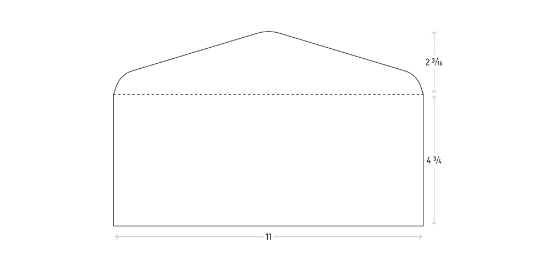
    The #10 envelope measures 4-1/8 x 9-1/2 inches (4.125 x 9.5 inches, or 104.8 x 241.3 millimeters). The interior enclosure space is approximately 4 x 9-1/4 inches.

    A standard 8.5 x 11 letter sheet folded into three equal horizontal panels produces a folded panel measuring approximately 3.67 x 8.5 inches. That fits inside the #10's interior with clearance on all sides. Up to three sheets of standard 20 lb paper fit cleanly, with a single sheet weighing approximately 0.16 ounces and an empty #10 weighing approximately 0.2 ounces. A three-sheet letter with envelope runs well under two ounces.

    USPS classification: the #10 sits at 4.125 inches high, 9.5 inches long, and under 1/4 inch thick on standard contents - comfortably inside letter-rate limits on all three dimensions. Its aspect ratio (9.5 divided by 4.125) is approximately 2.3, within the USPS automation requirement of 1.3 to 2.5, qualifying it for automated sorting and presort discounts on bulk programs.

    The Commercial Size Hierarchy Around the #10

    Size

    Dimensions

    Primary Use

    #6 3/4

    3-5/8 x 6-1/2 in

    Remittance, return, donation reply

    #9

    3-7/8 x 8-7/8 in

    Nested return inside #10

    #10

    4-1/8 x 9-1/2 in

    Standard outgoing business mail

    #11

    4-1/2 x 10-3/8 in

    Thicker enclosure packets

    #12

    4-3/4 x 11 in

    Heavy multi-enclosure correspondence

    #14

    5 x 11-1/2 in

    Legal-size letterhead tri-folded

    Every size above qualifies for USPS First-Class letter-rate postage. The #10 is the default because it matches the tri-folded 8.5 x 11 standard at the lowest per-unit cost of the formats that handle it cleanly.

    Every #10 Variant and What Each One Does

    Plain White Wove, Gum Flap

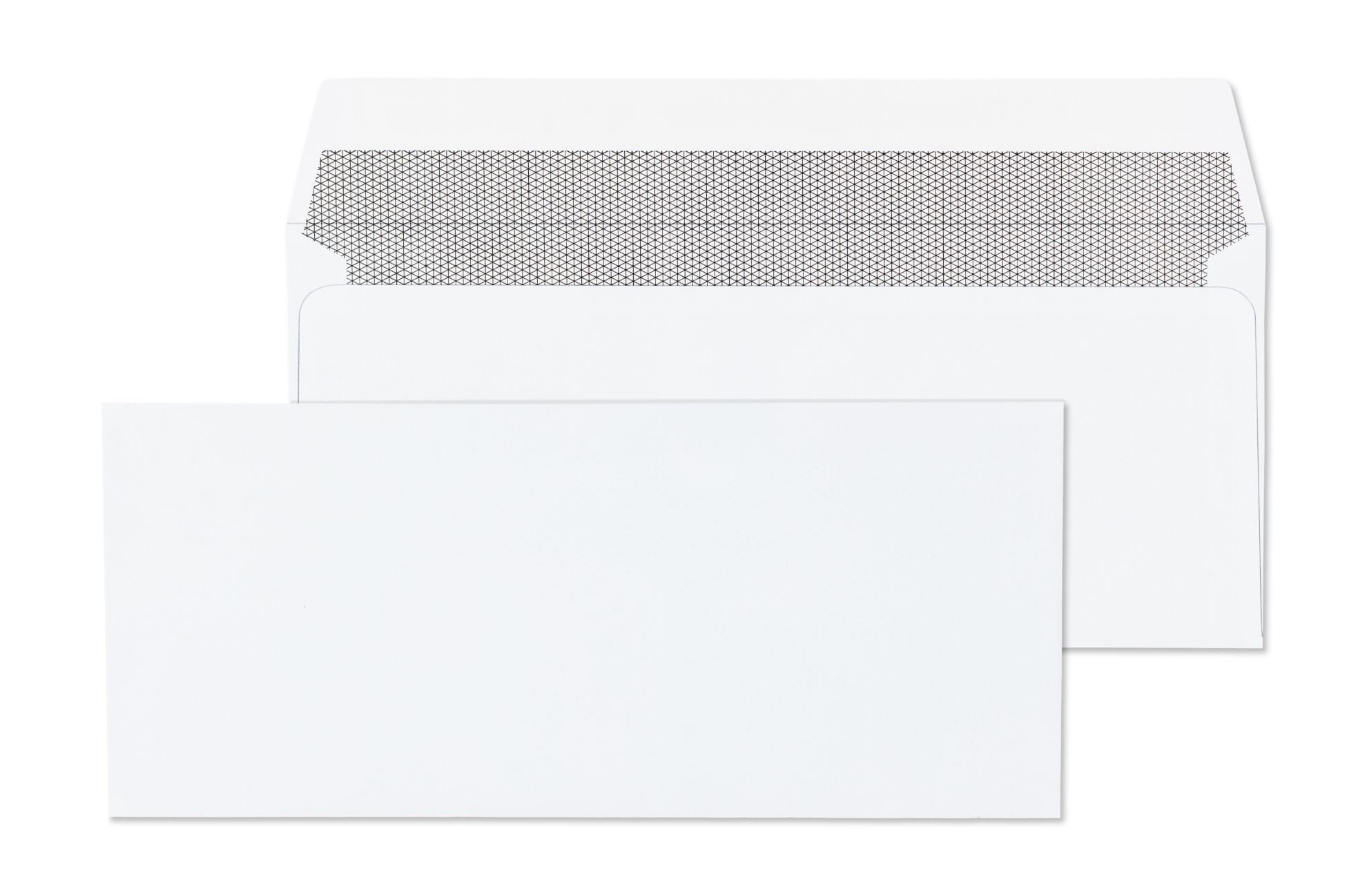
    24 lb bright white wove paper, V-shaped diagonal seam, moistenable gum flap. The baseline format for general business correspondence where contents aren't sensitive. The mandatory format for automatic mail insertion equipment - inserter machines are designed to moisten and seal gum flap stock mechanically. If your operation runs an inserter, gum flap is non-negotiable regardless of other preferences.

    Security Tinted, Gum Flap

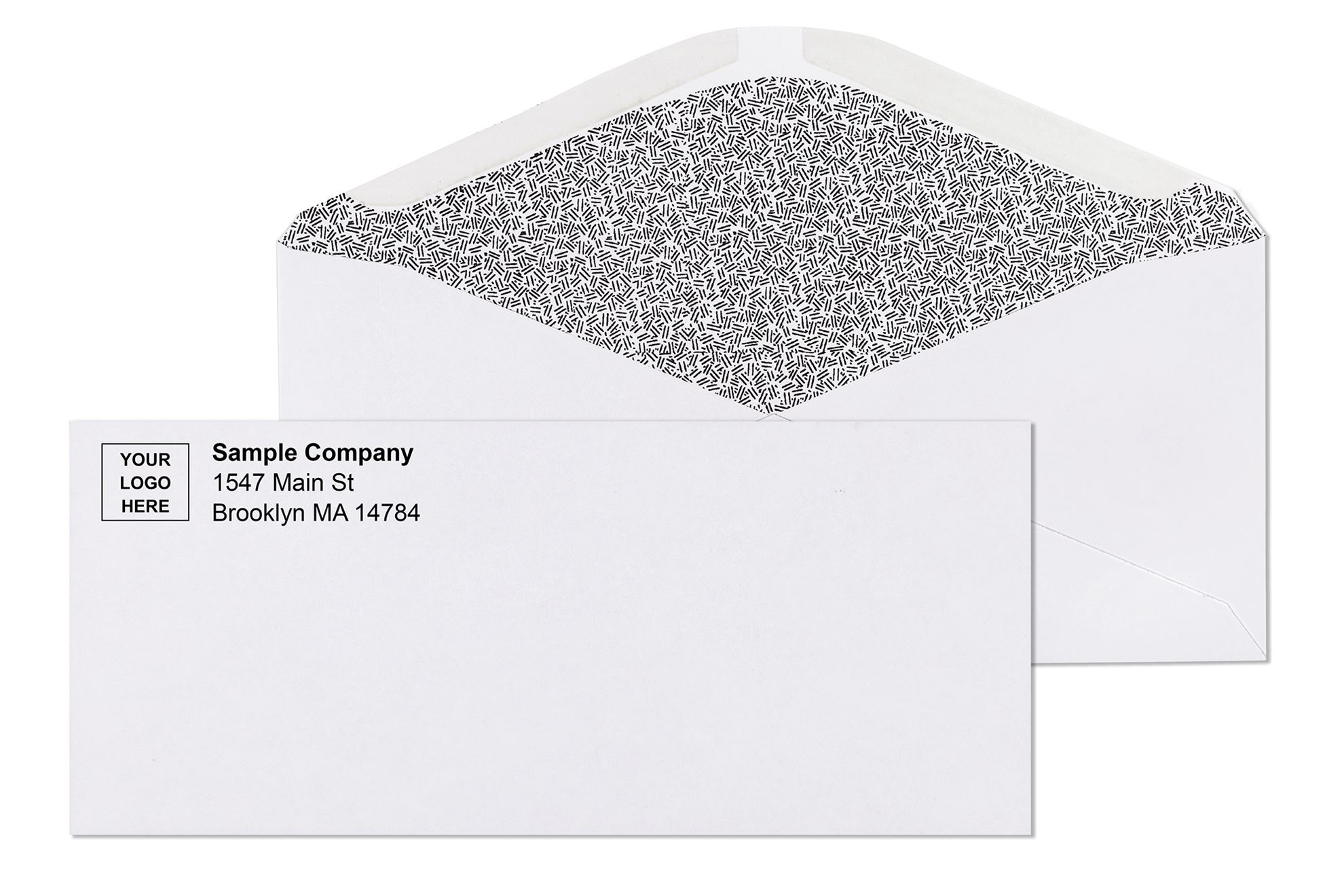
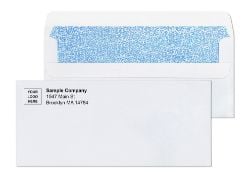
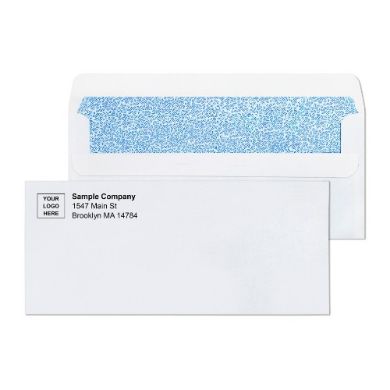
    A reflex blue or geometric pattern printed on the interior blocks document contents from showing through the paper when held to a light source. Account numbers, routing numbers, salary figures, patient identifiers, and check amounts stay concealed in transit.

    The #10 security tinted envelope is the professional standard for billing programs, payroll correspondence, healthcare mail, and financial services correspondence. The security tint is not a premium upgrade. It's the baseline specification for any mailing where the contents shouldn't be readable from outside the envelope.

    Security Tinted, Peel and Seal

    Security tint interior with a pressure-sensitive adhesive closure. The silicone release liner protects the adhesive until you peel it away and press the flap down. Bonds on contact, no moisture required. Most peel-and-seal formats include tamper-evident perforations that tear visibly if someone opens a sealed piece before delivery.

    The #10 self-seal security tinted envelope suits batch programs where envelopes are stuffed before the mailing date. The liner keeps the adhesive inactive in storage, so pre-stuffed envelopes staged for dispatch days later seal as cleanly as envelopes sealed immediately.

    Security Tinted, Flip and Stick

    No liner, no moisture. Two pressure-sensitive latex tabs on the flap interior fold over to contact the envelope body. One press, sealed. Faster per piece than peel and seal because there's no liner removal step. For billing and payroll operations processing large continuous batches manually, flip and stick is the fastest sealing method available without an inserter machine.

    Single Window

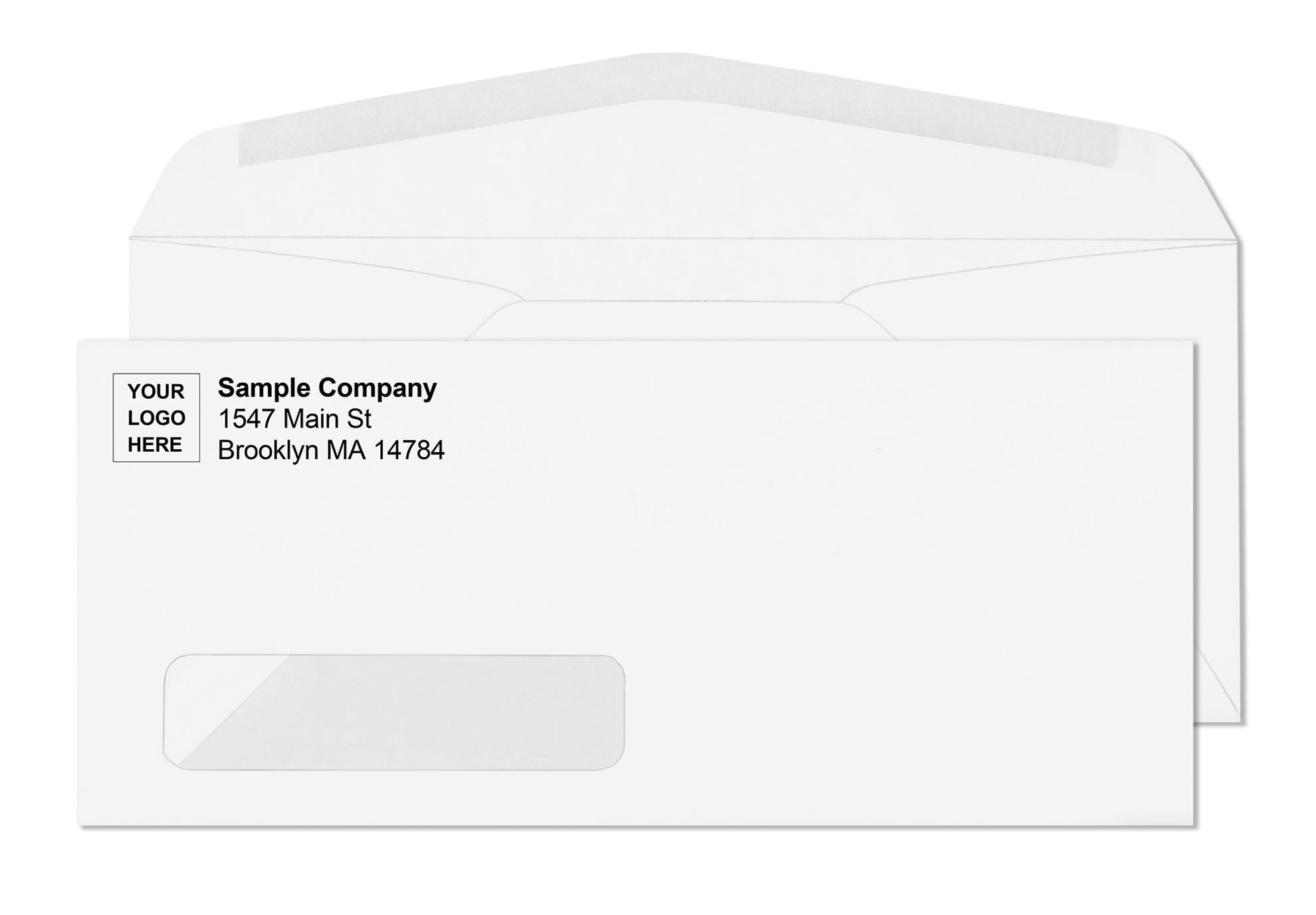
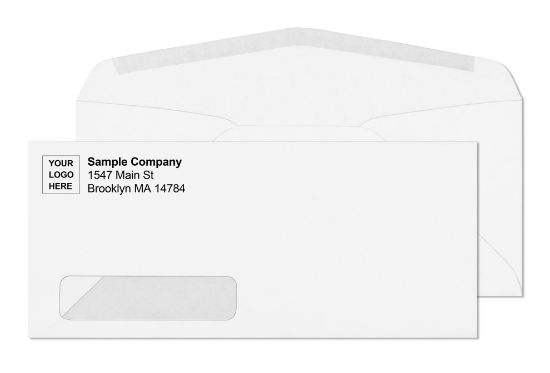
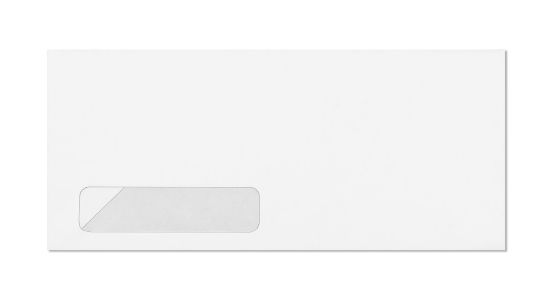
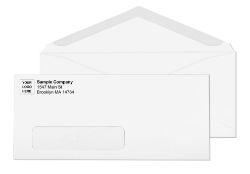
    A clear poly-film panel in the lower-left area of the envelope face, sized at approximately 1-1/8 x 4-1/2 inches and positioned 7/8 inch from the left edge and 1/2 inch from the bottom. The recipient's address printed on the enclosed document shows through the window, eliminating the addressing step from the mailing workflow. Standard for billing statements, invoice runs, and any outgoing program where the address already appears on the document.

    Browse all window envelope configurations for single and double window options.

    Double Window

    Two poly-film windows: upper-right displays the return address, lower-left displays the recipient address. Both pull from the document or check inside, requiring no envelope addressing or labels. Standard for check mailing programs using QuickBooks, Sage, Quicken, and similar accounting software. The double window envelope range covers gum flap, peel-and-seal, and flip-and-stick closures.

    Security Tinted vs. Plain: The Practical Decision Rule

    If the envelope contains any of the following, use security tinted: a check, check amount, account number, or routing number; salary, payroll, or HR information; Social Security numbers, patient identifiers, or protected health information; or any data that passes through a shared mailroom before reaching the final recipient.

    Plain white wove is appropriate for general correspondence, marketing mail, and outgoing pieces where the contents carry no sensitive data.

    Custom Printing on Size 10 Envelopes

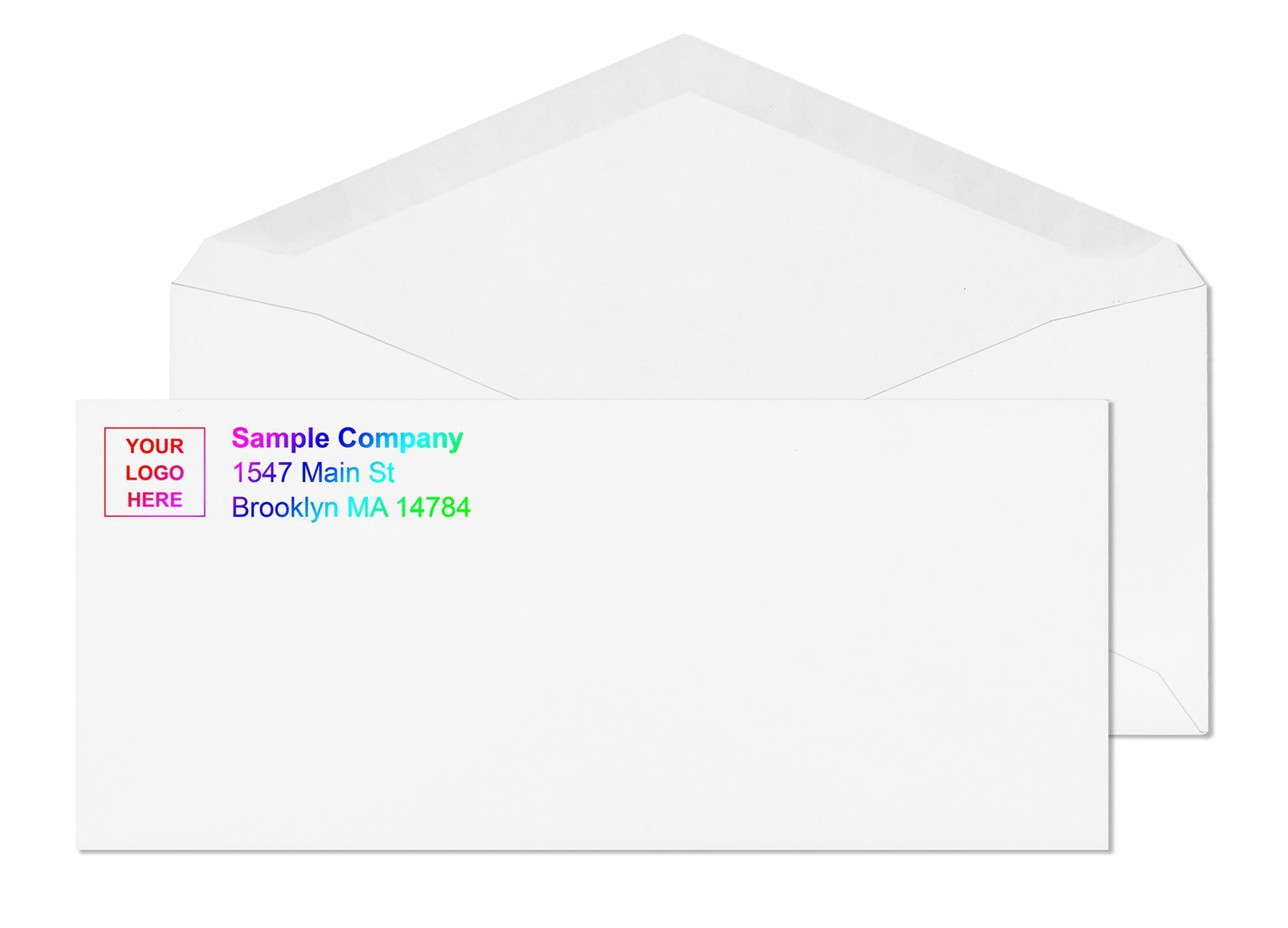
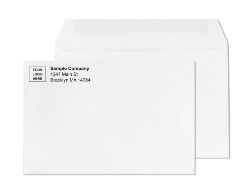
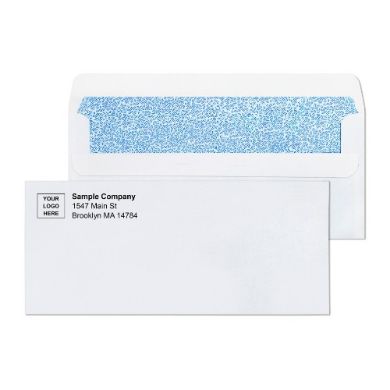
    Logo and return address printing is available on every #10 configuration with no minimum order. Printing goes directly on the envelope face. Artwork stays on file for reorders - every subsequent order produces the same result without re-submitting files. Custom orders ship within 7 to 10 business days from proof approval. Blank stock ships same or next business day. Free shipping on every order.

    For organizations running #10 outgoing mail alongside #9 return envelopes, one approved design file covers both sizes. Request a quote to price the full program together.

    Conclusion

    The size 10 envelope dimensions are fixed at 4-1/8 x 9-1/2 inches. Every other specification is a variant decision based on your mailing workflow. Plain for non-sensitive general mail, security tinted for financial and personal data, gum flap for inserter machines, self-seal for manual batches, window for automatic addressing, double window for check programs. Getting the variant right before ordering is what keeps a billing program, payroll run, or direct mail campaign running without friction. Business Envelopes has carried every #10 configuration since 1997, blank or custom printed, with free shipping and no minimum order.

    FAQs

    What are the dimensions of a size 10 envelope? 

    A #10 envelope measures 4-1/8 x 9-1/2 inches (104.8 x 241.3 mm) with an interior enclosure space of approximately 4 x 9-1/4 inches.

    What fits in a business envelope 10?

     A standard 8.5 x 11 sheet tri-folded fits with clearance on all sides. Up to three sheets of standard 20 lb paper fit cleanly. A single 20 lb sheet weighs 0.16 ounces; an empty #10 weighs approximately 0.2 ounces, so three sheets with the envelope runs under one ounce.

    Does the #10 envelope qualify for USPS letter-rate postage? 

    Yes. Its dimensions fall well within USPS letter-rate maximums and its aspect ratio of approximately 2.3 qualifies it for automated sorting. Contents must stay under 3.5 ounces and under 1/4 inch thick.

    What is the difference between security tinted and plain #10 envelopes? 

    Plain stock has no interior pattern. Security tinted stock has a reflex blue or geometric pattern printed on the interior that blocks document contents from showing through when held to light. Security tinting is the standard for billing, payroll, healthcare, and financial correspondence.

    What does a double window #10 envelope do?

     It displays both the recipient address and the return address through two separate windows, both pulled from the document inside. No addressing label required. Standard for check mailing and QuickBooks accounts payable workflows.

    Can I get custom printing on a #10 with no minimum order? 

    Yes. Custom logo and return address printing is available on every #10 variant with no minimum. Artwork stays on file for all future reorders.

    default image icon business envelopes

    Regular Size Envelopes: Every Standard US Format Explained

    Introduction

    When someone says "regular size envelope," they usually mean the standard #10. That works for most business mail. But regular size envelopes in the United States actually cover three separate sizing systems, each built for a different purpose. The commercial numbered series handles business correspondence. The A-series handles greeting cards and invitations. The catalog and booklet formats handle flat-document mailings that can't be folded. Getting the system wrong means ordering the wrong product entirely, and it happens more often than it should.

    How US Envelope Sizing Actually Works

    US envelopes follow three main sizing systems: commercial (numbered), announcement (A-series), and catalog or booklet formats. Each system uses a different size logic. TOPS Office Products

    The commercial system uses numbers: higher numbers mean larger envelopes. Those numbers don't correspond to inches or millimeters. They index to a manufacturing standard established in the 1870s. The A-series uses letter designations (A2, A6, A7) that correspond to card sizes, not paper sizes. The catalog and booklet formats use physical dimensions in inches (6x9, 9x12, 10x13).

    USPS classification runs parallel to all three systems. To qualify for First-Class letter rate, an envelope must be at least 3-1/2 inches high by 5 inches long and no more than 6-1/8 inches high by 11-1/2 inches long by 1/4 inch thick. Any piece exceeding those limits mails as a flat, at a higher postage rate. A piece smaller than the minimum is not mailable at all. The aspect ratio (length divided by height) must fall between 1.3 and 2.5 for automation processing. Square envelopes have a ratio of 1.0 and are nonmachinable by rule, triggering a surcharge on every piece. Businessenvelopes

    One USPS specification that surprises volume mailers: automated sorting equipment prints an Intelligent Mail barcode on each piece and requires at least 30 percent print reflectance difference between the barcode ink and the envelope background. White envelopes with dark ink sail through. Dark, heavily patterned, or fluorescent envelopes can fail barcode readability and cause processing delays. Test a sample at the post office before committing to a large run of colored stock.

    Commercial Envelopes: The Numbered Business Formats

    The #10 envelope dominates business mail for good reason. It measures 4-1/8 by 9-1/2 inches and perfectly fits a standard 8.5 by 11 inch sheet folded into thirds. It's the go-to for invoices, letters, and day-to-day correspondence. According to USPS data, this size accounts for over 80 percent of all business mail. Business EnvelopesBusiness Envelopes

    The full commercial standard size hierarchy that covers most business mailing needs:

    Size

    Dimensions

    Primary Use

    USPS Class

    #6 3/4

    3-5/8 x 6-1/2 in

    Remittance, return, donation reply

    Letter rate

    #9

    3-7/8 x 8-7/8 in

    Nested return inside #10, billing reply

    Letter rate

    #10

    4-1/8 x 9-1/2 in

    Standard outgoing business mail

    Letter rate

    #11

    4-1/2 x 10-3/8 in

    Thicker multi-sheet packets

    Letter rate

    #12

    4-3/4 x 11 in

    Heavy multi-enclosure correspondence

    Letter rate

    #14

    5 x 11-1/2 in

    Legal-size letterhead, tri-folded

    Letter rate

    All commercial sizes in this table fall within USPS letter-rate dimensions, which is one reason the commercial system dominates business correspondence: every standard size from #6 3/4 through #14 mails at the same postage class, and none require additional handling.

    For volume programs where per-piece postage cost matters, metered postage saves a small but consistent amount over individual stamps on every piece. At scale, that savings adds up quickly.

    How Much Fits in a Standard Commercial Envelope

    This is the question that gets people into trouble when they're loading enclosures. A single sheet of standard 20 lb copy paper weighs about 0.16 ounces. A standard business envelope weighs approximately 0.2 ounces empty. Five sheets plus the envelope comes in right at one ounce - the baseline weight for First-Class letter postage. Three sheets with a reply card and a nested #9 return envelope typically stays within the weight limit as well. Go beyond that and the combined weight may push the piece into a higher postage bracket. Business Envelopes

    The thickness limit of 1/4 inch is typically the constraint for multi-enclosure programs before weight becomes a factor. A #10 envelope with three folded sheets and a return envelope fits cleanly. A #10 with a thick booklet insert will hit the thickness ceiling before the weight limit.

    Announcement Envelopes: The A-Series for Cards and Invitations

    A-series envelopes are sized to match US card formats, not US paper formats. Their proportions are squarer than commercial envelopes. Most fit within USPS letter-rate size limits, but the aspect ratio of some A-series envelopes is close to the nonmachinable boundary, and square versions cross it entirely.

    Common A-series sizes and their card matches:

    • A2 (4-3/8 x 5-3/4 in): RSVP and note cards
    • A6 (4-3/4 x 6-1/2 in): Standard invitation and greeting card format
    • A7 (5-1/4 x 7-1/4 in): Fits a 5 x 7 card - default for wedding invitations, birthday cards, formal announcements
    • A9 (5-3/4 x 8-3/4 in): Oversized announcements and large photo cards
    • A10 (6 x 9-1/2 in): Largest A-series format

    Note: US A-series envelopes are completely different from ISO international A-series paper sizes, despite the shared letter designation. A7 in the US context is an announcement envelope sized for a 5 x 7 card. A7 in the ISO system refers to a paper size (74 x 105 mm). If you're working with international printers or sourcing from overseas suppliers, verify specifications carefully before ordering.

    Catalog and Booklet Envelopes: When Contents Can't Be Folded

    When the document cannot arrive creased, the commercial and A-series formats don't apply. Catalog and booklet envelopes hold 8.5 x 11 sheets flat and mail as USPS flats at the higher flat-mail rate.

    • 6x9: Holds a 5.5 x 8.5 booklet or brochure flat, or an 8.5 x 11 sheet folded in half
    • 9x12: Holds a full 8.5 x 11 sheet flat - standard for contracts, certificates, reports, and unfolded correspondence
    • 10x13: One inch larger on each dimension; accommodates thicker packets and legal-size 8.5 x 14 sheets flat

    Flats cost roughly double letter-rate postage per piece. If contents don't need to stay flat, folding them into a letter-size envelope saves real money, especially at volume. businessenvelopes

    Quick Reference: Which Envelope for Which Mailing

    • Standard business letter, 1 to 3 sheets tri-folded: #10
    • Reply envelope nested inside #10: #9 or #6 3/4
    • Legal letterhead letter, tri-folded: #14
    • Greeting card at 5 x 7: A7
    • RSVP card: A2
    • 8.5 x 11 sheet that cannot be folded: 9x12
    • Small brochure or booklet at 5.5 x 8.5: 6x9
    • Thick packet or legal-size flat: 10x13

    Browse window envelopes, the complete self seal range, and custom printing options across every format. Free shipping on every order, no minimums. Request a quote for volume programs.

    Conclusion

    Regular size envelopes in the US span three sizing systems that don't overlap. Commercial numbered formats cover business correspondence. A-series formats cover cards and invitations. Catalog and booklet formats cover flat-document mail. The #10 handles over 80 percent of US business mail by volume, and it's the right default for most outgoing correspondence. But the right standard envelope for any specific program depends on what's going inside, whether it needs to arrive unfolded, and which USPS classification determines the postage. Business Envelopes has carried every standard US format since 1997, blank or custom printed, with free shipping and no minimum order.

    FAQs

    What is the most common regular size envelope in the US? 

    The #10 envelope (4-1/8 x 9-1/2 inches) is the standard for US business mail, accounting for over 80 percent of business mail volume. It holds a standard 8.5 x 11 sheet tri-folded and qualifies for USPS First-Class letter-rate postage.

    What is the smallest envelope you can mail in the US? 

    USPS requires a minimum size of 3-1/2 inches high by 5 inches long. Anything smaller is not mailable as a standard letter piece.

    What makes an envelope nonmachinable? 

    Square shape (aspect ratio below 1.3), metal clasps, rigid contents, uneven thickness, or exceeding the 1/4 inch thickness limit. Each triggers a nonmachinable surcharge per piece on top of standard letter postage.

    What is the difference between a booklet and catalog envelope? 

    Both are flat-document formats in sizes like 6x9, 9x12, and 10x13. A booklet envelope opens on the long edge. A catalog envelope opens on the short edge. Booklet style suits automated insertion; catalog style suits heavier contents with top loading.

    Do colored envelopes affect USPS postage? 

    Color does not affect the postage class, but USPS automated sorting requires at least 30 percent print reflectance difference between the barcode ink and envelope background. Very dark or patterned envelopes may fail this requirement and cause processing delays.

    default image icon business envelopes

    What Envelopes Do You Need for QuickBooks Checks?

    Introduction

    Here's where most people go wrong. They search "QuickBooks check envelopes," see "double window #10" mentioned somewhere, order a box of standard #10 invoice envelopes, and then spend twenty minutes wondering why the payee address is showing up through the wrong window or the check won't insert cleanly.

    Envelopes for QuickBooks checks aren't standard #10 envelopes. They're a check-specific double window format with different outer dimensions and precisely positioned windows that were engineered around where QuickBooks actually prints addresses on a voucher check form. The difference matters a lot when you're mailing 200 vendor payments every month and need every envelope to align correctly without anyone manually verifying each one.

    This guide tells you exactly which format you need, why it works the way it does, and what to check before you run a full batch.

    First: What Check Format Is Your QuickBooks Account Printing?

    This is the question most people skip, and skipping it is why they end up with the wrong envelopes. QuickBooks prints three different check layouts, and they don't all use the same envelope.

    Standard voucher checks are what the majority of businesses are printing. You get the check on the top third of a full 8.5 x 11 sheet, with two detachable voucher stubs below it that show payment details. When you tear off the check and fold it for mailing, it goes into a double window check envelope. Your company return address lands in the upper window, the payee's address shows through the lower one. Nothing gets written or printed on the envelope itself.

    Wallet checks are smaller- three checks per page, about 6 inches wide each. They're handed off in person more often than mailed, but if you do mail them, a standard plain #10 works fine. Window alignment isn't really in play here the same way.

    Three-per-page business checks follow the same logic as wallet checks. Not a double window envelope situation.

    For the vast majority of QuickBooks users mailing vendor payments, contractor checks, or payroll, you're working with voucher checks. And that means you need a double window check envelope.

    Why Double Window, and Why the Envelope Can't Be a Standard #10

    This trips people up because "double window #10" gets thrown around online, and it sounds like it means a standard #10 envelope with two windows. It doesn't. The double window envelope designed for QuickBooks checks has different outer dimensions than a standard #10 invoice envelope. The window positions are calibrated to where QuickBooks places the payer and payee addresses on a voucher check form- not to where a billing statement or invoice puts them.

    The bottom window on a QuickBooks-compatible check envelope sits 3/4 inch from the bottom edge and 7/8 inch from the left, with a width of 3-1/2 inches and a height of 7/8 inch. The top window sits 3/8 inch from the left and 2-3/8 inches from the bottom. Those measurements exist because that's exactly where QuickBooks prints the two address fields on a standard voucher check. Use a different envelope and the addresses shift out of the windows, the financial data on the check starts peeking through where it shouldn't, or both.

    Business Envelopes carries all three closure types for this format. The gum flap version is what you want if your office uses an automatic inserter machine. The peel-and-seal version is good for batches that get stuffed and staged before the mailing date- the liner keeps the adhesive inactive until you remove it, so they don't pre-seal in storage. The flip-and-stick version is the fastest for hand-sealing a continuous run. No liner step, just fold and press.

    All three include security tint interior as standard. That's not optional for check mailing. Checks carry routing numbers, account numbers, and check amounts. Security tinting prevents any of that from being readable through the envelope when someone holds it to a light source during transit.

    The Seal Type Decision Is More Practical Than Most People Expect

    Once the format is right, the seal type is the daily workflow decision. It matters more than it seems when you're processing checks every week.

    Flip and stick is what most small to mid-size accounts payable teams prefer for hand-sealing. There's no liner to remove. You fold the short adhesive tab over and press the flap down onto it. Sealed. For someone doing 50 to 150 checks per week by hand, not having to peel anything saves a noticeable amount of time across a full check run. It's also the format that tends to produce the most consistent seal when you're moving at any kind of pace.

    Peel and seal takes one extra step per envelope- the liner removal- but it gives you something flip-and-stick doesn't: the ability to stuff the envelopes before the day you're mailing them. The release liner keeps the adhesive live and protected even if the envelope sits in a drawer for three days. If your AP team preps batches ahead of time, peel-and-seal is worth the extra second per piece.

    Gum flap is for inserter machines, period. Pitney Bowes, Neopost, standard Bell and Howell inserters- they're built to moisten and close a gum flap at the end of the insertion cycle. If you're hand-sealing, gum flap is the least convenient option of the three. You need moisture, you have to apply the right amount, and inconsistent sealing creates problems in transit. But if you've got a mailing machine running your check runs, it's the one to order.

    A Note on QuickBooks Online vs. Desktop

    This catches some buyers off guard. QuickBooks Desktop supports printing checks directly and mailing them through the standard voucher format. QuickBooks Online does not support direct check printing for mailing in the same way- the check printing workflow functions differently, and some users route through third-party services or a desktop integration instead.

    If you're using QuickBooks Online and printing checks through a connected service, confirm that the check template your service uses places both addresses in the standard positions before ordering envelopes in bulk. The window specs only work if the check form itself matches them.

    Always Test One Envelope Before You Mail the Batch

    This is the step that most teams skip until they've learned the hard way not to. Before any batch run, print one check, fold it exactly the way you'll fold them in the actual run, slide it into the envelope, and hold the whole thing up to a light. You're looking for four things:

    The payee name and full delivery address should sit completely inside the lower window with visible clearance on all four sides. Your company return address should sit completely inside the upper window the same way. The check amount, account number, routing number, and memo line should all be invisible- no financial data showing through the envelope body or the edges of either window. And the check should lie flat inside without bunching, which tells you the fold is consistent with how the envelope was designed to receive it.

    QuickBooks' standard voucher template is built around these envelope specs, so if you haven't customized your check template significantly, the alignment will usually be fine out of the box. But printer margin settings, paper stock changes, or a new version of a check template can shift things enough to matter. One test print takes two minutes. A misaligned batch of 300 checks takes considerably longer to deal with.

    Why It Matters Where You Source These Envelopes

    Check envelopes from a general office supply retailer work until they don't. Window position tolerances vary between manufacturers. Security tinting density is not consistent across commodity stock. When a batch of 300 vendor payments goes out with compromised window alignment or insufficient security tinting, the cost is more than just reprinting and remailing.

    Business Envelopes has been supplying accounting departments, payroll teams, and AP operations with check-compatible envelopes since 1997. The catalog is built specifically around the check formats that QuickBooks, Sage, Quicken, Peachtree, and Wave users are printing. Window positions are spec'd to those formats. Security tinting is standard on every check envelope in the catalog. Custom printing with your company name and return address pre-printed is available on every format if you want a more polished presentation on outgoing payments.

    No minimum order. Free shipping on every order. If you have questions about which format fits your specific check setup, the product pages walk through the specs in detail.

    Conclusion

    QuickBooks check mailing has one right envelope type: a double window check envelope, spec'd to the voucher check format, with security tinting, in whichever closure matches how your team processes outgoing mail. The double window removes the manual addressing step. The security tinting keeps financial data protected in transit. The window positions are calibrated to where QuickBooks prints. Test alignment before every batch, order quantities that match your actual cycle, and source from a catalog that was built around accounting software compatibility from the start. Get those three things right and check mailing becomes one of the most systematic, lowest-effort parts of your weekly AP workflow.

    FAQs

    What size envelope do I need for QuickBooks checks?

     You need a double window check envelope, which is not the same as a standard #10 invoice envelope. The check-format double window has window positions calibrated to where QuickBooks places addresses on a standard voucher check, with the bottom window at 3/4 inch from the bottom and 7/8 inch from the left.

    Will a regular #10 double window work for QuickBooks checks?

     No. A standard #10 double window envelope is designed for invoices and billing statements, not check forms. The window positions are different. Using it for QuickBooks voucher checks will produce misaligned addresses.

    Why do check envelopes need security tinting?

     Checks contain account numbers, routing numbers, and check amounts. Security tinting is a printed interior pattern that prevents that information from being visible through the envelope paper when held to light. It's standard practice, not optional, for check mailing.

    Which seal type should I use for QuickBooks check mailing?

     Flip-and-stick for fast continuous hand-sealing. Peel-and-seal if you stage batches before the mailing date. Gum flap only if you're using an automated mail inserter machine.

    Does QuickBooks Online work the same as Desktop for check printing?

     No. QuickBooks Desktop supports the standard voucher check printing workflow directly. QuickBooks Online handles check printing differently. If you're using QBO with a connected print service, verify the check template matches standard window positions before ordering.

    How do I confirm alignment before a batch run? 

    Print one check, fold it, insert it into the envelope, and hold it to a light source. Both addresses should appear fully inside their windows with clearance on all four sides. No financial data should be visible through the envelope body.

    Can I get custom printing on check envelopes without a minimum order?

     Yes. Company name and return address printing is available on all double window check formats with no minimum order. Artwork stays on file for reorders.


    default image icon business envelopes

    #9 Envelope: Size, Uses, Variants, and How to Run a Return Mail Program

    The #9 envelope has one defining purpose: it fits inside a standard #10 envelope. That nesting relationship is the entire reason this size exists. You mail the #10 with your invoice, statement, or solicitation, and you include an unsealed #9 inside. The recipient inserts their payment or reply and mails it back. No addressing. No label. A pre-fitted return envelope that arrives with the outgoing piece and goes right back.

    What most buyers miss when ordering #9s is that the format comes in six distinct variants, each built for a different return mail scenario. Choosing the wrong one for your program means either leaving money on the table or creating unnecessary friction for the recipient. This guide covers every variant, what each one is built for, and how to match the spec to your use case.

    #9 Envelope Dimensions and Why the Size Is Exactly What It Is

    The #9 envelope measures 3-7/8 x 8-7/8 inches (3.875 x 8.875 inches), approximately 98 x 225 mm. The No. 9 envelope measures 8.875 x 3.875 inches, slightly smaller than its No. 10 counterpart. Companies use this size for reply envelopes and return correspondence, and both sizes work with automated mail processing equipment. ClickRank

    That quarter-inch difference on each dimension is not a coincidence. It is the designed clearance that allows the #9 to nest cleanly inside a #10 without wrinkling, without binding, and without preventing the outer flap from seating flat for sealing. The commercial envelope numbering system that defines this relationship was standardized in the 1870s. The number has no correspondence to any physical measurement. It identifies the #9's position in the commercial size hierarchy: one step below the #10, with precisely the geometry needed to function as its standard return companion.

    The #9 holds an 8.5 x 11 letter sheet folded into thirds, same as a #10, and qualifies for USPS First-Class letter postage on contents under 3.5 ounces. In practice, the return contents going back inside a #9 are almost always a payment stub, a check, a folded reply card, or a single-page response form, all well within the weight and thickness limits for letter-rate postage.

    The #9 and #10 Nesting Pairing: How It Works Operationally

    The #10 envelope size serves as the standard business envelope, while the #9 envelope size functions as the standard reply envelope for business communication. The outgoing #10 carries the primary document. The enclosed unsealed #9 carries a pre-printed return address and travels with the outgoing piece so the recipient can respond without any additional preparation. Connectica

    One operational detail worth building into your setup: the #9 also fits inside a #10 window envelope. When the outgoing piece is a window mailer, the pre-printed return address on the enclosed #9 can be positioned to show through the outer #10 window. That means one printed document handles the recipient delivery address for the outer window and provides the return address on the nested #9, with no separate envelope addressing step needed on either piece.

    Enclosing a return envelope with an outgoing billing or donation piece measurably improves response rates. The recipient doesn't need to find their own envelope, address it, or look up the mailing address. For any program where response rate is a metric, the pre-fitted return envelope is not a convenience feature. It is a conversion mechanism. Launchcodex

    Every #9 Variant: Matched to Use Case

    Plain White Wove, Gum Flap

    Standard 24 lb white wove paper, diagonal seam construction, moistenable gum flap. The #9 white wove gum flap is the right format when the return contents carry no sensitive data: RSVP responses, survey returns, subscription renewals without payment information, or general correspondence replies where privacy protection is not a requirement.

    Security Tinted, Gum Flap

    The interior of the envelope body is printed with a soft-blue or geometric security pattern. This pattern is not a coating applied over the standard stock. It is printed on the interior surface specifically to block text from transmitting through the paper weight when the sealed envelope is held to light. The check amount, account number, routing number, and personal data inside the envelope remain unreadable from outside without opening it.

    The gummed flap closure on security-tinted envelopes also provides tamper evidence: once sealed, the flap shows visible signs of tampering if someone attempts to open it. LinkedIn

    The #9 security tinted gum flap is the standard format for billing programs where recipients return payment. One verified Business Envelopes customer confirms this use directly: "I use these #9 envelopes as return envelopes which I insert into the #10s. Thanks to their security tint, I can rest assured that the information inside will not be publicly exposed."

    Security Tinted, Peel and Seal

    Same security tint interior with a peel-and-seal closure. A pressure-sensitive adhesive strip sits behind a silicone-coated release liner on the flap. The recipient peels the liner off and presses the flap down. The adhesive bonds on contact, no moisture required.

    The #9 security tinted peel and seal addresses a specific problem in consumer-facing return programs. A gum flap requires the recipient to find moisture and apply the right amount to activate the adhesive. For a billing department, that's routine. For a donation recipient completing a one-time response, it's friction that reduces return rate. Peel-and-seal removes the moisture step entirely: peel, press, mail. For donation programs, membership renewals, subscription billing, and any response program where return rate matters, peel-and-seal is the correct closure choice.

    Window Variant, Security Tinted

    The #9 window envelope carries a clear poly-film window on the face. The window on a #9 envelope typically measures approximately 1 inch by 3.5 inches, positioned about 0.75 inches from the left and 0.75 inches from the bottom. When the return address on the pre-printed document inside aligns with this window position, the return address shows through without any label or printing on the envelope face itself. Amazon

    The #9 window tinted envelope combines the window addressing efficiency with the security tint interior. The window shows the address; the tinted body conceals the payment or form contents. This is the format for financial, medical, and legal return mail programs where the response carries private data and the return envelope needs to handle addressing automatically.

    Double Window Variant

    Two poly-film windows: a bottom window for the recipient address and an upper window for the return address. Both pull from the document or check inside. The standard bottom window on a #9 double window measures 1 x 4 inches, positioned 3/8 inch from the left and 1/2 inch from the bottom.

    The double window #9 is built for check mailing and accounts payable programs where the check itself carries both the payer return address and the payee delivery address in pre-printed positions. The double window format works because window positions are standardized to match the address block placement in accounting software check templates. When a check prints from QuickBooks, Sage, ADP, Paylocity, or any other major payroll or accounts payable platform, the return address and payee address print in positions that align with the windows in a standard double window check envelope. Amazon

    Starburst and Colored Wove

    The starburst format uses a bold color pattern with peel-and-seal closure, used in direct mail and fundraiser programs where the return envelope needs to prompt action visually. The color pattern makes the return piece distinctive in a pile of mail and signals a purpose-built response piece rather than a generic envelope. Colored wove variants serve branding programs where the return envelope carries organizational colors or needs visual differentiation from standard white stock. Launchcodex

    Business Reply Mail vs. Courtesy Reply Mail: The Postage Decision

    Organizations running high-volume return programs can structure their #9 envelopes in two ways, with different postage implications.

    Courtesy Reply Mail (CRM) encloses a pre-printed, pre-addressed #9 that the recipient affixes their own stamp to before mailing. The organization bears only the printing cost, not the return postage. CRM is the standard format for billing reply envelopes, donation response pieces, and most consumer-facing return programs.

    Business Reply Mail (BRM) uses a USPS permit-imprinted #9. The organization pays postage only on pieces actually returned, not for every envelope enclosed. BRM requires a USPS permit account and specific format specifications on the envelope face. For programs with low expected return rates, BRM can reduce postage cost versus pre-stamping every enclosed envelope.

    For most billing and membership operations, CRM with a pre-printed #9 is the simpler and more commonly used format. BRM makes economic sense when the enclosed volume is high and the expected return rate is low enough that per-piece permit accounting produces a net saving.

    Custom Printing on the #9 Return Envelope

    A custom-printed #9 pre-addresses the return envelope at the production stage. The organization's name and mailing address print directly on the envelope face so the recipient inserts their response, seals, and mails without any additional addressing step.

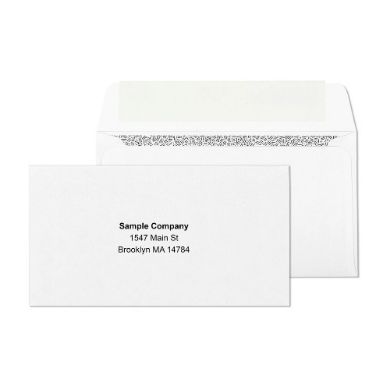
    Custom printing is available on every #9 variant. Artwork stays on file for reorders. Custom orders ship within 7 to 10 business days from proof approval. Blank stock ships same or next business day. Free shipping on every order.

    Organizations running programs across both the #10 outgoing and #9 return formats use one approved design file for both sizes. For recurring programs, request a quote to price the full package across both formats. The full self seal envelope range covers every peel-and-seal variant in one place for operations reviewing closure options across the complete mailing program.

    Conclusion

    The #9 envelope is not a commodity purchase ordered automatically alongside the #10. The variant selection, plain vs. security tinted, gum flap vs. peel and seal, windowless vs. windowed vs. double windowed, directly affects the return rate of your program, the privacy protection of the contents in transit, and the operational friction for the recipient completing the response. Getting the spec right before ordering is what makes a return mail program run cleanly on every cycle. Business Envelopes has carried every #9 variant since 1997, blank or custom printed, with free shipping and no minimum order.

    FAQs

    What size is a #9 envelope? 

    The #9 envelope measures 3-7/8 x 8-7/8 inches (approximately 98 x 225 mm). It is precisely a quarter inch shorter and narrower than a #10 on each dimension, providing the exact clearance to nest inside a #10 envelope without wrinkling or preventing the outer flap from sealing.

    Does a #9 fit inside a #10 envelope? 

    Yes. The #9 is designed for this specific purpose. It fits inside a standard #10 with a quarter inch of clearance on each side, and the outer flap seats and seals cleanly over the enclosed return piece.

    What is a #9 envelope used for?

     Primarily as a return reply envelope nested inside an outgoing #10. Billing programs, donation mailings, membership renewals, legal correspondence, and healthcare billing all enclose a #9 for the recipient to use when sending back a payment, form, or reply.

    What is the difference between security tinted and plain on a #9 envelope? 

    Security tinting is a pattern printed on the interior surface of the envelope that blocks the contents from being read through the paper when held to light. Plain white stock provides no such protection. Security tinted is standard for any return program where recipients mail back checks, account information, or personal data.

    What is the difference between courtesy reply mail and business reply mail on a #9 envelope? 

    Courtesy reply mail (CRM) is a pre-printed, pre-addressed return envelope the recipient stamps themselves. Business reply mail (BRM) uses a USPS permit and charges postage only on pieces actually returned. CRM is standard for most billing and donation programs. BRM suits high-volume programs with low expected return rates.

    Why use peel and seal instead of gum flap for a consumer-facing return envelope? 

    Gum flap requires moisture to activate. For a recipient completing a one-time reply, finding moisture adds friction that reduces return rate. Peel and seal removes that step: peel the liner, press the flap, and it's sealed. For donation and membership programs where return rate is a performance metric, peel and seal is the more effective closure.

    Can I custom print a return address on a #9 without a minimum order? 

    Yes. Custom logo and return address printing is available on every #9 variant with no minimum order. Artwork stays on file for reorders without re-submitting files.

    What is a double window #9 envelope used for? 

    Double window #9 envelopes display both the payer return address and the payee delivery address through separate windows, pulling from a printed check or statement inside. They are built for check mailing and accounts payable programs using QuickBooks, Sage, ADP, Paylocity, and similar accounting platforms.

    default image icon business envelopes

    What Size Envelope Fits a Folded 8.5x11 Sheet of Paper?

    Introduction

    The answer depends entirely on how you fold it. A tri-fold business letter goes in a #10 envelope, and an 8.5x11 document left unfolded goes in a 9x12. Folded in half, it fits a 6x9. Each fold type changes the postage class, the envelope format, and whether a window envelope will align with your address block. This guide covers all four scenarios with exact dimensions, USPS postage classification, sheet capacity limits, and which format to order for each use case. MyEnvelopes247

    The #10 Envelope: Standard Choice for an 8.5x11 Sheet Folded in Thirds

    The #10 envelope measures 4-1/8 x 9-1/2 inches (105 x 241 mm) and is the standard business envelope used for letters, invoices, statements, and direct mail campaigns. It fits a standard 8.5x11 letter folded in thirds and qualifies for USPS letter-rate postage. Businessenvelopes

    When folded in thirds, an 8.5x11 sheet measures 3.6875 inches wide by 8.5 inches tall. The letter fold uses slightly different sized panels to ensure that the panel that folds in fits nicely inside the other two. That's why the folded piece slides cleanly into the #10's 4 x 9-1/4 inch interior without buckling or catching. Gwprint

    This is why the #10 is the default business envelope in the United States. Invoices, billing statements, payroll letters, account notices, and standard business correspondence all travel tri-folded inside a #10.

    USPS letter size requirements are: at least 3.5 inches high by 5 inches long, and no more than 6.125 inches high by 11.5 inches long by 1/4 inch thick. The #10 sits comfortably within these bounds, which is why it qualifies for first-class letter postage on contents under 3.5 ounces. Amazon

    A note on window envelopes: the standard C-fold places the address block in the lower-left area of the top panel, which aligns directly behind the window on a #10 window envelope. Most US accounting and billing software formats invoices and statements to land in exactly this position. Test one piece before running a large batch by folding a printed document, inserting it, and holding the envelope to a light source. USPS requires 1/8-inch minimum clearance between the address text and all four window edges for automated sorting compliance.

    For sensitive financial or medical correspondence, the #10 security tinted self seal envelope adds a reflex blue interior pattern that blocks document contents from showing through the paper when held to light. This is the format billing departments, payroll teams, and healthcare offices use as their standard outgoing mailer.

    The 6x9 Envelope: Right for an 8.5x11 Sheet Folded in Half

    A bi-fold (half-fold) of an 8.5x11 sheet folds to 5.5 inches by 8.5 inches. This does not fit a #10 envelope. The folded width of 5.5 inches far exceeds the #10's 4-inch interior. Trying to insert a half-folded sheet into a #10 produces a crumpled document and a flap that will not seat. Businessenvelopes

    The correct envelope for a half-folded 8.5x11 sheet is a 6x9 booklet envelope, with an interior space of 5.75 x 8.75 inches. The half-folded sheet fits cleanly with clearance on all sides.

    A 6x9 envelope is still within the standard letter-mail size limits for USPS, so it can mail at regular first-class letter rates, provided it is under the weight and thickness limit. A single half-folded sheet stays well within that threshold. Multiple sheets, heavier inserts, or added enclosures may push the piece into flat-rate territory at increased postage. MyEnvelopes247

    Common use cases for the 6x9 include half-folded event programs, tri-panel brochures, and marketing materials where a two-panel fold is built into the design. The 6x9 booklet envelope opens on the long edge, which makes loading a half-folded piece fast at volume.

    The 9x12 Envelope: No Fold Required

    A 9x12 booklet or catalog envelope holds an 8.5x11 sheet completely unfolded. The interior measures 8.75 x 11.75 inches, enough clearance for a full letter-size sheet without bending or creasing it.

    This is what legal offices, accounting firms, and medical practices use when the document cannot arrive creased. Contracts, multi-page agreements, explanation-of-benefits forms, certificates, and client reports all mail better in a 9x12 when presentation matters. 9x12 envelopes fit a full 8.5x11 sheet flat, making them perfect for contracts or multi-page documents. Businessenvelopes

    The USPS classifies 9x12 envelopes as flats, not letters. They do not qualify for first-class letter rate. For a single occasional document that needs to arrive uncreased, that is a reasonable cost. For high-volume recurring mailings of standard business letters, the 9x12 is the wrong format: the postage difference over thousands of pieces per month adds up considerably.

    The 9x12 is available in two opening styles. The 9x12 booklet envelope opens on the long edge and suits single-sheet and thin-packet loads. The 9x12 open-end catalog envelope opens on the short edge and provides extra structural strength for thicker document packets and multi-page reports.

    Quick Reference: Envelope Size by Fold Type

    How You Fold the 8.5x11 Sheet

    Folded Dimensions

    Correct Envelope

    USPS Classification

    Tri-fold (letter fold, into thirds)

    3.69" x 8.5"

    #10 (4-1/8 x 9-1/2")

    First-class letter rate

    Half-fold (bi-fold)

    5.5" x 8.5"

    6x9 booklet

    Letter rate if under 1/4" thick

    Quarter-fold (two folds)

    4.25" x 5.5"

    6x9 booklet

    Letter rate if under 1/4" thick

    No fold

    8.5" x 11"

    9x12 booklet or catalog

    First-class flat rate

    No fold, thicker packet

    8.5" x 11"

    10x13 catalog

    First-class flat rate

    USPS Postage Implications by Envelope Size

    Getting the envelope size right is not just about fit. It determines what you pay per piece.

    To qualify for USPS bulk mail automation discounts, letters must be between 3.5 x 5 inches and 6.125 x 11.5 inches, no more than 1/4 inch thick, flexible, and rectangular with an aspect ratio between 1.3:1 and 2.5:1. Meeting these specs can reduce postage significantly per piece compared to non-automation rates. Businessenvelopes

    USPS adds a non-machinable surcharge to letters that are square, too rigid, poly-wrapped, have clasps or buttons, or fall outside the 1.3:1 to 2.5:1 aspect ratio requirement. The #10 envelope with its 4-1/8 x 9-1/2 inch dimensions has an aspect ratio of approximately 2.3:1, well within the automation window. Businessenvelopes

    The 9x12 flat-rate classification is the most common postage surprise for offices upgrading from #10 to a larger format. The rate difference between a first-class letter and a first-class flat matters when you are mailing hundreds of pieces monthly. If the document can be tri-folded without loss of information or readability, the #10 letter rate is the more efficient choice.

    Sheet Capacity: How Many Pages Fit in Each Size

    Capacity varies by paper weight. Standard US office paper runs at 20 lb bond (75 gsm).

    #10 envelope, tri-folded sheets: Up to three sheets of standard 20 lb paper fit cleanly. The #10 envelope can fit up to three sheets of standard 8.5x11 paper folded in thirds, making it a versatile and efficient option for day-to-day business mail. At four sheets, the flap may not seat flat and the piece may trigger non-machinable handling. For higher sheet counts, the #11 envelope at 4-1/2 x 10-3/8 inches provides additional clearance while still accepting a tri-folded 8.5x11 sheet. Amazon

    6x9 envelope, half-folded sheets: One to four sheets of standard paper fit half-folded. Beyond that, combined thickness may push the piece into flat-rate territory.

    9x12 envelope, unfolded: A 9x12 envelope can hold up to fifteen sheets of standard 8.5x11 paper without folding, making it excellent for bulkier documents that need to be mailed securely. Amazon

    For billing operations sending statements with multiple enclosed pages plus a return reply envelope, the #10 with a #9 window envelope nested inside is the standard industry configuration. Three sheets plus a return envelope generally stays within the #10's capacity and under the 3.5 oz first-class weight limit.

    Choosing a Window Envelope When the Document Is Folded

    If your document has the recipient's address pre-printed, a window envelope eliminates the addressing step. The fold type determines whether this works.

    For #10 window envelopes, the C-fold tri-fold places the address block in the lower-left panel facing outward, directly behind the transparent film. Most US billing platforms, accounting software, and word processors format invoices and statements to align with the standard #10 window position (1-1/8 x 4-1/2 inches, positioned 7/8 inch from the left, 1/2 inch from the bottom) automatically.

    For double window envelopes used in check mailing, both the payer return address and the payee delivery address appear through separate openings when the check is inserted correctly. This eliminates the addressing step entirely for QuickBooks, Sage, and standard laser check formats. Run a single test piece before any batch run to confirm alignment with your specific check template.

    The full range of self seal envelopes covers every size discussed in this guide across both peel-and-seal and flip-and-stick closure types, blank or custom printed, with free shipping and no minimum order.

    Conclusion

    The envelope size that fits a folded 8.5x11 sheet is determined by how the sheet is folded, not just its unfolded dimensions. Tri-fold into thirds: #10, first-class letter rate, the US standard for business mail. Half-fold: 6x9 booklet, still letter-rate eligible at standard weights. No fold at all: 9x12, flat rate, right when the document cannot arrive creased. Getting this right before ordering prevents mis-sized stock, returned mail, and unexpected postage. Business Envelopes has carried every size in this guide since 1997, blank or custom printed, with free shipping and no minimum order on every format.

    FAQs

    What size envelope fits an 8.5x11 sheet folded in thirds?

     A #10 envelope (4-1/8 x 9-1/2 inches). When folded into three equal horizontal panels, an 8.5x11 sheet measures 3.69 x 8.5 inches, which fits cleanly inside the #10's 4 x 9-1/4 inch interior with clearance on all sides.

    Does a half-folded 8.5x11 sheet fit in a #10 envelope?

     No. A half-folded 8.5x11 sheet measures 5.5 x 8.5 inches, which is significantly wider than the #10's 4-inch interior. A 6x9 booklet envelope is the correct size for a half-folded 8.5x11 sheet.

    What envelope fits an unfolded 8.5x11 sheet?

     A 9x12 booklet or catalog envelope, with an interior of 8.75 x 11.75 inches. The sheet fits flat with clearance on all sides. The 9x12 mails at the USPS first-class flat rate, not the letter rate.

    How many sheets fit in a #10 envelope?

     Up to three sheets of standard 20 lb paper, tri-folded. Four sheets may prevent the flap from seating properly. For higher page counts, a #11 envelope (4-1/2 x 10-3/8 inches) provides additional clearance while still accepting a tri-folded letter sheet.

    Does envelope size affect postage? 

    Yes. The #10 and 6x9 both qualify for USPS first-class letter rate when within weight and thickness limits. The 9x12 is classified as a flat and mails at the higher first-class flat rate. Non-standard shapes and rigid envelopes may also trigger a non-machinable surcharge.

    Can I use a window envelope with a tri-folded 8.5x11 document?

     Yes. Standard #10 window envelopes are designed so the address block on a C-fold tri-fold lands directly behind the window. Most US billing and accounting software formats documents to align with the #10 window position automatically. Test one piece before running a full batch.

    What is the quarter-fold envelope size for an 8.5x11 sheet?

     A quarter-fold produces a 4.25 x 5.5 inch piece. A 6x9 booklet envelope accommodates this with space to spare, and it qualifies for first-class letter rate if the combined thickness stays under 1/4 inch.

    default image icon business envelopes

    Business Envelopes With Window: Types, Sizes, and How to Choose the Right One

    Introduction

    Business envelopes with window are the operational standard for any office that processes mail in volume. The reason is straightforward: the recipient's address is already on the document going inside, so displaying it through a transparent film panel eliminates the labeling and addressing step entirely. No separate print run for the envelope, no adhesive labels that peel in transit, no risk of mismatching an address to the wrong piece.

    What most buyers don't account for until they're mid-order is that "window envelope" covers a wide range of configurations. Security tinted vs. plain, single window vs. double window, gum flap vs. self seal, standard vs. full view, and specific window positions that must align with your document template. Choosing the wrong combination means misaligned addresses, non-machinable surcharges, or returned mail. This guide covers every variable in plain terms so you choose correctly the first time.

    How Window Envelopes Work and Why Alignment Matters

    A window envelope has a rectangular cutout on the front face covered by a thin transparent film. You fold the enclosed document so the address block faces outward and sits directly behind the film. The postal carrier reads the address through the window without you printing or labeling anything on the envelope.

    The standard window patch on a commercial business envelope measures 1-1/8 inches by 4-1/2 inches, positioned 7/8 inch from the left edge and 1/2 inch from the bottom. This is the industry specification that QuickBooks, Microsoft Word mail merge, Sage, Wave, and most other US accounting and billing platforms are already formatted around. For most offices using standard software, the address aligns correctly with no adjustments needed.

    Before running any large batch, test one piece first. Fold a printed document, insert it, hold the envelope up to a light source. USPS requires a minimum 1/8-inch clearance between the address text and all four edges of the window for automated sorting compliance. If any side of the address text runs too close to the window edge, the piece may fail optical character recognition at the sorting facility and miss automation pricing. Fix the document template position before the batch, not after.

    Single Window vs. Double Window: Which One Your Operation Needs

    Single Window Envelopes

    One transparent opening in the lower-left area displays the delivery address. Return address is either pre-printed on the envelope during manufacturing or added separately.

    Single window envelopes cover the majority of business mailing: monthly billing statements, invoice runs, marketing letters with personalized address blocks, legal notices, and healthcare correspondence. The #10 window envelope is the US default for business mail at 4-1/8 x 9-1/2 inches. It accepts a standard 8.5 x 11 letter sheet folded in thirds with the address block landing in the window automatically.

    Double Window Envelopes

    Two openings: one lower for the recipient's address, one upper for the return address. Both pull from the document inside. Nothing is printed or labeled on the envelope face.

    Double window envelopes were designed specifically for check mailing and accounts payable operations. If your accounting software prints checks with both the payer and payee addresses on the check face, a double window removes the addressing step entirely. Slide the check in, both addresses sit in their windows, seal and mail.

    For QuickBooks users: QuickBooks prints three check formats, voucher, standard, and wallet. Voucher check format places addresses in positions that align with standard double window envelopes. Standard and wallet checks use different address positions. Run a test piece with your specific check format before a full AP or payroll batch. One misaligned format at 500 pieces is 500 returned checks.

    Security-Tinted Window Envelopes, Full-View Windows, and Plain Clear Film

    Security-Tinted Window Envelopes

    Same transparent film window, but the interior of the envelope body is printed with a reflex blue or dark geometric pattern. When a sealed envelope is held to light, the interior pattern blocks the contents from showing through the paper. Only the address block behind the clear window remains visible from outside.

    Security tinting is the professional standard for financial statements, payroll correspondence, insurance documents, healthcare notices, and any mailing carrying personal or financial data. The #10 tinted window self seal envelope is the format most billing departments, medical offices, and financial services firms use as their default outgoing mailer.

    On HIPAA compliance: the regulation requires covered entities to implement reasonable safeguards for protected health information in transit. Security-tinted window envelopes are the recognized industry standard for satisfying that safeguard requirement for physical mail. They're used by default in healthcare billing operations, not as a special precaution.

    Plain Clear Window Envelopes

    Standard clear film, white wove body, no interior tinting. Appropriate for general business correspondence, marketing mail, and any mailing where the contents are not sensitive. The #10 window wove gum flap is the baseline format for everyday correspondence.

    A note on recycling, since it's a real operational question: most commercial window envelopes use polypropylene film over the window opening. Polypropylene is a plastic material. It needs to be removed from the envelope before the envelope body goes into paper recycling, since most curbside programs don't accept mixed paper-plastic materials. Glassine film, a paper-derived alternative, is available from some suppliers and is recyclable with standard paper. If your organization has a sustainability or ESG purchasing policy, confirm the film type with your supplier before placing a bulk order.

    Full-View Window Envelopes

    A large clear panel covering most of the envelope face. The 9x12 full-view window booklet envelope displays up to 7 x 9-3/4 inches of the enclosed piece, most of an unfolded 8.5 x 11 sheet. Used for direct mail campaigns where the visual impact happens before the envelope is opened, and for shipping headshots, certificates, and portfolio materials where arrival presentation matters.

    Window Envelope Sizes: Which Format Fits Which Document

    Size

    Dimensions

    Fits

    Primary Use

    #10

    4-1/8 x 9-1/2 in

    8.5x11 tri-folded

    Invoices, statements, business letters, payroll

    #9

    3-7/8 x 8-7/8 in

    Shorter document or card

    Return envelope nested inside outgoing #10

    #11

    4-1/2 x 10-3/8 in

    Longer document, minimal folding

    Multi-page statements, legal notices

    #14

    5 x 11-1/2 in

    Legal-size documents

    Government mail, legal filings

    9x12

    9 x 12 in

    8.5x11 unfolded

    Contracts, catalogs, certificates

    The #9 window envelope deserves a specific note: its primary role is not outgoing mail. It's the standard return piece nested inside an outgoing #10. The recipient pulls out the pre-addressed return envelope, inserts their payment or response, and mails it back. For any billing or donation program that includes a reply envelope, the pairing is a #10 outgoing with a #9 enclosed. Browse the full window envelope range for all sizes and configurations.

    Sealing Options: Gum Flap, Peel and Seal, and Flip and Stick

    Gum flap (remoistenable) uses water-activated adhesive. It's the mandatory format for automatic mail insertion equipment. Inserter machines from Pitney Bowes, Neopost, and Bell and Howell are calibrated to moisten and seal gum flap stock at the end of the insertion cycle. If your operation runs an inserter, gum flap is the only compatible closure.

    Peel and seal has a pressure-sensitive adhesive strip protected by a paper liner. Peel the liner, press the flap. The adhesive bonds on contact and most formats include tamper-evident perforations along the flap that tear visibly if someone tries to open a sealed piece. Right for pre-stuffed batches, staged mailings, and any correspondence where tamper evidence is a compliance requirement.

    Flip and stick uses two exposed latex adhesive tabs on the flap interior. No liner, one fold-and-press motion. Faster per piece than peel and seal because there's no liner removal step. For billing and payroll departments running large same-session batches manually, flip and stick is the fastest sealing method available without an inserter machine.

    All three closure types are available across the full self seal envelope range in every standard commercial size.

    USPS Automation Requirements for Window Envelopes

    For window envelopes to qualify for USPS automation pricing, the delivery address must be readable through the transparent film without distortion. USPS automation standards require the address to fall within the OCR read zone: between 1/2 inch and 2-3/4 inches from the bottom of the envelope, and between 1 inch and 5-1/2 inches from the right edge. The 1-1/8 x 4-1/2 inch standard window positioned 7/8 inch from the left and 1/2 inch from the bottom sits within this zone when used with standard tri-folded 8.5 x 11 documents.

    Non-compliance doesn't always mean the piece is undeliverable. It means it may be sorted manually, which triggers non-machinable surcharges and slower delivery. For high-volume operations, the postage cost of non-machinable handling adds up quickly. All window envelopes carried at Business Envelopes are manufactured to current USPS postal specifications.

    Custom Printing on Window Envelopes

    Logo and return address printing is available on every window envelope format with no minimum order. The artwork prints on the envelope face, not the window area. Once your design is approved and on file, reorders reproduce without re-submitting files or running new proofs. Custom stock ships within 7 to 10 business days from proof approval. Blank stock ships same or next business day. Free shipping on every order, no minimums, across the contiguous 48 states.

    For organizations setting up a complete mailing program across multiple formats, request a quote and we'll price the full package.

    Conclusion

    Business envelopes with window are not a specialty purchase. They're the operational standard for billing departments, payroll teams, accounts payable operations, healthcare billing services, and any office that processes outgoing mail consistently. The specific configuration you choose, security tinted vs. plain, single vs. double window, gum flap for inserters vs. self seal for manual batches, determines how efficiently your mailing program runs. The USPS window clearance spec and alignment test are two details worth getting right before a large run. Business Envelopes has supplied window envelopes to US businesses since 1997. Every format in the catalog is built to postal specification, laser-safe, and available blank or custom printed with free shipping and no minimum order.

    FAQs

    What is a business envelope with a window? 

    A mailing envelope with a transparent film panel on the front that displays the recipient's address printed on the document inside. No label or separate envelope addressing is required.

    What are the standard window dimensions on a commercial envelope? 

    The standard window measures 1-1/8 inches by 4-1/2 inches, positioned 7/8 inch from the left edge and 1/2 inch from the bottom. This position aligns with standard accounting and billing software document layouts.

    What is the USPS clearance requirement for window envelopes?

     USPS requires a minimum 1/8-inch clearance between the address text and all four edges of the window. Pieces that fail this requirement may not pass optical character recognition at sorting facilities and may miss automation pricing.

    What is the difference between single and double window envelopes?

     Single window shows the recipient address only. Double window shows both the recipient and return addresses, both pulled from the document inside. Double window is the standard for check mailing and QuickBooks accounts payable workflows.

    What does security tint do on a window envelope? 

    A reflex blue or geometric pattern printed on the interior blocks document contents from showing through the paper when the envelope is held to light. Only the address behind the clear window remains visible from outside.

    Are window envelopes recyclable? 

    The paper body is recyclable. Most window envelopes use polypropylene film over the window opening, which is plastic and should be removed before paper recycling. Glassine film versions are recyclable with standard paper and are available for organizations with sustainability requirements.

    Which window envelope works with QuickBooks check printing?

     Double window envelopes align with QuickBooks voucher check format. Standard and wallet check formats use different address positions, so test one printed check against the envelope before running a full payroll or AP batch.

    Do window envelopes work with automatic insertion equipment? 

    Yes, with gum flap closures. Inserter machines are designed to moisten and seal gum flap envelopes mechanically. Self seal and peel and seal formats require manual sealing and are not compatible with automated insertion equipment.

    4-1/8 x 9-1/2 Envelopes: Every Variant, Use Case, and Buying Decision Explained

    Introduction

    Searching for 4-1/8 x 9-1/2 envelopes puts you in a specific category: you know the size, and now you need the right variant. This dimension is the #10 business envelope - the most widely used commercial envelope format in the United States. What most buyers find out mid-order is that "4-1/8 x 9-1/2" covers a wide range of products: different closures, different interiors, different window configurations. Choosing the wrong one doesn't affect fit. It affects how secure your mail is, how fast your team processes it, and whether your operation runs cleanly at volume. This guide covers every variant in this size, what separates them, and which one belongs in your mailing workflow.

    What Size Is a 4-1/8 x 9-1/2 Envelope, and What Is It Called?

    The 4-1/8 x 9-1/2 inch dimension is the standard #10 envelope. It holds a standard 8.5 x 11 letter sheet folded into thirds, which is why it became the default format for business correspondence, invoices, and check mailing across the United States. The interior enclosure space measures 4 x 9-1/4 inches, which gives enough clearance for a tri-folded letter without the paper buckling on insertion.

    In metric, this envelope measures 104.775 x 241.3 millimeters. Its length-to-height ratio of approximately 2.3 falls within the USPS automation compatibility range of 1.3 to 2.5, which means it qualifies for first-class letter rate and automated sorting discounts on contents under 3.5 ounces. The "#10" designation is a commercial sizing index, not a measurement. The number 10 does not correspond to any inch or metric value - it simply identifies this size in the standard US commercial envelope numbering system that also includes #6 3/4, #9, #11, and #12.

    What Fits in a 4-1/8 x 9-1/2 Envelope

    The tri-folded 8.5 x 11 letter sheet is the primary use case. Standard business checks, payroll stubs, single-page invoices, explanation-of-benefits letters, medical correspondence, and account statements all fit cleanly. The 4-inch interior width also accommodates a #9 or #6 3/4 reply envelope folded flat inside the outgoing #10 mailer - which is the standard configuration for payment response programs, donation drives, and any billing cycle that includes a return piece.

    Beyond three sheets of standard 20 to 24 lb letter paper, the envelope starts to feel overstuffed and the flap may not seat properly. For thicker packets, contracts, or multi-page documents, a 6x9 or 9x12 booklet envelope is more appropriate.

    Every Variant That Comes in the 4-1/8 x 9-1/2 Size

    Plain White Wove, Gum Flap

    24 lb bright white wove stock, V-shaped diagonal-seam flap, moistenable gum adhesive on the flap edge. This is the baseline format and the correct choice for automatic mail insertion equipment. Inserter machines (Pitney Bowes, Neopost, Bell and Howell) are calibrated for gum flap stock because the flap activates only when moisture is applied at the sealing stage of the insertion cycle. Self seal closures are not compatible with automatic inserters. Plain wove without tinting is appropriate for general correspondence where contents are not sensitive.

    Security Tinted, Gum Flap

    Identical construction to plain wove, with a printed reflex blue security pattern on the interior. Reflex blue is a high-density pigment that creates opacity when printed on the inside of the envelope wall. When a sealed security tinted envelope is held up to a light source, the pattern blocks the contents from showing through the paper. This is the same interior treatment used by the IRS, Social Security Administration, and healthcare providers for mailing sensitive correspondence. The gum flap closure makes this format compatible with inserter machines.

    Security Tinted, Self Seal (Peel and Seal)

    Security tint interior with a peel-and-seal closure: a pressure-sensitive adhesive strip on the flap protected by a silicone-coated release liner. Peeling the liner exposes the adhesive; pressing the flap down bonds it on contact. No moisture required. The release liner keeps the adhesive inactive during storage, which means pre-stuffed envelopes can sit for days before a mailing run without the adhesive degrading. Most peel-and-seal formats include perforated security slits along the flap edge that tear visibly if someone attempts to open a sealed piece - a tamper-evident feature that matters for payroll, legal, and financial correspondence.

    Security Tinted, Self Seal (Flip and Stick)

    The #10 security tinted flip and stick envelope is the format billing departments and payroll operations use most. No liner to remove. Two pressure-sensitive latex adhesive tabs sit on the inside face of the flap. A short lower section folds up to expose the contact surface, the flap presses down, and the tabs bond immediately. No liner disposal, no peel step, one motion per envelope.

    One verified buyer describes it precisely: "no annoying strip to peel makes this the only choice." Another notes the tabs are "not sticky at all unless you press them together" - which means no accidental pre-sealing in the box. At 500 pieces per billing cycle, skipping the liner removal step produces real time savings. Laser safe, 24 lb bright white wove, V-shaped flap, dual diagonal seams, windowless.

    Single Window Variants

    A single poly-film window cut into the face of the envelope displays the recipient address from the enclosed document, removing the separate addressing step. Standard positioning is lower-left, sized at 1-1/8 x 4-1/2 inches, set 7/8 inch from the left edge and 1/2 inch from the bottom. This positioning accommodates standard invoice and statement address block layouts. Available in security tinted and plain configurations, with gum flap or self seal closure. Browse window envelopes for all configurations.

    Double Window for Checks and QuickBooks Formats

    Two poly-film windows: upper-right for the return address, lower-left for the recipient. Both pull directly from a standard laser-printed check or statement, which means neither window requires a label, handwritten address, or merge-print on the envelope face itself. The window dimensions and positions are pre-aligned to QuickBooks, Quicken, Sage, and standard laser check formats used by most US accounting software.

    This format removes three steps from check mailing: addressing, labeling, and return address printing on the envelope. The double window envelopes range covers both flip and stick and peel and seal closures.

    Security Tinted vs. Plain: How to Decide

    The decision rule is straightforward. If any of the following applies to your mailing, security tinted is the correct specification:

    The piece carries a check, a check amount, a bank account number, or a routing number. The piece contains salary, payroll, or HR information covered by employment privacy standards. The piece carries protected health information (PHI) governed by HIPAA. The correspondence passes through a shared building mailroom, an office mail desk, or any intermediate handler before reaching the recipient directly.

    Plain white wove without interior tinting is appropriate for general business correspondence, marketing mail, and any outgoing piece where contents are not sensitive. For billing operations, payroll departments, healthcare providers, and financial services firms, security tinting is the functional standard specification, not an upgrade.

    Gum Flap, Peel and Seal, or Flip and Stick: Matching Closure to Workflow

    Gum flap is non-negotiable if your operation uses automatic mail insertion equipment. Beyond that, it suits low-volume operations where moistening a flap individually does not represent meaningful labor cost.

    Peel and seal is the correct choice for operations that stage mail before dispatch. Because the silicone liner keeps the adhesive inactive until intentional removal, a batch of stuffed envelopes can sit between prep and mailing without any seal degradation. The tamper-evident perforation on the flap adds a compliance layer for financial and legal correspondence.

    Flip and stick produces the fastest per-piece sealing in a continuous high-volume run processed all at once. No liner step, one motion, immediate bond. This is the format used by accounting offices, billing departments, and payroll operations running recurring batch mailings where throughput speed is the operational priority.

    All three closures are available across the full self seal envelope lineup in every standard commercial size.

    Custom Printing on 4-1/8 x 9-1/2 Envelopes

    Custom printing is available on every closure type and interior configuration in this size at Business Envelopes. Logo and return address in black and white or full color prints directly on the envelope face. The adhesive sits on the flap only, so the print surface is clean and color registration is consistent from order to order.

    There is no minimum order requirement. Once artwork is approved and on file, every reorder of the same format reproduces without re-submitting files or running a new proof cycle. Custom stock ships within 7 to 10 business days from proof sign-off. Blank stock ships same or next business day. Free shipping on every order, site-wide.

    For accounting departments standardizing on the flip and stick security tinted format, the #10 self seal security tinted envelope is the product page. For the full format comparison across all #10 envelopes, the size hub covers every variant in one place.

    Conclusion

    The 4-1/8 x 9-1/2 envelope is a fixed dimension with a wide range of operational specifications underneath it. Security tinted or plain, gum flap or self seal, windowed or windowless, single window or double window for QuickBooks: each variant exists because each one solves a specific problem in a specific mailing workflow. The right one for a billing department processing 400 payroll pieces a month is not the same as the right one for a small office mailing twenty general letters a week. Matching the spec to the workflow is what determines whether the mailing operation runs efficiently or creates friction every time. Business Envelopes carries every variant in stock, blank or custom printed, with free shipping and no minimum order on every format.

    FAQs

    What envelope number is 4-1/8 x 9-1/2? 

    The 4-1/8 x 9-1/2 inch envelope is a #10. It is the standard US business envelope, designed to hold a letter-sized sheet folded in thirds, and qualifies for USPS first-class letter rate on contents under 3.5 ounces.

    What is the interior space of a 4-1/8 x 9-1/2 envelope? 

    The interior enclosure space is 4 x 9-1/4 inches. This is slightly smaller than the outer dimension due to seam and flap construction. One to three sheets of standard 20 to 24 lb letter paper fit cleanly without forcing the flap.

    What does the security tint in a 4-1/8 x 9-1/2 envelope actually do?

     The interior is printed with a reflex blue security pattern, a high-density pigment that creates opacity inside the envelope wall. When held to a light source, the pattern prevents check amounts, account numbers, and document text from showing through the paper.

    Are self seal envelopes in this size compatible with insertion machines? 

    No. Both peel and seal and flip and stick closures require manual sealing and are not compatible with automatic mail insertion equipment. Gum flap is the correct specification for automated insertion workflows.

    Can I print return address and logo on these envelopes without a minimum order? 

    Yes. Business Envelopes offers custom logo and return address printing on every 4-1/8 x 9-1/2 variant with no minimum order. Artwork stays on file for future reorders without re-submitting files each time.

    What is the difference between single window and double window in this size? 

    A single window displays the recipient address from the enclosed document. A double window displays both the recipient and return address, pre-aligned to QuickBooks, Quicken, and standard laser check formats so neither window requires a separate label or envelope printing step.

    default image icon business envelopes

    Stop Licking Envelopes: Everything You Need to Know Before Your Next Order

    Introduction

    Most people buy envelopes the same way they buy pens -grab whatever's in stock and move on. That works fine at low volume. It stops working the moment you're running a 500-piece billing cycle every month and someone on your team is spending half an hour hunched over a wet sponge before the mail goes out. Switching to a self adhesive envelope (1/3) sounds like a small operational upgrade, but it removes an entire failure point from your mailing workflow. No moisture, no inconsistency, no flaps lifting in transit. The adhesive is already on the envelope -you peel or press, and it's done. What most buyers don't realize before they order is that there are two different closure types inside this category, and choosing the wrong one for your workflow creates its own set of problems.

    Two Closure Types, One Category -and Why the Difference Actually Matters

    The terms "self seal," "peel and seal," and "flip and stick" get used interchangeably online, but they describe two distinct products with different mechanics, different shelf lives, and different best-use scenarios.

    Peel and seal envelopes have a pressure-sensitive adhesive strip on the flap, covered by a waxy release liner. You pull the liner off, fold the flap down, and press. The adhesive bonds immediately on contact -no activation time, no moisture needed. The liner is what makes this format reliable in storage. It keeps the adhesive completely inert until you deliberately remove it, which means pre-stuffed envelopes sitting in a box for two or three days before the mailing date seal just as cleanly as envelopes processed immediately. That's a significant operational advantage for any team that stages mail before it goes out.

    Peel and seal also provides a tamper-evident seal. Most formats include security slits cut into the flap. If someone tries to open a sealed envelope, the flap tears visibly along those lines -which matters for payroll correspondence, financial statements, medical records, and anything where the recipient needs to trust that the contents arrived intact.

    One technical limitation worth flagging: peel and seal is not compatible with automatic mail insertion equipment. The liner removal step is manual, and inserter machines aren't built to handle it. If your team uses a mailing machine that inserts and seals automatically, this isn't the right format.

    Flip and stick skips the liner entirely. An adhesive panel sits exposed on the envelope body, and a short tab on the flap folds over to contact it. Two adhesive surfaces press together and bond instantly. Because there's no liner to peel first, the sealing motion is faster per piece -which matters in a continuous high-volume run where speed is the priority. The tradeoff is shelf life. The latex adhesive in flip and stick formats degrades over time, particularly in warm or humid storage conditions. Most guidance puts the reliable window at six to twelve months from manufacturing. Envelopes stored longer than that may not bond securely.

    Explore the full range of self seal envelopes -both peel and seal and flip and stick -across every standard business size.

    Where Gum Flap Envelopes Start Failing at Scale

    If gum flap has been working for your operation, that's real. But "working" at small volumes often masks a failure rate that becomes expensive at scale.

    Gum requires moisture to activate, and moisture application isn't consistent. Different people apply different amounts. The flap gets held for different durations. Some envelopes seal cleanly. Others bond at the edges but lift in the middle when the piece flexes inside a postal sorting tray. A percentage of your mailing arrives at the destination looking like it was opened in transit -even when it wasn't.

    For a company mailing account statements, explanation-of-benefits letters, or payroll notices, an envelope arriving with the flap visibly compromised is a trust issue before the recipient reads a word. For a healthcare provider, it may be a compliance issue. The professional presentation of everything printed on the outside gets undermined by a seal that couldn't hold through automated postal handling.

    Then there's the labor math. A 500-piece billing run with gum flap typically costs your team 30 to 45 minutes in sealing time -sponge moistening, pressing, waiting. That recurs every billing cycle. Every payroll run. Every direct mail campaign. The per-unit cost difference between gum and peel and seal is marginal. The compounding labor cost over twelve months usually isn't.

    Matching the Right Format to Every Part of Your Mailing Program

    This is where most businesses either get it right or find out later they didn't. Picking the right peel and seal or flip and stick format (2/3) for each use case in your operation is what keeps each part of the mailing workflow running without friction.

    Standard business correspondence and billing

    The standard for most billing and statement programs is the #10 security tinted peel and seal. Security tint interior blocks document contents from showing through the paper when held up to light -standard specification for financial, payroll, and healthcare correspondence. All #10 envelopes in this format are laser-safe, so the stock runs through your printer before sealing without any jamming risk.

    For statement and invoice runs where speed per piece is the priority, the #10 window flip and stick is what billing departments and medical offices use. The address window aligns with the recipient address printed on the document inside, which removes the addressing step from the workflow entirely -no labels, no handwriting, no merge printing on the envelope itself.

    Check and invoice formats

    The double window check peel and seal has two poly-film windows pre-aligned with QuickBooks, Quicken, Sage, and standard laser check formats. Both the return address and the recipient address pull from the printed check inside. Nothing to label, nothing to address by hand. Peel, press, run.

    For invoice and statement runs where continuous volume is the workflow, the double window flip and stick check envelope handles the same setup with a faster per-piece sealing motion. And for dedicated invoice and statement programs on a #10 format, the double window invoice envelope uses flip and stick closure with security tint interior and both address windows pulling from the document.

    Return envelopes

    The #6 3/4 peel and seal fits inside a standard #10 outgoing envelope and comes back as the pre-addressed return piece. Standard format for donation programs, payment response mailings, and billing cycles where the recipient mails back a check or payment stub. The security tint interior covers whatever the recipient encloses on the return.

    The #9 peel and seal is the alternative return size. It nests inside a standard #10 outer mailer the same way, carries the same security tint specification, and works for any program where the #9 is the preferred return format.

    Flat document mailers

    For contracts, reports, certificates, brochures, and anything that can't be folded into a standard #10, the 9x12 peel and seal booklet envelope holds an 8.5x11 sheet completely flat with no creasing. Side opening makes loading a full document packet faster than a top-open format.

    For documents where arrival condition genuinely isn't negotiable -anything moisture-sensitive, anything that can't be recreated, anything where a torn or water-damaged delivery creates a real problem -the Tyvek peel and seal format is tear-proof, puncture-resistant, and moisture-resistant. The Kwik-Tak closure bonds the same way as standard peel and seal, with no moisture required.

    Why High-Volume Mailers Order Their Custom Printed Envelopes Here

    Custom printing on self sealing envelopes tends to get overcomplicated by most suppliers. High minimums that only pencil out at 10,000 units. Separate artwork submissions for every size. Long lead times that make reprinting feel like launching a project.

    At Business Envelopes, every self seal format in the catalog supports custom printing -logo, return address, company name, and mailing indicia printed directly on the envelope face, not applied as a label. The adhesive sits on the flap, not the face, so the print surface is clean and the registration is consistent whether you're printing in black and white or full color.

    There's no minimum order. A healthcare practice mailing #10 tinted self seal for billing and 9x12 peel and seal for document packages doesn't need to commit to 5,000 units of each to get branded stock. They order what the program actually requires.

    For organizations running multiple formats, the artwork handling is what saves real time on an ongoing basis. Once your design is approved and on file, it applies across every size and format in your program without re-submitting files or running new proof cycles on every reorder. A legal office running four formats -#10 billing, #9 return, 9x12 document mailer, and double window check -manages one approved design file, not four.

    Every job goes to a PDF proof before production. Nothing prints without your sign-off. Custom stock ships within seven to ten business days from proof approval. Blank stock ships same or next business day. If you're setting up a new custom program or adding formats to an existing one, request a quote and we'll price the full package. Free shipping on every order, no minimums, same terms on the first order and the fiftieth reorder.

    Conclusion

    Switching to no-moisture sealing isn't a dramatic change -it just removes a task that was adding time and inconsistency to every mailing run. A proper self adhesive envelope (3/3) program, matched to your actual use cases across the right sizes and closure types, is straightforward to build. Peel and seal for anything pre-stuffed, stored, or tamper-sensitive. Flip and stick for continuous high-volume runs where speed per piece is what matters. Custom printed or blank, the full format lineup from Business Envelopes covers every standard commercial mailing need with free shipping and no minimums. The labor your team recovers in the first mailing cycle usually covers any per-unit cost difference. The consistency across every mailing run after that is just the new standard.

    FAQs

    What does self adhesive mean on a business envelope?

     The flap seals without moisture. A pressure-sensitive adhesive strip bonds on contact when pressed -either exposed by peeling a liner, or by pressing two latex strips together.

    Is peel and seal the same as flip and stick? 

    No. Peel and seal has a release liner protecting the adhesive -better for stored batches and tamper-evident mail. Flip and stick has no liner and seals faster per piece but has a 6 to 12 month shelf life.

    Will self seal envelopes pre-seal in the box during storage? 

    Peel and seal formats won't -the liner keeps the adhesive inactive until you remove it. Flip and stick formats should be used within 6 to 12 months of the manufacturing date.

    Are these envelopes compatible with laser printers?

     Yes. All white wove self seal formats are laser-safe. The adhesive is on the flap only, so it doesn't interfere with printing or cause jams on standard office printers.

    Can I get custom logo printing with no minimum order? 

    Yes. Logo and return address printing is available on every self seal format with no minimum. Artwork stays on file for all future reorders without re-submitting files each time.

    Do peel and seal envelopes show if they've been tampered with? 

    Yes. Most peel and seal formats include security slits on the flap. If someone tries to open a sealed envelope, the flap tears visibly -making any tampering immediately obvious on arrival.

    Heavyweight Brown Clasp Envelopes: The Complete Guide for Professional Document Mailing

    Heavyweight brown clasp envelopes are the document mailing standard that general-purpose envelopes can't match. Built from 28 lb brown kraft paper- 104 GSM, long-fiber construction- with a dual closure system combining a pliable metal clasp and a moistenable gummed flap, these catalog envelopes protect legal filings, financial reports, real estate packages, and client-facing correspondence through every stage of postal handling. Every professional mailing operation eventually needs a reliable business envelope that goes beyond standard correspondence formats- and this is it. Available in five standard sizes with no minimum order and free ground shipping, this guide covers everything worth knowing before you buy.

    What "Heavyweight" Actually Means- and Why It Changes Performance

    The term heavyweight gets used loosely across the envelope market. Understanding what it means structurally separates an informed purchase from a frustrating one.

    Envelope paper weight is measured as basis weight- the weight in pounds of 500 sheets at the standard basis size for that paper grade. For kraft paper, the standard basis size is 24 x 36 inches. A 28 lb kraft envelope means 500 sheets of 24x36 inch kraft paper weigh 28 pounds. In metric, that's 104 GSM (grams per square meter)- a consistent comparator across paper grades.

    At 104 GSM, brown kraft paper operates in a meaningfully different performance tier than standard white wove envelopes, which typically run 75 to 90 GSM. Three practical consequences result from that gap. First, at 104 GSM the paper doesn't telegraph the edges of rigid contents through the envelope wall- a common failure mode in lighter stock where the outline of a stiff document is visible before the envelope is opened. Second, the higher density provides real resistance to corner bending during USPS automated sorting, where mechanical equipment handles thousands of pieces per hour. Third, the envelope maintains dimensional stability under stacking pressure in mail bins and during carrier handling- something lighter alternatives fail to do consistently.

    The unbleached brown kraft specification adds a structural layer beyond weight alone. Unlike bleached white paper, kraft fiber retains its long-chain cellulose structure during manufacturing. Longer fibers mean greater tensile strength, better tear resistance, and a material that holds its form through the repeated open-and-close cycles that interoffice routing and multi-stage review workflows demand. This is why legal offices, government agencies, and financial institutions have used brown kraft catalog envelopes as the document mailing standard for decades. It's not tradition- it's material performance.

    Not all "28 lb" envelopes are equal. Competing products in this category draw Amazon reviews calling them "super thin," "tears easily," and "clasp hole not aligned." The 28 lb specification matters only when the paper is manufactured to that standard and the eyelet is reinforced rather than die-cut. At BusinessEnvelopes.com, the eyelet is punched and finished- not die-cut- which preserves the structural integrity of the clasp point across repeated use cycles.

    Five Sizes, USPS Classification, and Choosing the Right Format

    Every size in the heavyweight brown clasp envelope range shares the same 28 lb kraft construction and dual closure. Size determines which documents fit correctly- and critically, how USPS classifies the mailing for postage purposes.

    6 x 9 inches- the smallest and most postage-efficient format in the range. At exactly 6 inches tall, it clears the USPS letter-rate maximum height of 6 1/8 inches, meaning light content qualifies for First-Class letter postage rather than the higher flat-mail rate. Interior capacity covers an 8.5 x 11 sheet folded once horizontally, 5 x 7 photos flat, small booklets, folded brochures, and multi-card document packets. For marketing insert mailings and lightweight document programs where per-piece postage cost compounds at volume, this is the operationally correct format.

    9 x 12 inches- the American standard for flat-document mailing. Holds an 8.5 x 11 sheet completely flat with clearance on all sides. No folding, no center crease, no document arriving with handling marks from transit. Contracts, certificates, real estate disclosures, financial reports, and any correspondence important enough to arrive completely unfolded defaults to this size. USPS classifies it as flat-mail, which carries a higher postage rate than letter-rate- factor this into high-volume mailing program budgets.

    9.5 x 12.5 inches- adds a quarter inch on each dimension over the 9 x 12. That extra clearance accommodates thicker content stacks, documents with attached cover sheets, and multi-page submissions where contents would press against the walls of a standard 9 x 12 under postal handling pressure.

    10 x 13 inches- for larger document sets, full-color printed materials, multi-component packages, and catalog mailings that exceed what a 9 x 12 comfortably carries. Real estate agencies mailing disclosure packages, law firms sending multi-exhibit filings, and marketing operations distributing large-format materials use this size when the 9 x 12 creates a tight fit.

    10 x 15 inches- maximum capacity in the range. Legal-size documents mailed flat, oversized architectural drawings, large-format marketing catalogs, and multi-component packages requiring the largest standard document mailer format before stepping into custom packaging.

    The Dual Closure System: Two Mechanisms, One Reliable Result

    Every heavyweight brown clasp envelope combines a metal clasp and a gummed flap- and the combination isn't redundant. Each mechanism serves a different function in the document workflow.

    The metal clasp provides immediate mechanical closure and reusability. The ribbed pliable design bends cleanly, holds securely, and straightens back without breaking across repeated openings. The reinforced punched eyelet maintains structural integrity through the open-and-close cycles that interoffice document routing generates- something a die-cut eyelet can't sustain. For billing departments circulating approval packages, law firms routing files between attorneys, and any workflow where the same envelope moves through several hands before a final send, the clasp makes this format reusable across multiple workflow stages.

    The gummed flap provides the permanent mailing seal. Once moistened and pressed closed, it bonds for postal transit. For outgoing mail, both mechanisms work simultaneously- clasp for mechanical security, gummed flap for the sealed closure postal automation equipment expects. The combination means the envelope stays sealed even under the handling pressure of USPS automated sorting facilities.

    This dual closure design is exactly what separates a proper catalog envelope from a standard correspondence envelope pressed into document mailing service. Standard gummed-flap envelopes are single-use- once opened, the flap can't be cleanly resealed. Heavyweight brown clasp envelopes serve multiple workflow stages as a single physical object.

    Industries That Rely on This Format Every Week

    Legal offices and law firms. Contracts, deeds, legal filings, and exhibit packages require flat delivery in a format that protects document integrity through multi-stop handling chains. The 9 x 12 and 10 x 13 clasp formats are the legal mailing standard. The reusable clasp supports internal routing between attorneys and support staff before a final seal-and-send.

    Real estate agencies. Disclosure packages, title documents, and closing correspondence involve thick multi-page submissions and time-sensitive deadlines. Brown kraft clasp envelopes in 9.5 x 12.5 and 10 x 13 handle the content volume while the dual closure protects documents through delivery.

    Accounting and financial services. Tax documents, financial statements, and audit packages need to arrive flat and undamaged. The opaque brown kraft also provides natural content privacy that white envelopes don't- document contents aren't readable through the paper wall when held to light.

    Healthcare and medical administration. Patient records requests, insurance correspondence, and medical documentation packages use 9 x 12 and larger clasp envelopes for flat document integrity. The reusable closure supports internal processing workflows before outgoing mail.

    Government and institutional mailing. Federal agencies, state departments, and educational institutions have defaulted to brown kraft catalog envelopes as the document mailing standard for decades- because the format's durability, security, and reusability match the volume and importance of institutional correspondence.

    The Right Place to Buy Business Envelopes Online

    When you buy business envelopes online, the difference between a dedicated envelope specialist and a general retailer shows in three specific ways: product specification integrity, reorder consistency, and practical knowledge behind the catalog.

    BusinessEnvelopes.com has supplied US businesses, legal offices, government agencies, and healthcare billing operations with professional business envelope inventory since 1997. The heavyweight brown clasp envelope range is stocked across all five sizes- 6x9, 9x12, 9.5x12.5, 10x13, and 10x15- with blank stock available for same or next-day dispatch on every order. No minimum order applies to any size. A small law practice ordering 100 envelopes for a specific client matter places the same kind of order as a corporate legal department ordering 10,000 for an ongoing program- and both ship with free ground shipping that applies site-wide across all quantities without a spend threshold.

    The product specification is consistent across every order. The 28 lb kraft stock, reinforced punched eyelet, ribbed metal clasp, and gummed flap depth don't vary between small orders and large ones because they reflect a defined product standard.

    For organizations wanting custom printing- logo, return address, or department identifier pre-printed- custom printing is available in single-color and full-color formats. A PDF proof is provided before production. Artwork stays on file after the first order so reorders run from the same approved file without re-uploading or re-proofing. Custom printed orders ship in seven to ten business days from proof sign-off.

    Conclusion

    Heavyweight brown clasp envelopes earn their professional status because the alternative- standard envelopes used for document mailing- fails under the conditions these formats are specifically built to handle. The 28 lb kraft construction at 104 GSM, reinforced punched eyelet, dual metal clasp and gummed seal, and five-size range from 6x9 through 10x15 inches cover every standard document mailing scenario. When you buy business envelopes online at BusinessEnvelopes.com, that specification ships with no minimum order, free ground shipping on every order, and reorder consistency that general retailers can't deliver. For the business envelope that handles your most important documents, this is the format to start with.

    FAQs

    Q: What does 28 lb heavyweight mean for a clasp envelope?

     28 lb is the basis weight- equivalent to 104 GSM. It delivers greater tear resistance, corner stability, and transit durability than lighter white wove alternatives typically running 75 to 90 GSM.

    Q: Does the 6x9 clasp envelope qualify for USPS letter-rate postage? 

    Yes, for light content. At exactly 6 inches tall it clears the USPS letter-rate height maximum of 6 1/8 inches. Larger sizes- 9x12 and above- are classified as flat-mail and carry a higher postage rate.

    Q: How many times can the metal clasp be opened and reclosed? 

    Many times. The ribbed clasp bends cleanly and holds without snapping — offices use the same envelope through several internal stops before it ever gets sealed and mailed. 

    Q: What is the difference between 9x12 and 9.5x12.5 clasp envelopes?

    A quarter inch on each side. That extra room matters when you're sliding in a thick report or a document with a cover sheet attached- nothing pressing against the walls. 

    Q: Can I buy business envelopes online with custom printing and no minimum order? 

    Yes. BusinessEnvelopes.com offers custom logo and return address printing on all clasp envelope sizes- no minimum, PDF proof before production, free ground shipping on every order.

    Q: Why choose brown kraft over white envelopes for important documents? 

    Unbleached brown kraft retains longer cellulose fibers than bleached white paper, delivering greater tensile strength and tear resistance at 104 GSM. The opaque material also provides natural content privacy- documents aren't readable through the paper wall when held to light.

    Orange Mailing Envelope

    Orange Mailing Envelopes: Why This Bold Format Belongs in Every Serious Mailing Operation

    Orange mailing envelopes are one of the simplest ways to guarantee your mail gets noticed. In a world where most business correspondence travels in identical white envelopes, a warm amber-toned kraft envelope signals something different immediately - it looks considered, handcrafted, and important before the recipient reads a single word. Whether you're mailing marketing materials, legal documents, event invitations, business proposals, or client-facing correspondence, the rich orange-brown kraft format creates an impression that standard white stock simply cannot match. This guide covers everything you need to know before you order.

    What Makes Orange Kraft Envelopes Work - Psychology and Practicality Together

    Orange mailing envelopes, in professional mailing contexts, refer to the warm amber-brown kraft envelopes that have been a staple of document mailing for decades. The color comes from the natural wood pulp processing of kraft paper - unbleached, fibrous, and inherently rich in the deep orange-brown tones that make these envelopes instantly recognizable in any mailbox.

    That color does specific psychological work. In a physical mailbox where white envelopes dominate, a warm kraft envelope registers as unusual - and unusual gets picked up first. Open rates in direct mail campaigns correlate strongly with outer envelope distinction, and no format creates visual contrast more reliably than amber kraft against a field of white.

    The material reinforces the impression too. Unlike standard white wove stock, 28 lb heavyweight brown kraft paper has a tactile presence - a slight texture and a solidity in the hand that communicates durability and care. Recipients handling a kraft envelope before opening it have already received a signal that what's inside was sent by someone who thought about the packaging. That subconscious impression starts doing persuasion work before the contents are seen.

    Orange-toned kraft envelopes are the professional standard for:

    • Direct mail campaigns where open rates depend on standing out in the physical mailbox
    • Legal and business documents where a distinct format aids immediate identification
    • Event invitations where the outer envelope sets the tone before the card is read
    • Marketing inserts, brochures, and promotional packets that benefit from brand character
    • Real estate, architecture, design, and creative industry correspondence
    • Retail, food, and artisan brands where natural kraft material aligns with brand values

    The 6x9 Format: Postage Efficiency Meets Professional Capacity

    The 6x9 envelope occupies a position in the format landscape most buyers don't fully appreciate until they calculate postage.

    At exactly 6 inches tall, the 6x9 envelope clears the USPS letter-rate maximum height threshold of 6 1/8 inches. That means light content mailed in a 6x9 qualifies for First-Class letter postage rather than the higher flat-mail rate that larger 9x12 catalog envelopes automatically incur. For organizations running recurring mailings at any consistent volume, that postage differential accumulates into meaningful savings across a month or a quarter.

    The interior accommodates a genuine working range of content - an 8.5x11 sheet folded once horizontally producing a 5.5x8.5 panel that fits with clean clearance on all sides, 5x7 photos completely flat without bending, small booklets, folded brochures, multi-card invitation suites, and grouped multi-piece inserts. For content too important to tri-fold into a standard #10 but not requiring the full footprint of a 9x12, the 6x9 is the operationally correct and most cost-efficient format.

    Product Breakdown: What the 6x9 Brown Open-End Clasp Envelope Delivers

    The 6x9 brown open-end clasp blank envelope from BusinessEnvelopes.com is built to a specification that standard envelopes don't reach.

    28 lb Heavyweight Brown Kraft. This is the same paper weight commercial print shops specify when an envelope needs to survive real handling. At 28 lb - 104 GSM - the envelope holds its shape through the entire postal journey. Documents arrive flat. Photos arrive uncreased. Multi-piece inserts arrive intact. Standard lightweight kraft envelopes flex and crease under handling. This one doesn't.

    Dual Closure: Metal Clasp and Gummed Seal. The ribbed metal clasp provides immediate mechanical security and allows the envelope to be opened and resealed multiple times without losing structural integrity - practical for interoffice routing, multi-stage handling workflows, and filing systems where the same envelope circulates before a final send. The gummed flap provides the permanent mailing seal. The reinforced eyelet is punched and finished rather than die-cut, maintaining integrity across repeated open-and-close cycles without tearing. Two closure mechanisms working together provide security that neither alone can deliver.

    Open-End Configuration. The opening sits on the short side - the 6-inch edge. Contents slide in horizontally. For operations loading printed materials, folded brochures, or grouped document stacks, the open-end format is faster and cleaner than a long-side booklet flap, reducing handling time per envelope in any batch processing situation.

    Industries and Use Cases Where Orange Kraft Envelopes Outperform White

    Direct mail marketing. Open rate in direct mail is decided at the mailbox before the envelope is opened. An amber kraft envelope in a white mailbox registers as personal correspondence rather than bulk mail - and that visual signal drives higher open rates consistently across campaigns.

    Legal and professional services. Law firms, accounting practices, and financial services organizations use brown kraft envelopes for documents that need to be immediately distinguishable from routine correspondence at reception. The format signals "open immediately" in a way white never reliably does.

    Creative and design industry. Architects, brand studios, interior designers, and photographers treat the envelope as a deliberate extension of their work. The kraft format communicates attention to craft before a portfolio piece, proposal, or creative brief is even seen. For these industries, the envelope is part of the deliverable.

    Boutique retail and artisan brands. A thank-you card or branded insert arriving in a kraft envelope lands differently than the same card in white - the natural, unbleached material signals authenticity and care that processed white stock doesn't convey.

    Event invitations. Wedding invitations, product launch invitations, corporate event mailings, and fundraiser packets benefit from an outer envelope that signals the importance of what's inside. Kraft envelopes communicate occasion. White envelopes communicate routine.

    Nonprofit and fundraising. Donor appeal mailings in kraft envelopes perform differently than the same appeals in white. The warm natural material reduces the mass-production perception that is a genuine response barrier in fundraising direct mail.

    Why Choose BusinessEnvelopes.com for Your Orange Mailing Envelopes

    There's a version of this purchase that goes wrong every time - ordering from a general office supply retailer that happens to list kraft envelopes in its catalog, discovering inconsistent quality on reorders, getting no guidance on which size or closure type suits the actual mailing workflow, and managing three separate suppliers when the operation needs multiple formats. That's not a supply chain problem. That's a sourcing problem, and BusinessEnvelopes.com solves it permanently.

    Since 1997, BusinessEnvelopes.com has been the dedicated envelope supplier for US businesses, billing departments, legal offices, marketing agencies, nonprofit organizations, and professional mailing operations of every size. The distinction between a general retailer and a dedicated envelope specialist shows immediately in the product specification details - the 28 lb kraft stock that holds up through real postal handling, the reinforced eyelet that survives repeated clasp openings without tearing, the dual closure system that gives outgoing mail both mechanical security and a sealed flap - and it shows again in the reorder experience, where artwork files are stored, where production specs are on file, and where the same quality arrives every time without re-specification.

    The no-minimum-order policy is not a footnote - it's a core operational benefit. A boutique launching a 150-piece event invitation mailing orders the same way as a regional law firm ordering 8,000 document envelopes for a quarterly program. Both orders ship with free ground shipping that applies site-wide across all quantities, all products, and all order sizes. There's no threshold to hit, no surplus inventory pushed on buyers, and no penalty for ordering precisely what the mailing program requires.

    For organizations that want custom printing on their orange kraft envelopes - logo, return address, campaign messaging, or compliance language - custom printing is available in single-color and full-color formats. A PDF proof is provided before any production begins, showing exact logo position and return address placement at production size. Nothing runs without approval. Artwork stays on file after the first order so reorders are a single-step process rather than a production restart. Custom printed orders ship in seven to ten business days from proof sign-off, and blank stock ships same or next day.

    This is the supplier that answers the question "which window position works with my QuickBooks template?" with a specific answer based on operational experience - not a generic redirect to a product page. For mailing operations that depend on envelope performance rather than just envelope delivery, that depth of category knowledge is the difference between a supplier and a partner.

    Conclusion

    Orange mailing envelopes earn their place in professional mailing operations because they do something white envelopes categorically cannot - they create an immediate, memorable first impression before the recipient engages with the contents at all. The warm amber-brown kraft format signals quality, intentionality, and distinction in a mailbox full of identical white correspondence. The 6x9 brown open-end clasp blank envelope from BusinessEnvelopes.com delivers that impression with 28 lb heavyweight construction, a dual closure system combining a reusable metal clasp with a gummed seal, and an open-end configuration built for clean batch handling. With USPS letter-rate eligibility for light content, no minimum order, and free ground shipping site-wide, it's the format that serious mailing operations reach for when presence and performance both matter.

    Shop Now at BusinessEnvelopes.com 

    FAQs

    Q: What are orange mailing envelopes typically used for?

     Direct mail campaigns, legal document mailing, event invitations, marketing inserts, and creative industry correspondence - any mailing where the outer envelope needs to stand out and signal quality before being opened.

    Q: What fits inside the 6x9 brown open-end clasp envelope?

     An 8.5x11 sheet folded once in half, 5x7 photos flat without bending, small booklets, folded brochures, multi-card invitation suites, and grouped small document packets.

    Q: Does the 6x9 brown kraft envelope qualify for USPS letter-rate postage?

     Yes, for light content. At exactly 6 inches tall it clears the USPS letter-rate height maximum of 6 1/8 inches - qualifying for First-Class letter postage rather than the higher flat-mail rate of larger 9x12 formats.

    Q: What makes the clasp closure reusable across multiple openings? 

    The ribbed metal clasp bends open and closed without breaking. Combined with a reinforced punched eyelet rather than a die-cut opening, it maintains structural integrity across repeated open-and-close cycles - practical for interoffice routing and multi-stage handling.

    Q: Can I get custom printing on these orange kraft envelopes?

     Yes. Custom logo and return address printing in single-color and full-color is available at BusinessEnvelopes.com. A PDF proof is provided before production. Artwork is stored for reorders. Custom orders ship in seven to ten business days from proof approval.

    Q: Is there a minimum order quantity? 

    No minimum at BusinessEnvelopes.com. Order any quantity with free ground shipping on every order, every size, site-wide.