

Last updated: October 2026
Medical offices send more mail than most businesses realize. Patient billing statements, appointment reminders, lab result notifications, insurance correspondence, referral letters, and records requests all move through the postal system. Each type of mailing has its own requirements: some need security features that prevent contents from being read through the envelope, others need window openings to eliminate addressing, and still others need to hold multi-page documents flat without folding. This guide covers every envelope type a medical or healthcare office needs, matched to each use case.
In This Guide
- Quick Summary
- Why Envelope Choice Matters in a Medical Office
- Security Tinted Envelopes for Confidential Patient Mail
- Window Envelopes for Medical Billing Statements
- Double Window Envelopes for EOB and Insurance Statements
- Peel and Seal vs. Gum Flap: Which Closure Works Best?
- 9x12 Envelopes for Documents That Cannot Be Folded
- Custom Printed Envelopes for Your Practice
- Postage Guide for Medical Office Envelopes
- Choosing the Right Envelope for Each Type of Medical Mail
Quick Summary
Most medical offices need three core envelope types: a security-tinted #10 for confidential patient correspondence, a window #10 for billing statements where the patient address prints on the document, and a 9x12 for larger documents that should not be folded. A double window version handles insurance and EOB statements that need to show both the sender and recipient address. All are available in gum flap, peel-and-seal, or self-seal closures depending on your mailing volume and workflow.
- Patient letters and notifications: Security tinted #10, gum or peel-and-seal
- Billing statements: Window #10 (plain or security tinted), gum or peel-and-seal
- EOB and insurance statements: Double window #10, compatible with billing software
- Records, forms, multi-page documents: 9x12 flat envelope
- High-volume mailing: Peel-and-seal or self-seal closures save time
- Branding: Custom printed envelopes with practice name and logo
Why Envelope Choice Matters in a Medical Office
The stakes in medical office mailing are higher than in most business correspondence. A patient's billing statement reveals account balances, treatment dates, and procedure codes. A referral letter contains diagnostic information. A lab result notification may include details a patient would not want visible to anyone who handles the piece before it reaches them.
Beyond privacy concerns, efficiency matters too. Medical offices frequently send hundreds or thousands of pieces per month. Billing runs, appointment reminder campaigns, and insurance correspondence all benefit from workflows that minimize manual handling. Window envelopes eliminate addressing. Peel-and-seal closures eliminate moistening. Double window envelopes eliminate a separate addressing step for software-generated statements entirely.
Getting the envelope right also reflects on the practice. A well-chosen, professionally addressed, securely sealed envelope tells patients that the same care that goes into their treatment goes into how the practice handles their information.
Security Tinted Envelopes for Confidential Patient Mail
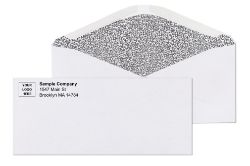
A security-tinted envelope has an interior pattern printed on the inside surface of the paper. When the envelope is held up to a light source, the tinted pattern makes the contents illegible. Someone looking through the envelope from the outside cannot read the document inside.
This is the standard choice for medical correspondence that contains any patient-identifiable information. Typical uses in a medical office include appointment reminders that reference the practice name or department, referral letters, notification letters about test results, and any communication where the content would be recognizable as medical correspondence.
#10 Security Tinted, Gum Flap
The gum flap version requires moistening the flap to seal it. This is the traditional business envelope closure and works well for lower-volume mailings where an automatic inserter is not involved. Standard #10 size: 4‑1/8 x 9‑1/2 inches. Holds a standard letter-size (8.5 x 11 inch) document tri-folded into thirds.
#10 Security Tinted, Peel and Seal
The peel-and-seal version has a strip that peels off to expose a pressure-sensitive adhesive. You peel, fold the flap, and press to seal. No moisture needed. This closure is significantly faster than gum flap for high-volume mailing and does not require a sponge or water source at the mailing station.
#10 Self Seal White Security Tinted (Flip and Stick)
This version uses a flip-and-stick closure: fold the flap over and press. It is similar to peel-and-seal in terms of speed and convenience. The 24 lb wove stock is the same as the standard #10 business envelope. Size: 4‑1/8 x 9‑1/2 inches. This style is well suited to offices that process a high volume of outgoing mail per day and want the fastest possible sealing process.
All three security tinted styles are available at the #10 envelopes page. All can be ordered plain or with custom printing.

Window Envelopes for Medical Billing Statements
A window envelope has a clear poly-film opening on the front face. When the billing statement is folded and inserted correctly, the patient's name and address printed on the statement show through the window. The envelope does not need to be separately addressed or labeled.
Window envelopes are the standard choice for any billing or statement workflow where the patient address is already printed on the document. They are faster to process, eliminate handwriting or label application, and remove one source of mailing error: when the address is part of the document itself, there is no risk of mislabeling.
#10 White Window Envelope (Gum Flap)
The standard single-window #10. The window is positioned on the lower left of the envelope front. When the statement is tri-folded with the address block near the top of the document and inserted address-first, the address shows through the window. Laser safe for compatibility with laser printers and statement printing systems.
#10 White Window Tinted, Peel and Seal
Combines the window for address display with security tinting for privacy and a peel-and-seal closure for fast sealing. This is the most versatile option for medical billing: the patient address shows through the window, the tinted interior keeps billing detail private in transit, and peel-and-seal handles high volume efficiently. Laser safe.
#10 White Window Tinted, Self Seal (Flip and Stick)
Same combination of window, security tinting, and quick closure in the flip-and-stick format. Machine insertable, which matters if your practice uses an automatic mail inserter for billing runs.
All window styles are available at #10 envelopes. For a broader view of window envelope options across multiple sizes, see the window envelopes page.
Double Window Envelopes for EOB and Insurance Statements
A double window envelope has two clear openings: one for the recipient address and one for the sender address. Both show through the envelope from the document inside, so the fully addressed envelope is produced in a single step when the statement is printed and inserted.
Double window envelopes are designed specifically for software-generated documents. Common uses in medical offices include:
- Explanation of benefits (EOB) statements generated by billing software
- Patient invoices and account statements printed from practice management systems
- Insurance remittance forms where both the insurer's address and the patient's address appear on the document
- Check mailings compatible with QuickBooks, Quicken, and Sage check printing
Double Window Security Tinted (Gum Flap, Peel and Seal, Flip and Stick)
BusinessEnvelopes.com offers double window #10 envelopes in three closure styles. The security tinted version adds an interior privacy pattern for statements that include sensitive account or patient information. All three closures are available: gum flap for standard volume, peel-and-seal and flip-and-stick for higher volume billing runs.
Double Window for Invoices and Statements
A non-tinted double window version for invoices and account statements is also available. This style is appropriate when the document content is financial but not patient-identifiable, such as a practice management invoice sent to a referring provider or a vendor payment.
All double window styles are at #10 envelopes.
| Envelope Type | Window(s) | Security Tinted | Best Use in Medical Office |
|---|---|---|---|
| Plain #10 | None | No | Internal admin mail, non-sensitive correspondence |
| Security tinted #10 | None | Yes | Patient letters, referrals, lab notifications |
| Window #10 | Single (left) | No | Non-sensitive billing and invoices |
| Window tinted #10 | Single (left) | Yes | Patient billing statements, insurance mail |
| Double window tinted #10 | Double | Yes | EOB, software-generated billing, QuickBooks checks |
| Double window #10 | Double | No | Vendor invoices, non-patient financial statements |
Highlighted row is the most common choice for medical office patient billing.
Peel and Seal vs. Gum Flap: Which Closure Works Best for a Medical Office?
The closure type matters when you are sealing a large volume of envelopes. Medical offices often process billing runs of hundreds or thousands of pieces. The wrong closure adds significant time and physical effort to the sealing process.
Gum Flap (Moistenable)
The traditional envelope closure. The flap has a water-activated adhesive strip. You moisten it with a damp sponge or wet your finger and press the flap closed. Gum flap closures work well for low to moderate volume mailings, up to 50 to 100 pieces at a time. For larger volumes, moistening every flap by hand becomes time-consuming.
Gum flap envelopes are compatible with automatic inserters that moisten and seal envelopes mechanically. If your office uses an inserter machine, confirm it can moisten and seal gum flap closures, or switch to a peel-and-seal style that the machine feeds without a moistening unit.
Peel and Seal
A strip on the inside of the flap peels away to reveal a pressure-sensitive adhesive. Fold the flap, press, done. No moisture, no sponge, no slowing down. Peel-and-seal is the faster choice for high-volume hand sealing. When a billing clerk is processing 200 statements per day, the saved seconds per envelope add up to meaningful time savings across the week.
Self Seal (Flip and Stick)
Fold the flap and press. The adhesive is already exposed and activates on contact pressure. This closure works the same way as peel-and-seal from the user's perspective: fast, moisture-free, requires only one motion. The difference from peel-and-seal is a manufacturing one: self-seal uses a different adhesive system. Both achieve the same practical result in a medical office mailing workflow.
| Closure Type | Speed | Moisture Required | Best Volume | Inserter Compatible |
|---|---|---|---|---|
| Gum flap | Slower | Yes | Low to medium (under 200/day) | Yes (with moistener) |
| Peel and seal | Fast | No | Medium to high (200+ per day) | Check inserter specs |
| Self seal (flip-and-stick) | Fast | No | Medium to high (200+ per day) | Check inserter specs |
All three closure types are available across the security tinted, window, and double window #10 styles at #10 envelopes.

9x12 Envelopes for Medical Documents That Cannot Be Folded
The 9x12 envelope holds a standard letter-size (8.5 x 11 inch) document completely flat, without any folding. This is the right choice when the document must arrive uncreased.
In a medical office, the types of mail that typically cannot or should not be folded include:
- Multi-page patient intake packets that include forms requiring signatures on every page
- New patient information packets sent before an appointment
- Medical records or chart summaries sent to other providers
- Referral documentation that includes printed imaging reports or detailed notes
- Insurance pre-authorization packets with multiple attached forms
- Letters of medical necessity submitted with supporting documentation
A 9x12 envelope mails at the USPS First-Class flat rate rather than the letter rate. Flats start at $1.69 for the first ounce compared to $0.82 for a letter. This is a consideration for high-volume use, but for documents where presentation and arrival condition matter, the extra postage cost is worth it.
See the full selection at 9x12 envelopes.
Custom Printed Envelopes for Your Medical Practice
Custom printed envelopes have the practice name, return address, and logo printed directly on the envelope stock. They remove the extra step of applying a pre-printed return address label to every outgoing piece and give your mail a consistent, professional appearance.
For a medical practice, the benefits of custom printing are both practical and patient-facing:
- Professional appearance: Patients recognize correspondence from the practice immediately. A printed envelope looks more deliberate than a label, which can peel or apply crookedly under time pressure.
- Consistent branding: Every outgoing piece, from a billing statement to an appointment reminder to a records packet, carries the same visual identity.
- No label step: Eliminating the label application from the mailing workflow saves time across every mailing run, not just large ones.
- Reduced confusion: A clearly identified return address on the envelope makes it immediately clear where the mail is from, which reduces unopened mail and improves response rates.
Custom printing is available on all #10 styles, including security tinted, window, and double window versions, as well as on 9x12 envelopes. Every custom order includes a PDF proof before production. See the full range at printed envelopes.
Postage Guide for Medical Office Envelopes
Understanding postage costs helps medical offices budget mailing expenses accurately and choose the most cost-effective option for each mailing type.
| Envelope Type | USPS Class | Stamp Rate (1 oz) | Metered Rate (1 oz) | Max Weight at This Rate |
|---|---|---|---|---|
| #10 (all styles) | First-Class letter | $0.82 | $0.78 | 3.5 oz |
| 9x12 (flat) | First-Class flat | $1.69 | Varies | 13 oz |
A standard billing statement in a #10 envelope typically weighs under 1 ounce: the envelope weighs approximately 0.4 to 0.5 ounces, and a single printed page of 20 lb paper weighs approximately 0.16 ounces. A two-page statement and envelope will total approximately 0.8 ounces, well within the one-ounce first stamp threshold.
For billing runs that include a return envelope inside (such as a remittance envelope for patient payment), add approximately 0.4 ounces per enclosed reply envelope. That may push the total above 1 ounce, requiring additional postage. Weigh a sample before committing to a postage run.
For a complete postage guide covering all envelope sizes and weights, see the how many stamps do I need guide.
Choosing the Right Envelope for Each Type of Medical Office Mail
Different types of outgoing mail in a medical office have different requirements. The table below matches the most common mail types to the recommended envelope for each.
| Mail Type | Recommended Envelope | Key Feature Needed | Where to Find It |
|---|---|---|---|
| Patient appointment reminder | #10 security tinted, gum flap | Interior privacy tinting | #10 envelopes |
| Lab result notification letter | #10 security tinted, peel-and-seal | Privacy tinting, fast seal | #10 envelopes |
| Referral letter to specialist | #10 security tinted, gum flap | Interior privacy tinting | #10 envelopes |
| Patient billing statement | #10 window tinted, peel-and-seal | Window for printed address, tinting for privacy | #10 envelopes |
| EOB or insurance statement | #10 double window tinted | Both sender and recipient address windows | #10 envelopes |
| Vendor or internal invoice | #10 double window (plain) | Double window, no tinting needed | #10 envelopes |
| New patient intake packet | 9x12 flat envelope | Holds letter-size forms flat, no folding | 9x12 envelopes |
| Medical records to another provider | 9x12 flat envelope | Holds multi-page documents flat | 9x12 envelopes |
| Insurance pre-authorization packet | 9x12 flat envelope | Holds attached forms flat | 9x12 envelopes |
Highlighted row is the most common mailing type in most medical office billing workflows.
How Many Envelopes Does a Medical Office Need to Stock?
The answer depends on your monthly mailing volume, but most medical offices benefit from keeping stock of at least three types on hand at all times:
- A security tinted #10 in your preferred closure (peel-and-seal for high volume, gum flap for lower volume) for patient correspondence.
- A window or double window #10 that matches your billing software's address layout, for statement runs.
- A 9x12 for sending multi-page documents flat.
If your practice uses custom printing, you can consolidate the first two: a custom-printed window tinted #10 serves both the correspondence and billing roles, since the printed return address is on the envelope and the patient address shows through the window.
Related Resources
For practices that also handle legal correspondence, patient release authorizations, or court-related filings, see the guide to envelopes for law firms, which covers the #14 legal envelope for legal-size documents and certified mail procedures.
To compare sizes across all standard business envelopes, see the envelope sizes chart guide. For the full catalog, visit all envelope sizes.
To order: browse the #10 envelope page for all security tinted, window, and double window styles. All orders ship with free ground shipping and no minimum quantity requirement. Custom printed orders include a PDF proof and ship 7 to 10 business days after proof approval.