shipping icon business envelopes Free shipping

FREE Ground Shipping site-wide. No minimums. Excludes PR, HI, AK, AS, VI, WA.


* More info

Envelope Blogs

    Large Envelope Sizes: 9x12, 10x13, and Every Format Explained

    HomeEnvelope GuidesLarge Envelope Sizes Guide

    When a document needs to arrive flat, folding it into a standard business envelope is not an option. Contracts with original signatures, certificates, reports, medical records, photographs, and legal submissions all need a large envelope that holds them without creasing. The question is which large envelope size fits the specific content, at what postage cost, and in what material.

    This guide covers every standard large envelope size available at Business Envelopes, what each size holds, how USPS classifies and prices large envelopes in 2026, and how to choose between white, kraft, and Tyvek stock for different mailing programs.


    What Is a Large Envelope? The USPS Definition

    USPS uses the term "flat" interchangeably with "large envelope." Any envelope that exceeds one or more of the standard letter-rate size limits qualifies as a large envelope and mails at flat-mail postage rates regardless of content weight or flexibility.

    Dimension Letter Rate Maximum Large Envelope (Flat) Range
    Height 6-1/8 inches maximum 6-1/8 to 12 inches
    Length 11-1/2 inches maximum 11-1/2 to 15 inches
    Thickness 1/4 inch maximum 1/4 to 3/4 inch
    Weight 3.5 oz maximum at letter rate Up to 13 oz at First-Class flat rate

    Every 9x12, 10x13, and 10x15 envelope exceeds the letter-rate height limit. They always mail as USPS flats. A 6x9 envelope sits at the boundary , at 9 inches long it falls below the letter-rate length limit of 11-1/2 inches, and at 6 inches tall it falls below the 6-1/8 height limit. The 6x9 qualifies for letter-rate postage on light contents, making it a lower-postage compact option for brochures and small documents.


    Large Envelope Sizes: The Complete Comparison

    Size Outer Dimensions Interior Clearance USPS Class Best For
    6 x 9 6 x 9 inches 5-3/4 x 8-3/4 inches Letter rate (light contents) Brochures, photos, small booklets, compact documents
    9 x 12 9 x 12 inches 8-3/4 x 11-3/4 inches Flat 8.5x11 sheets flat, contracts, certificates, reports
    10 x 13 10 x 13 inches 9-3/4 x 12-3/4 inches Flat Legal-size 8.5x14 flat, presentation folders, thick packets
    10 x 15 10 x 15 inches 9-3/4 x 14-3/4 inches Flat Oversized legal documents, architectural drawings, calendars

    The 9x12 handles the majority of flat-document programs because it holds an 8.5x11 sheet flat with clearance on all sides. The 10x13 earns its place when the content is thicker, legal-size, or includes a presentation folder that a 9x12 cannot accommodate. For a complete breakdown of when to use each size, see the 10x13 Envelope: Sizes, Uses, and When to Use It Over 9x12.


    9x12 Envelope Size: The Flat-Document Standard
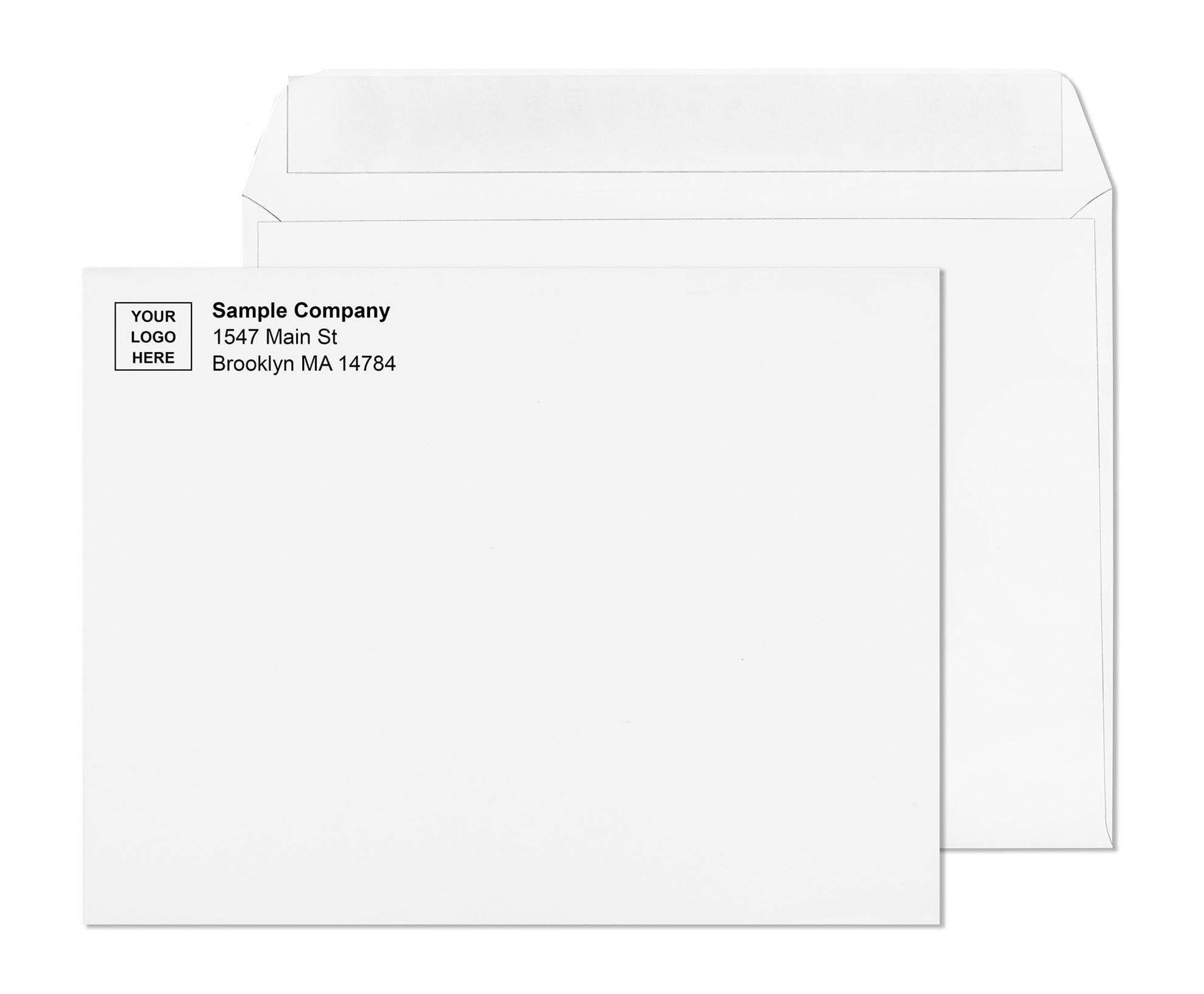
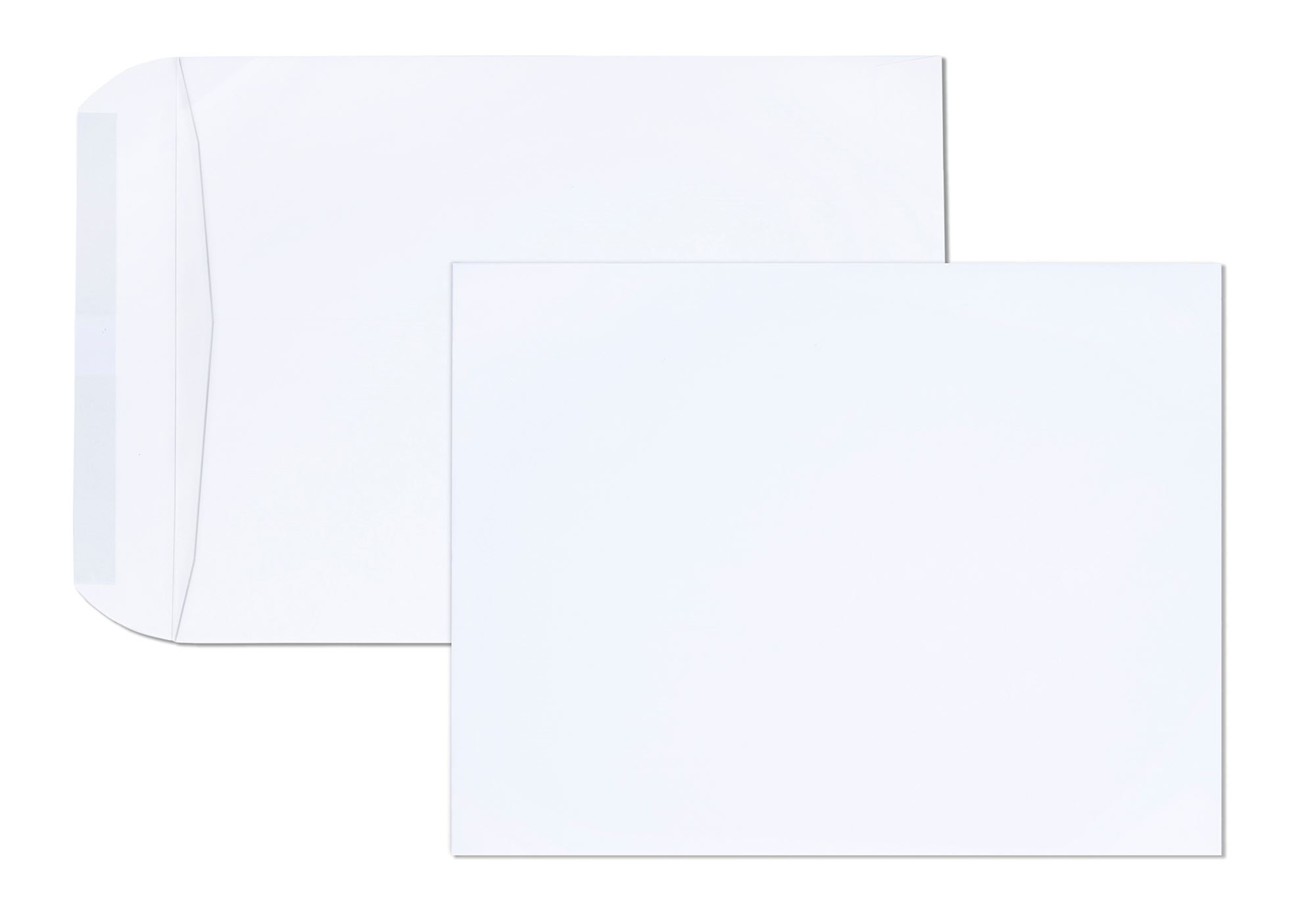
    10x13 white booklet envelopes showing the larger large envelope size for legal documents and thick document packet mailing

    The 9x12 envelope is the US standard for flat-document mailing. At 9 inches wide and 12 inches tall, it holds an 8.5x11 sheet completely unfolded with approximately 1/4 to 1/2 inch of clearance on all sides. Any document that needs to arrive without a crease belongs in a 9x12: contracts with original signatures, certificates, multi-page proposals, annual reports, photographs, and any 8.5x11 correspondence where fold lines would compromise the document's presentation or legal integrity.

    The 9x12 exceeds the USPS letter-rate height limit of 6-1/8 inches and always mails as a USPS flat. There is no version of the 9x12 that qualifies for letter-rate postage. This is the most important cost consideration for organizations switching from a folded #10 letter program to a flat 9x12 program: postage roughly doubles per piece.


    What a 9x12 envelope holds

    • One standard 8.5x11 sheet flat, with 1/4 to 1/2 inch clearance on all sides
    • Up to approximately 15 standard 20 lb copy paper sheets without folding
    • Letter-size photos, certificates, and diplomas
    • 5.5 x 8.5 inch booklets and brochures
    • Multi-page bound proposals and reports

    What a 9x12 does not hold without forcing: a standard 9x12 presentation folder, which measures exactly 9 x 12 inches and leaves zero clearance inside the envelope. For presentation folders, the 10x13 is the correct format.

    ★★★★★

    "I need to put several personal documents together to get my Real Id. Just 1 of these made the paperwork fit and close tightly."

    Lisa Zimmerman | Verified buyer, 9x12 Brown Catalog Envelopes With Metal Clasp Closure

    Source: businessenvelopes.com product reviews


    10x13 Envelope Size: Legal Documents and Thicker Packets

    The 10x13 envelope adds one inch of clearance on each side over the 9x12. At 10 inches wide by 13 inches tall, the interior measures approximately 9-3/4 x 12-3/4 inches. That extra clearance solves four specific problems the 9x12 cannot handle cleanly.


    When the 10x13 is the right large envelope size

    • Legal-size 8.5x14 documents: An 8.5x14 sheet cannot lie flat in a 9x12. The 10x13 holds it with about 1 inch of clearance on each side and approximately 1 inch at the top.
    • Presentation folders: A standard letter-size presentation folder measures 9 x 12 inches exactly, which means zero clearance in a 9x12. The 10x13 lets it slide in cleanly without damaging the corners.
    • Thick multi-tab document packets: When the 9x12 flap consistently struggles to close over a thick packet, the 10x13 provides enough depth and clearance to handle the stack without strain.
    • Multi-insert direct mail kits: Marketing packages with a letter, brochure, reply card, and return envelope fit together in a 10x13 with room to spare where a 9x12 would be overstuffed.

    The 10x13 and 9x12 mail at identical USPS flat rates. The size decision is based entirely on content capacity, not postage savings. See the full 10x13 range at 10x13 envelopes.


    Large Envelope Postage: 2026 USPS Flat Rates

    All large envelopes (9x12, 10x13, 10x15) mail at the same USPS First-Class flat-mail postage rates. The 9x12 and the 10x13 cost exactly the same to mail at the same total piece weight. The postage rate is determined by weight, not by which flat size you choose.

    Weight (First-Class Flat) 2026 Postage Rate Stamps Needed
    Up to 1 oz $1.63 2 Forever stamps ($1.64)
    Up to 2 oz $1.90 3 Forever stamps ($2.46) or metered
    Up to 3 oz $2.17 3 Forever stamps or metered
    Up to 4 oz $2.44 3 Forever stamps or metered
    Each additional oz $0.27 Additional postage up to 13 oz max

    Source: USPS Notice 123, effective July 12, 2026. The $1.63 First-Class flat rate for the first ounce is approximately double the $0.82 First-Class letter rate. For organizations mailing flat documents in high volume, this postage difference is the primary cost consideration when deciding whether a document can be folded into a #10 or needs to mail flat. For a detailed analysis of whether folding vs mailing flat is the right choice for a specific document type, see What Size Envelope Fits a Folded 8.5x11 Sheet of Paper?


    Large Envelope Materials: White, Kraft, and Tyvek
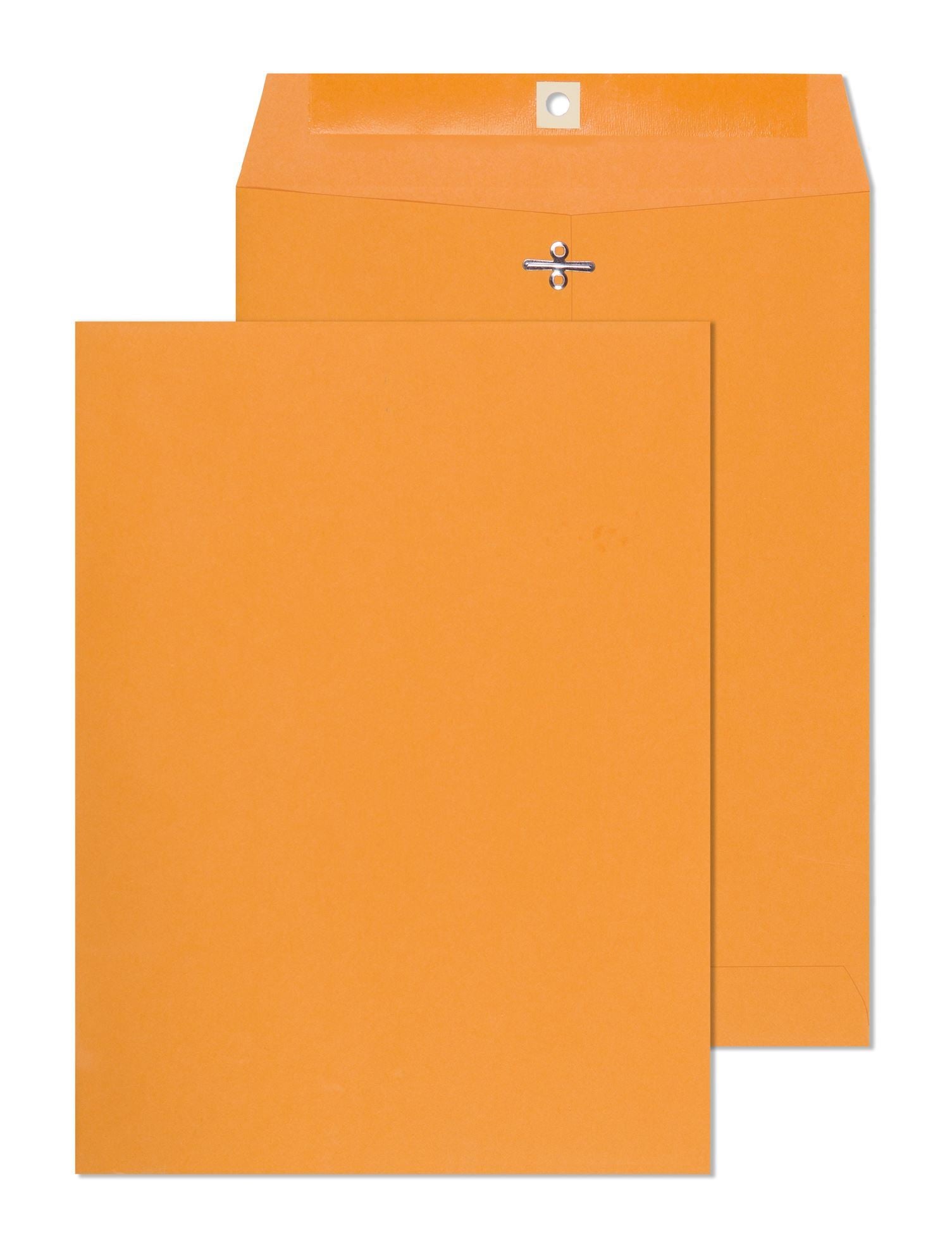
    9x12 brown kraft catalog envelopes with metal clasp closure showing the durable material option for large envelope document mailing


    Large envelopes come in three primary stock materials. The right choice depends on what the contents are, how critical arrival condition is, and what postage cost is acceptable at volume.


    White wove

    Standard 24 lb or 28 lb white wove is the most common material for large envelope programs. White stock is laser-safe for address and return address printing, presents professionally, and is available in booklet, open-end, window, and full-view window configurations. White wove is the right material for most standard flat-document programs where contents are not sensitive to moisture and the mailing environment is controlled.


    Brown kraft

    Brown kraft at 28 lb is heavier and more durable than standard white wove. The natural kraft color signals a heavy-duty mailer and is the standard for interoffice document routing, government submissions, and any program where the envelope will be handled multiple times. Kraft is available with metal clasp closures in addition to standard gum flap, making it reusable for interoffice circulation. See all kraft formats at clasp envelopes.


    Tyvek

    DuPont Tyvek at 14 lb provides the strongest protection of any large envelope material. Tear-resistant, puncture-resistant, and moisture-resistant, Tyvek protects contents that cannot be replaced or re-sent: legal filings, medical records, executed contracts, and financial documents. At roughly half the weight of kraft, Tyvek also reduces per-piece postage at volume because the lighter envelope stock contributes less to the total ounce weight. See all Tyvek large envelope sizes at Tyvek envelopes.

    ★★★★★

    "We have ordered this products many times before and will in the future. We use them so often for so many uses... the clasp works just fine!"

    Peggy Orbeg | Verified buyer, 9x12 Brown Catalog Envelopes With Metal Clasp Closure

    Source: businessenvelopes.com product reviews


    Booklet vs Catalog (Open-End): Which Large Envelope Opening Is Right
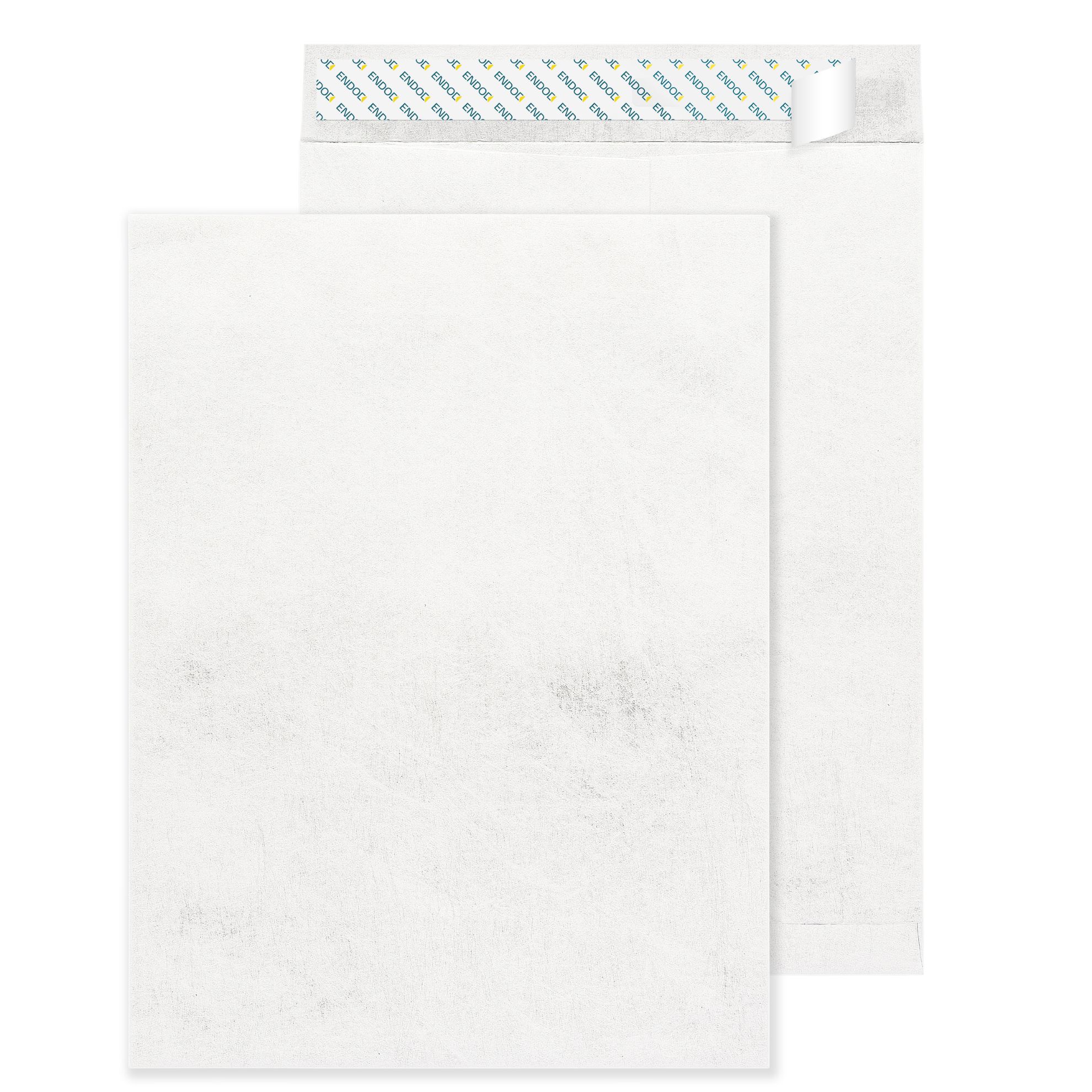
    9x12 Tyvek envelopes peel and seal tear-resistant waterproof showing the open-end large envelope format for critical document mailing

    Large envelopes come in two opening orientations that affect how documents are loaded and which equipment can process them. Both are available in the same sizes. The distinction matters before placing an order.

    Factor Booklet (Long-Edge Opening) Catalog / Open-End (Short-Edge Opening)
    Flap position Long edge (12 inches on a 9x12) Short edge (9 inches on a 9x12)
    Loading direction Side-load from the long opening Top-load from the short opening
    Inserter compatibility Compatible with most automated insertion equipment Better for manual top-loading workflows
    Common use Direct mail, marketing pieces, general flat mailing Document submission, interoffice routing, filing

    For a detailed explanation of the construction and workflow differences, see the Booklet Envelope: Sizes, Uses, and How It Differs from Catalog.

    ★★★★★

    "These envelopes were good quality and very good price/ quantity"

    Verified buyer | 9x12 Brown Catalog Envelopes With Metal Clasp Closure

    Source: businessenvelopes.com product reviews


    How to Choose the Right Large Envelope Size

    Three questions determine the correct large envelope size for any mailing program:

    1. What are the exact dimensions of the largest item going inside? Measure the content flat, including any folder or binder spine, and choose the size that provides at least 1/4 inch of clearance on all sides.
    2. How thick is the content stack? A 9x12 handles up to approximately 3/8 inch of content comfortably. If the stack approaches or exceeds that, upgrade to the 10x13, which provides more depth before the flap begins to strain.
    3. Does the content need to arrive completely unfolded? If yes, choose a 9x12 or 10x13. If the content can be tri-folded, a standard #10 letter envelope mails at letter rate and costs half the postage per piece.

    For all large envelope formats at Business Envelopes in one place, see all sizes envelopes.


    Why Business Envelopes for Large Envelope Orders

    Business Envelopes has supplied 9x12, 10x13, and 10x15 large envelopes to businesses, law firms, healthcare facilities, and government agencies across the United States since 1997. Every large envelope format in the catalog is available blank or with custom printing of your logo and return address, with no minimum order and free ground shipping on every order.

    • No minimums on any order
    • Free ground shipping to the contiguous 48 states on every order
    • Blank stock ships same or next business day
    • Custom-printed orders ship within 7 to 10 business days from proof approval
    • Logo upload at no additional charge with PDF proof before production
    • White, kraft, and Tyvek stock in all major flat-document sizes
    Business Reply Envelope Size: Specs, Setup, and How BRE Programs Work

    HomeEnvelope GuidesBusiness Reply Envelope Guide

    A business reply envelope is a pre-addressed return envelope enclosed in outgoing correspondence so the recipient can respond without providing their own envelope, address, or in the case of Business Reply Mail, their own postage. The phrase covers two distinct USPS programs: Business Reply Mail (BRM), where the sender pays postage only on pieces returned, and Courtesy Reply Mail (CRM), where the recipient affixes their own stamp. Both use the same envelope size. The difference is in the face layout, the postage arrangement, and whether a USPS permit is required.

    This guide covers the business reply envelope size standard, USPS BRE specifications, and the difference between BRM and CRM. It also explains how to set up each type of program, which #9 envelope format to order, and how custom printing fits into a return mail program. Business Envelopes has supplied #9 business reply envelopes to billing departments, nonprofits, law firms, and membership organizations across the United States since 1997.


    Business Reply Envelope Size: The #9 Standard

    The business reply envelope size used in virtually all US commercial return mail programs is the #9. The #9 envelope measures 3-7/8 inches tall by 8-7/8 inches wide, with an interior clearance of approximately 3-5/8 x 8-5/8 inches. This size is the industry standard for one specific reason: it fits inside a #10 outgoing envelope with approximately 1/4 inch of clearance on each side.

    That nesting fit is the entire operational basis of business reply mail. The #10 outgoing envelope carries the invoice, statement, or solicitation letter. The unsealed #9 is enclosed inside. The recipient removes the #9, inserts their payment, signature, or response form, and returns it. No separate envelope needed. No address lookup. No label. Just a pre-fitted return piece that eliminates every barrier between receiving the outgoing mail and completing the response.

    Specification Detail
    Standard size #9 envelope: 3-7/8 x 8-7/8 inches
    Interior clearance Approximately 3-5/8 x 8-5/8 inches
    Nests inside #10 envelope with 1/4 inch clearance on each side
    USPS classification First-Class letter rate
    2026 return postage (CRM) $0.82 per ounce (recipient affixes stamp)
    2026 return postage (BRM) $0.82 + per-piece permit fee (sender pays on pieces returned)
    USPS size limits (BRM) Minimum 3-1/2 x 5 inches, maximum 6-1/8 x 11-1/2 inches
    Paper stock 24 lb white wove; security-tinted interior available
    Common closures Gum flap (moistenable), peel-and-seal

    The #9 fits within USPS letter-rate dimensional limits on all sides and qualifies for automation pricing when the face is formatted to current USPS specifications. For the complete #9 range including all variants, see #9 envelopes.


    Business Reply Mail vs Courtesy Reply Mail: Which Program Is Right for Your Operation

    #9 security tinted peel and seal self-seal business reply envelopes for CRM and BRM return mail programs

    The term "business reply envelope" is used colloquially for both BRM and CRM programs. Operationally they are different. Understanding the distinction before printing envelopes is important because a BRM envelope cannot be used as a CRM envelope and vice versa , the face layouts, USPS compliance requirements, and postage arrangements are completely different.


    Courtesy Reply Mail (CRM)

    Courtesy Reply Mail is a pre-printed, pre-addressed #9 envelope enclosed in outgoing mail. The recipient affixes their own postage before mailing it back. The organization bears the printing cost but not the return postage. CRM is the standard format for billing reply envelopes, donation response pieces, membership renewal packets, and any program where the response rate is predictable and the per-piece stamp cost is manageable.

    CRM requires no USPS permit. The face carries the organization's return address printed in the standard upper-left position. The envelope can be plain white wove or security-tinted, with a gum flap or peel-and-seal closure. No special barcode or permit imprint is required. The face is functionally similar to any other return address envelope, but formatted and distributed specifically as an enclosed return piece.


    Business Reply Mail (BRM)

    Business Reply Mail is a USPS-permitted program where the organization pays postage only on reply envelopes actually returned. The organization obtains a USPS BRM permit, a unique ZIP+4 code assigned by USPS for each mail category, and must format the envelope face to USPS BRM specifications before distribution. USPS must approve a proof before printing.

    The BRM envelope face carries specific required elements: the permit number, the Facing Identification Mark (FIM C pattern), the organization's address, and the USPS-assigned ZIP+4. These elements must be positioned and sized to USPS standards. The USPS Automated Business Reply Mail (ABRM) tool at the Business Customer Gateway generates approved artwork that meets all specification requirements.

    Factor Courtesy Reply Mail (CRM) Business Reply Mail (BRM)
    Who pays return postage Recipient (affixes own stamp) Sender (pays per piece returned)
    USPS permit required No Yes , PS Form 3615 at receiving Post Office
    Annual permit fee None Yes , paid annually
    Advance deposit account Not required Required to cover per-piece charges
    Face layout Standard return address in upper left Specific BRM layout with FIM, permit number, ZIP+4
    USPS proof approval Not required Required before printing
    Window envelope permitted Yes No , windowless envelopes only for BRM labels
    Best for Billing, donations, membership , consistent return rates Programs with low expected return rates and high outgoing volumes


    How to Set Up a Business Reply Mail Program

    Setting up a Business Reply Mail program involves a sequence of USPS steps before any envelopes are printed. The setup happens at the Post Office where returned mail will be received, not the Post Office closest to the organization's physical location.

    1. File PS Form 3615 at the receiving Post Office. This is the permit application for Business Reply Mail. The annual permit fee is assessed at filing and renewed annually. The Post Office assigns a BRM permit number.
    2. Obtain a USPS ZIP+4 code. USPS assigns a unique ZIP+4 for each category of BRM (card-size vs letter-size). This ZIP+4 is specific to your BRM account and must appear on every piece.
    3. Open an advance deposit account. BRM return postage and per-piece fees are charged against a prepaid advance deposit account maintained at the Post Office. The account must have sufficient funds to cover returned pieces.
    4. Design the envelope face using the ABRM tool. The USPS Automated Business Reply Mail application at the Business Customer Gateway generates USPS-approved artwork for BRM pieces. The tool produces artwork files in PDF and EPS formats that meet all FIM, barcode, and layout specifications.
    5. Submit proof for USPS approval. Before printing any envelopes, USPS must approve the face artwork. For regular BRM, a proof must be approved before distribution. For Qualified Business Reply Mail (QBRM), an Intelligent Mail barcode (IMb) is required and must be included in the proof.
    6. Order and print envelopes. After USPS approves the artwork, envelopes are ordered and custom-printed with the approved face design. The #9 is the standard size for letter-size BRM pieces.


    Choosing the Right #9 Business Reply Envelope Format

    #9 white window envelope gum flap showing format options for business reply and courtesy reply mail programs

    The #9 envelope for business reply programs comes in several formats. Choosing correctly depends on whether the program is BRM or CRM, whether the return contents are sensitive, and how the recipient will seal the envelope.


    Plain white wove #9, gum flap

    The baseline format for CRM programs where the contents are non-sensitive correspondence. The gum flap requires the recipient to moisten the adhesive before sealing. For programs where recipients are motivated to respond and the contents do not carry private data, plain white wove gum flap is the most economical option. Available blank or with custom return address and logo printing.


    Security-tinted #9, gum flap

    The interior is printed with a reflex pattern that blocks document contents from showing through the paper when held to light. For programs where the return envelope will carry payment information, account numbers, personal data, or any confidential content, security tinting is the professional standard. This is the most widely ordered #9 format for billing, healthcare, and financial services return programs.

    ★★★★★

    "I use these #9 envelopes as return envelopes, which I insert into the #10s. Thanks to their security tint, I can rest assured that the information inside will not be publicly exposed."

    Chris Bellhorn | Verified buyer, #9 Security Tinted Window Envelopes Gum Flap Reply Return

    Source: businessenvelopes.com product reviews


    Security-tinted #9, peel-and-seal

    Same security-tinted interior with a pressure-sensitive peel-and-seal closure. No moisture needed , the recipient peels the liner and presses the flap. For return programs where the recipient seals the envelope, peel-and-seal is more reliable than gum flap because the adhesive bond is consistent regardless of how much effort the recipient puts into moistening. This is the recommended format when the enclosed return envelope will be sealed by someone outside the organization.


    Window #9 for CRM programs

    A window format is available on the #9 for CRM programs. The window displays a return address from the enclosed reply card or form, eliminating the need to print the return address separately on the envelope face. Note that window formats are NOT compatible with Business Reply Mail label applications. Window #9 envelopes are appropriate for CRM programs only.

    #9 security tinted window envelopes gum flap for courtesy reply mail programs where window displays return address


    Format Stock Closure BRM Compatible Best For
    Plain white wove, gum flap 24 lb white Moistenable gum Yes CRM , non-sensitive general correspondence
    Security tinted, gum flap 24 lb tinted Moistenable gum Yes CRM and BRM , billing, financial, healthcare
    Security tinted, peel-and-seal 24 lb tinted Peel-and-seal Yes CRM , recipient-sealed reply programs
    Window, gum flap 24 lb white Moistenable gum No (CRM only) CRM , reply card address shows through window


    Custom Printing on Business Reply Envelopes

    Custom printing on a business reply envelope depends on whether the program is CRM or BRM.

    For Courtesy Reply Mail, custom printing covers the organization's return address and logo in the upper-left of the face. This is the same custom print layout used on outgoing envelopes , logo, name, and street address printed in one or two colors on white or security-tinted stock. For billing programs, the CRM return envelope is typically printed in the same color and layout as the outgoing #10, creating a visually matched package.

    For Business Reply Mail, the face layout is governed by USPS specifications. Custom artwork must be created using the USPS ABRM tool and approved by USPS before printing. The BRM face includes the permit imprint, FIM C barcode pattern, and USPS-assigned ZIP+4 , there is limited space for additional branding. Organizations commonly include their name and logo in the address block area within the USPS-approved layout.

    Custom printing is available on all #9 formats at custom printed envelopes. For BRM pieces, the USPS-approved artwork file is submitted as the print file. For CRM pieces, standard logo and return address artwork applies. No minimum order is required. A PDF proof is provided before production. Custom-printed orders ship within 7 to 10 business days from proof approval.


    BRE Programs: Common Mistakes and How to Avoid Them

    Printing BRM envelopes without USPS proof approval

    USPS requires proof approval before any Business Reply Mail piece is printed or distributed. Envelopes printed without prior USPS approval may not qualify as BRM even if the face layout appears correct. The ABRM tool generates approved artwork that eliminates this risk. Never print BRM envelopes from a self-designed template without USPS review.


    Using a window envelope for Business Reply Mail

    USPS restricts window envelopes on BRM label applications. A window #9 is appropriate only for CRM programs. Using a window #9 for a BRM program may result in pieces not being processed correctly at postal sorting facilities.


    Selecting gum flap for high-volume recipient-sealed programs

    Gum flap closures require the recipient to moisten the adhesive. For programs where the reply envelope is sealed by the recipient rather than by the sender's mailing department, peel-and-seal is the more reliable choice. Inconsistently moistened gum flaps can produce pieces that arrive with partially open seals, which creates both a privacy concern and a professionalism issue.


    Ordering blank envelopes for CRM programs

    A CRM envelope without the organization's return address printed on it defeats the purpose of the format. The entire value of CRM is that the recipient receives a pre-addressed, ready-to-use return piece. Order CRM envelopes with the return address and logo custom-printed. The incremental cost of custom printing is offset by the consistency and professionalism of every piece that comes back.


    Why Business Envelopes for Business Reply Envelope Programs

    Business Envelopes has supplied #9 business reply envelopes to billing departments, nonprofits, law firms, membership organizations, and healthcare billing operations across the United States since 1997. Every #9 format in the catalog is built to USPS postal specifications, laser-safe, and available blank or custom-printed.

    • No minimums on any order
    • Free ground shipping to the contiguous 48 states on every order
    • Blank stock ships same or next business day
    • Custom-printed orders ship within 7 to 10 business days from proof approval
    • Logo upload at no additional charge with PDF proof before production
    • All #9 formats stocked: plain white, security tinted, window, peel-and-seal

    ★★★★★

    "super quality!"

    Jamie | Verified buyer, #9 White Business Envelopes Gummed Flap Wove Reply Return

    Source: businessenvelopes.com product reviews

    For the complete #9 envelope range, see #9 envelopes. For the full guide on #9 sizes, variants, and return mail program setup, see the #9 envelope guide. For all envelope sizes in the catalog, see all sizes envelopes.

    default image icon business envelopes

    Wedding Invitation Envelopes: The Complete Size, Postage, and Mailing Guide

    Wedding invitations are the most carefully designed piece of mail most people ever send. They go through months of design decisions, paper selections, and printing approvals. Then a significant number of them come back stamped "return to sender" because the postage was wrong, the address was off, or the envelope triggered a non-machinable surcharge that nobody knew about.

    This guide covers everything: the right envelope size for every invitation format, the exact postage rules USPS applies to wedding mail, the inner and outer envelope question, addressing etiquette for every household type, the correct mailing timeline, and the specific mistakes that cost couples hundreds of dollars in re-mailing costs every year.

    The standard wedding invitation envelope size

    The A7 envelope (5.25 x 7.25 inches) is the US standard for wedding invitations. It holds a 5 x 7 inch invitation card with exactly the right amount of clearance on all sides: 1/8 inch on the width and 1/4 inch on the height. That clearance matters. An envelope that fits too tight buckles the card corners on insertion. An envelope with too much room lets the card shift in transit, which can bend it or leave visible creases.

    A7 is the right choice because it hits the sweet spot between large enough to carry a formal invitation suite and small enough to mail at First-Class letter rate. At 5.25 x 7.25 inches, it stays under the USPS maximum letter dimensions of 6.125 x 11.5 inches and its aspect ratio (7.25 divided by 5.25 = 1.38) falls within the required 1.3 to 2.5 range that keeps it machinable. That means standard postage rather than a surcharge.

    Invitation card size

    Correct envelope

    Envelope dimensions

    Postage class

    5 x 7 inches

    A7

    5.25 x 7.25 in

    First-Class letter

    5.5 x 8.5 inches

    A9

    5.75 x 8.75 in

    First-Class letter

    4.25 x 5.5 inches (RSVP)

    A2

    4.375 x 5.75 in

    First-Class letter

    4 x 6 inches (details card)

    A6

    4.75 x 6.5 in

    First-Class letter

    For oversized suites, pocket folders, or invitations that require an A8 or larger envelope, contact your local USPS Business Mail Entry Unit before ordering stamps in bulk. Envelopes that exceed 6.125 inches in height move into flat-mail territory and cost significantly more per piece.

    How much postage do wedding invitations need in 2025

    This is the question most couples get wrong. They buy one Forever stamp per invitation, discover at the post office that the suite weighs more than one ounce, and either have to restamp everything or accept that some pieces will come back. The 2025 USPS postage rates for wedding invitations break down as follows.

    Suite weight and type

    Postage per envelope

    Under 1 oz, rectangular

    $0.78 (one Forever stamp)

    Under 1 oz, square or non-machinable

    $1.27

    1 to 2 oz, rectangular

    $1.07

    1 to 2 oz, non-machinable

    $1.56

    2 to 3 oz, rectangular

    $1.36

    3 to 3.5 oz, rectangular

    $1.65

    International, 1 oz

    $1.70 (Global Forever stamp)

    The single most important thing you can do before buying any postage: take a fully assembled, sealed sample suite to a post office counter and have it weighed. Not an unassembled stack of cards. A complete suite, in the outer envelope, sealed, with every insert, RSVP card, and return envelope included. That is the weight that determines your postage cost. Do this before you stamp 150 envelopes.

    What no envelope guide tells you about wedding invitation postage

    This section covers the details that competitors either miss entirely or bury where nobody finds them.

    Square invitations always cost more, regardless of weight. Many couples choose square invitations because they look distinctive. A square envelope has an aspect ratio of 1:1, which falls below the USPS minimum of 1.3. It is automatically classified as non-machinable and charged a 49-cent surcharge on every single piece, regardless of how light the suite is. A square invitation that weighs 0.5 ounces still costs $1.27 to mail. On a guest list of 150, that is $73.50 in surcharges on top of standard postage. If you want the visual impact of a square card, the most cost-effective solution is to enclose the square card inside a rectangular A7 or A9 envelope. The outer envelope mails at the standard rate. The square card is inside it.

    Wax seals can push you out of letter-rate processing. A wax seal applied to the envelope flap creates a raised bump. If that bump is large enough to make the envelope non-uniform in thickness, it triggers the non-machinable surcharge. More importantly, a wax seal on an envelope run through a high-speed postal sorting machine will be crushed and likely arrive cracked. If you use wax seals, request hand-cancellation at the post office. Present the envelopes at the counter and specifically ask for hand-cancellation so they do not go through the machine. Most post offices will accommodate this during non-peak hours.

    Belly bands, vellum wraps, and ribbon ties add thickness. The USPS maximum thickness for First-Class letter rate is 0.25 inches. A thick invitation card with a belly band and vellum overlay can approach or exceed this. Exceed it and the piece moves to flat-mail rate, which starts at $1.63 for one ounce. Assemble your complete suite with all embellishments and measure the thickness before committing to a printing run. A caliper or even a ruler can give you a rough check. If you are near 0.25 inches, the safe move is to take a sample to the post office.

    A paper envelope cannot hold a rigid or hard object at letter rate. Some couples include a small gift, a coin, a key charm, or a hard plastic card inside invitation envelopes. Objects like these make the envelope non-uniform and rigid, which can cause it to be classified as a package rather than a letter. The postage difference between a First-Class letter at $0.78 and a First-Class package can be significant. If your invitation suite includes any hard or non-flat insert, take a sample to the post office counter before assembling the full run.

    Different inserts going to out-of-town guests change the weight. Many couples include a directions card or accommodation information with invitations going to out-of-town guests but not with local ones. Those two versions of the suite will weigh differently. Assemble and weigh both versions separately and buy the correct postage for each batch. Mixing up the stamps between batches means some pieces will arrive postage-due.

    RSVP return envelopes need a stamp too. This one gets forgotten consistently. The RSVP card goes inside a smaller pre-addressed return envelope. That envelope needs postage on it before you seal it inside the outer envelope. One Forever stamp covers a light RSVP card and envelope at one ounce. The total postage cost per invitation suite includes the outgoing postage plus the return postage on the enclosed RSVP envelope.

    Inner and outer envelopes: what they are and when you need both

    Traditional formal wedding etiquette uses two envelopes: an outer envelope that carries the address through the postal system, and an inner envelope that lists exactly who in the household is invited. The outer envelope is addressed formally with full names and titles. The inner envelope is addressed more casually with first names or titles plus last names.

    The inner envelope serves a specific purpose: clarity about who is invited. If you are inviting Mr. and Mrs. James Holloway but their children are not invited, the outer envelope carries the formal address. The inner envelope says "James and Margaret" and by listing only them, communicates clearly that children are not included. If you are inviting the entire family, the inner envelope can say "The Holloway Family."

    Inner envelopes are not required. Many modern couples skip them entirely. If you use only one envelope, all invited guests need to be clearly named on the outer envelope. For households where not everyone is invited (adults only, no plus-ones, children excluded), the outer-only approach works fine as long as the names are explicit. Writing only the parents' names on the outer envelope communicates, through convention, that children are not invited. If a guest gets a plus-one, the envelope should say "James Holloway and Guest."

    From an envelope cost and postage standpoint, using two envelopes means the inner envelope adds weight to the suite. An inner envelope, even a lighter-weight one, adds approximately 0.1 to 0.2 ounces to the package. If your suite is already close to an ounce without the inner envelope, adding one may push you into the two-ounce rate. Weigh a fully assembled suite with both envelopes before buying stamps.

    How to address wedding invitation envelopes correctly

    The outer envelope carries the address through the postal system. Every detail matters: the format, the titles, the placement, and the legibility.

    Return address placement. Return address goes in the top-left corner on the front or centered on the back flap. Back flap is traditional for wedding mail and is the preference for formal invitations. Front top-left is also acceptable and works better for printed return addresses where you want the address visible to anyone processing the envelope.

    Recipient address placement. Center of the envelope, parallel to the long edge. For horizontal envelopes (landscape orientation), center both horizontally and vertically. For A7 envelopes mailed landscape, the address should sit roughly in the optical center of the face.

    Format for married couples sharing a surname:
    Mr. and Mrs. James Holloway
    1234 Oak Street
    Chicago, Illinois 60601

    Format for married couples with different surnames:
    Ms. Margaret Chen and Mr. James Holloway
    1234 Oak Street
    Chicago, Illinois 60601

    Format for unmarried couples at the same address:
    Ms. Margaret Chen
    Mr. James Holloway
    1234 Oak Street
    Chicago, Illinois 60601

    Format for a guest with a plus-one:
    Mr. James Holloway and Guest
    1234 Oak Street
    Chicago, Illinois 60601

    Formal outer envelope rules:
    Titles are abbreviated (Mr., Mrs., Ms., Dr.) but all other words are spelled out. "Street" not "St." "Boulevard" not "Blvd." "Avenue" not "Ave." State names may be spelled in full (Illinois) or abbreviated (IL) depending on formality level. No middle initials. Full first name always.

    One thing almost no guide addresses: USPS recommends using all capitals and no punctuation for machine-readable addresses. This is the standard for bulk commercial mail. For wedding invitations addressed by hand or through a calligrapher, standard title case with proper punctuation is appropriate and processes correctly through automated sorting for First-Class mail. You do not need to sacrifice elegance for machine readability on handwritten wedding invitations.

    The correct order of assembly inside the envelope

    Assembling the suite in the correct order affects both the guest experience and the physical integrity of the piece in transit.

    The invitation is placed at the bottom, face up, so it is the first thing visible when the envelope is opened. Tissue paper (traditional, now optional) is placed on top of the invitation. All enclosure cards, reply card, details card, accommodation card, are stacked on top of the invitation in size order, smallest on top, all face up. The reply card sits tucked under the flap of the pre-stamped return envelope, with the return envelope also face up so the addressed side is visible.

    If using a single outer envelope, insert everything as described above with the text of the invitation facing the back flap. When the recipient opens the envelope, they see the printed side of the invitation immediately.

    If using inner and outer envelopes, stack everything into the inner envelope in the order above. Slide the inner envelope into the outer envelope with the names on the inner envelope facing the back flap of the outer envelope. When the outer envelope is opened and the inner envelope removed, the guest names on the inner envelope face them directly.

    Wedding invitation mailing timeline

    The timing of your mailing is as important as the envelope. Too early and guests forget. Too late and people have already made other plans.

    Piece

    When to send (local wedding)

    When to send (destination wedding)

    Save the date

    6 to 8 months before

    8 to 12 months before

    Formal invitations

    6 to 8 weeks before

    10 to 12 weeks before

    RSVP deadline

    3 to 4 weeks before

    5 to 6 weeks before

    Final headcount to caterer

    7 to 10 days before

    7 to 10 days before

    For a local wedding where most guests are within driving distance, the 6-week mark for invitations is sufficient. For a wedding where guests need to book flights and hotels, 10 to 12 weeks gives people the lead time to make arrangements. For destination weddings requiring international travel or passports, 12 weeks is the minimum.

    RSVP deadline should be set 3 to 4 weeks before the wedding, not closer. This gives you 1 to 2 weeks to follow up with non-responders before you have to give the caterer a final headcount. If your RSVP deadline is one week before the wedding, you have no buffer for the people who will not respond until you contact them directly.

    One practical detail most guides skip: Drop your invitations at the post office counter rather than in a blue collection box, for two reasons. First, if any piece is flagged for additional postage, the counter agent can tell you before it goes out. Second, for pieces with wax seals or unusual closures, requesting hand-cancellation at the counter is only possible in person. Collection boxes run everything through automated processing.

    The right envelopes from Business Envelopes for wedding mailing

    Business Envelopes carries the commercial envelope formats that work for wedding invitation mailing. Here is what is available and when to use each one.

    Colored envelopes in wove and starburst formats bring visual impact to the outer envelope. A white envelope in a stack of mail disappears. A colored outer envelope gets noticed and handled first. Wove colored envelopes offer solid-color dyed stock in a professional finish. Starburst envelopes carry a bold multicolor pattern for maximum visual presence. Both support custom return address printing.

    Self seal envelopes eliminate the moisture activation step on outer envelopes, RSVP return envelopes, and any inner envelopes. For a 150-piece mailing where each piece has three envelopes (outer, RSVP return, and optional inner), sealing 450 envelopes by lick-and-press is a legitimate logistics problem. Self seal removes it. Peel the liner, press the flap, move to the next one.

    Regular envelopes in #9 format (3.875 x 8.875 inches) work as RSVP return envelopes inside a #10 outer mailer, or for any reply piece enclosed in a larger catalog envelope. In the A-series formats for invitations, the all sizes envelopes page covers the full range from #6 3/4 through 10 x 15.

    Printed envelopes with a return address printed on the outer envelope add a professional and personal touch. For couples who want the return address to match the invitation design, custom printing on the envelope stock is available across every size in the catalog. PDF proof before production, 7 to 10 business day turnaround from proof approval.

    9 x 12 catalog envelopes work for oversized or pocket-folder invitation suites that cannot fit in an A7 or A9 without forcing. A pocket folder invitation that measures 5.5 x 7.75 inches assembled will not enter an A7 envelope cleanly. The 9 x 12 holds it flat with no bending. The piece mails as a flat at $1.63 for one ounce, but arrives in perfect condition.

    What makes Business Envelopes different for wedding and event mailing

    Business Envelopes has supplied commercial envelopes to US businesses, event planners, nonprofits, and direct mail operations since 1997. Here is what separates this catalog for wedding and event mailing.

    Every format from one supplier. Outer envelopes, RSVP return envelopes, inner envelopes, colored envelopes, self seal options, and custom printed formats, all available without splitting your order across multiple vendors.

    No minimums. A 150-envelope wedding order ships the same way as a 10,000-envelope corporate run. Free ground shipping to the contiguous 48 states on every order regardless of size.

    Custom printing with 7 to 10 business day turnaround. Return address, monogram, and custom design elements printed directly on the envelope stock. PDF proof before any production begins. Artwork stays on file for reorders.

    Self seal in every major size. Peel-and-seal and flip-and-stick closures available across all commercial sizes. For high-quantity wedding mailings where sealing 300 or 400 envelopes is a physical task, self seal matters.

    Colored envelopes with custom printing. Wove solid-color and starburst pattern envelopes are available with return address printing. The combination of a colored or patterned outer envelope with a printed return address gives the piece a finished, intentional look from the outside before it is ever opened.

    The bottom line on wedding invitation envelopes

    The envelope is the guest's first physical contact with your wedding. Before they see the design, the paper, or the calligraphy, they hold the envelope. Getting the size, the postage, and the assembly right is not a detail. It determines whether the invitation arrives at all, whether it arrives in the condition you intended, and whether the first impression is what you planned.

    A7 envelope for 5 x 7 invitations. One fully assembled sample weighed at the post office before buying stamps. Hand-cancellation requested if wax seals are used. RSVP return envelope pre-stamped and enclosed. Mailed six to eight weeks out for local guests, ten to twelve weeks for destination.

    Frequently asked questions 

    What size envelope do I need for a 5 x 7 wedding invitation?
    An A7 envelope (5.25 x 7.25 inches). It provides 1/4 inch of clearance in height and 1/8 inch in width, which is the correct fit for a standard 5 x 7 card.

    How much postage does a wedding invitation need in 2025?
    A standard A7 outer envelope with a lightweight suite under one ounce costs 78 cents (one Forever stamp). Most full suites with RSVP card and return envelope weigh more than one ounce and cost $1.07 (two-ounce rate). Weigh a fully assembled, sealed sample at the post office before buying stamps.

    Do square wedding invitations cost more to mail?
    Yes, always. Square envelopes are classified as non-machinable by USPS and incur a 49-cent surcharge on every piece, regardless of weight. A 1-ounce square invitation costs $1.27 instead of $0.78. On 150 invitations, that is $73.50 in surcharges.

    Do I need inner and outer envelopes for wedding invitations?
    No. Inner envelopes are traditional but optional. Many modern couples use only an outer envelope. If you skip the inner envelope, all invited guests must be clearly named on the outer envelope, including children and plus-ones.

    Where does the return address go on a wedding invitation envelope?
    Back flap is traditional for wedding mail. Top-left front is also acceptable. Both placements are correct etiquette and both process correctly through USPS.

    Can I use wax seals on wedding invitation envelopes?
    Yes, but request hand-cancellation at the post office. Wax seals that go through automated sorting machines will be crushed and arrive damaged. Request hand-cancellation when you drop off the envelopes.

    When should I mail wedding invitations?
    Six to eight weeks before the wedding for a local event. Ten to twelve weeks before for a destination wedding. Set the RSVP deadline three to four weeks before the wedding to give yourself time to follow up with non-responders before submitting a final headcount to your caterer.

    How many extra envelopes should I order?
    Order 15 to 20 percent more than your guest list count. Addressing errors, envelope damage, last-minute additions to the guest list, and keepsake sets all create demand beyond the base count. Running out of outer envelopes after the addressing stage is an expensive reprinting problem.

    Can the RSVP return envelope be a different size from the outer invitation envelope?
    Yes. A #9 envelope (3.875 x 8.875 inches) fits inside a #10 outer envelope. A smaller A2 envelope works as a return piece inside an A7 outer envelope. The return envelope should be small enough to fit inside the outer invitation envelope without forcing or bending.

    Legal Size Window Envelope: What It Is, When to Use It, and How to Order


    HomeEnvelope GuidesLegal Size Window Envelope Guide

    The #14 window envelope provides that longer format at 5 x 11.5 inches, with the window positioned to display the recipient's address from the document inside. This eliminates the separate addressing step for legal correspondence programs just as effectively as a #10 window eliminates it for standard letter programs. Business Envelopes has carried legal size window envelopes since 1997, with free ground shipping and no minimum order requirement.


    What Is a Legal Size Window Envelope?

    A legal size window envelope is any commercial envelope sized to accommodate 8.5 x 14 legal-size paper, with a transparent poly-film panel on the face that displays the recipient's address from the document inside. In US commercial envelope numbering, the #14 is the standard legal size envelope at 5 x 11.5 inches.

    The window on a #14 legal size envelope follows the same commercial standard as #10 windows. The clear poly-film panel measures 1-1/8 x 4-1/2 inches and sits 7/8 inch from the left edge and 1/2 inch from the bottom of the face. This window position aligns with address blocks on standard US legal-size letterhead when the document is tri-folded and inserted correctly.

    For organizations that mail legal-size documents regularly, the #14 window format is a significant operational improvement over plain #14 envelopes. Instead of typing, handwriting, or printing a separate address label for every outgoing piece, the address on the document itself does the work. For a law firm mailing 50 to 500 pieces per batch, that elimination of the addressing step produces meaningful time savings across every run.

    ★★★★★

    "Perfect size for mailing brochures."

    Trish | Verified buyer, #14 White Window Envelopes Gum Flap

    Source: businessenvelopes.com product reviews


    Legal Size Window Envelope Dimensions: #14 Specifications

    Specification Detail
    Outer dimensions 5 inches tall x 11.5 inches wide
    Interior clearance 4-3/4 x 11-1/4 inches (4.75 x 11.25 inches)
    Window size 1-1/8 x 4-1/2 inches
    Window position 7/8 inch from left, 1/2 inch from bottom
    Paper stock 24 lb bright white wove
    Closure Moistenable gum flap
    USPS classification First-Class letter rate
    2026 postage (1 oz) $0.82 per ounce (First-Class letter rate)
    Documents held 8.5 x 14 legal sheet tri-folded, or 8.5 x 11 sheet with extra clearance
    Printer compatibility Laser and inkjet compatible for in-house addressing

    The #14 white window envelope is available at #14 White Window Envelopes Gum Flap, blank or custom-printed with logo and return address. See all #14 envelope formats including plain and window configurations at #14 envelopes.

    white #14 window envelopes with logo option business envelopes

    Legal Size Window Envelope vs #10 Window Envelope: Choosing the Right Format

    The decision between a #10 window and a #14 legal size window envelope comes down to one question: what is the paper size of the document going inside? If the answer is 8.5 x 11 letter-size, the #10 is the correct format. If the answer is 8.5 x 14 legal-size, the #14 is the correct format. Both mail at First-Class letter rate. Both eliminate the addressing step with the window. The difference is purely the document size they are designed to hold.

    Factor #10 Window Envelope #14 Legal Size Window Envelope
    Outer dimensions 4-1/8 x 9-1/2 inches 5 x 11-1/2 inches
    Document size 8.5 x 11 letter-size (tri-fold) 8.5 x 14 legal-size (tri-fold)
    USPS class First-Class letter First-Class letter
    2026 postage $0.82 per ounce $0.82 per ounce (identical)
    Window function Shows address from letter-size doc Shows address from legal-size doc
    Best for Invoices, statements, standard correspondence Legal filings, government mail, real estate, insurance
    Stock 24 lb white wove 24 lb white wove

    For a complete overview of all window envelope sizes from #9 through #14 and 9x12 full-view formats, see the Business Envelopes With Window: Complete Buyer's Guide and the full window envelopes catalog.


    How to Fold a Legal Document for a Legal Size Window Envelope

    The window on a #14 legal size window envelope is designed to align with address blocks on standard US legal-size letterhead when the document is tri-folded and inserted correctly. Here is the exact folding process:

    1. Start with the 8.5 x 14 document face-up with the printed side facing you and the top of the letter at the top of the sheet.
    2. Fold the bottom third up so the bottom edge meets approximately the 9.3-inch mark, bringing it one-third of the way up the sheet. The address block on your legal letterhead should be positioned in the top third of the sheet, which will become the outer face of the fold.
    3. Fold the top third down over the panel you just folded up. The address block is now on the outer face of the top panel.
    4. Insert into the #14 window envelope with the address-side panel going in first, facing the window side of the envelope. Slide the document until the address block aligns with and shows cleanly through the poly-film window.
    5. Check the window alignment before sealing. The full address, including city, state, and postal code, should be visible within the window with at least 1/8 inch of clearance on each side of the text.


    Legal Size Window Envelope: USPS Postage in 2026

    One of the practical advantages of the #14 legal size window envelope over large catalog formats is postage class. At 5 x 11.5 inches, the #14 fits within USPS letter-rate size limits on both dimensions. The maximum letter-rate envelope is 6-1/8 inches tall and 11.5 inches long. The #14 is exactly at the maximum length and well under the maximum height, which means it qualifies for First-Class letter rate rather than the higher flat rate that applies to 9x12 and larger catalog envelopes.

    Weight #14 First-Class Letter Rate (2026) Notes
    Up to 1 oz $0.82 One Forever stamp covers most single-document mailings
    Up to 2 oz $1.11 Thick multi-page legal correspondence, add $0.29
    Up to 3 oz $1.40 Maximum weight for letter-rate: 3.5 oz
    Over 3.5 oz Reclassified as flat USPS reclassifies as large envelope at $1.63+

    Source: USPS Notice 123, effective July 12, 2026. The $0.82 First-Class letter rate applies to pieces meeting all letter-rate physical requirements: maximum 6-1/8 x 11.5 inches, maximum 0.25 inches thick, maximum 3.5 oz, and sufficiently flexible and uniform. A standard #14 window envelope with a tri-folded legal document inside meets all of these requirements at typical content volumes.

    10x13 white open end catalog envelopes showing the large-format document mailing context for legal offices and government agencies


    Who Uses Legal Size Window Envelopes

    The legal size window envelope is the standard outgoing format for organizations whose primary correspondence runs on 8.5 x 14 legal-size paper. These tend to be organizations in fields where legal-size documents are a compliance requirement rather than a preference.


    Law firms and legal practices

    Legal offices mail on legal-size letterhead for client correspondence, court filings, engagement letters, and contract transmittals. The #14 window envelope handles legal-size tri-folded correspondence without the document-to-envelope mismatch that occurs when legal-size paper is forced into a #10. For high-volume legal correspondence programs, the window format eliminates the label application step on every outgoing piece.


    Government agencies and courts

    State and local government offices, court systems, and administrative bodies regularly mail on legal-size paper for official notices, summons documents, and regulatory correspondence. The #14 window envelope is the standard format for these programs, providing letter-rate postage eligibility alongside the window's addressing efficiency.


    Real estate and title companies

    Real estate attorneys and title companies mail closing documents, deeds, settlement statements, and recorded document copies on legal-size paper. The #14 window format accommodates these documents and provides a professional branded appearance when custom-printed with the firm's logo and return address.


    Insurance and financial institutions

    Insurance companies, banks, and financial services organizations use legal-size correspondence for policy documents, disclosure statements, and account correspondence that requires the longer paper format for regulatory compliance. The #14 window envelope provides the capacity alongside window-based addressing for volume mailing programs.


    When to Use a Different Envelope Format Instead

    When the #11 window is the right choice

    #11 window envelopes gummed flap showing the mid-size legal correspondence format sitting between the #10 and #14 window envelope

    The #11 window envelope at 4.5 x 10.375 inches sits between the #10 and the #14. It holds an 8.5 x 11 sheet with more clearance than a #10, or an 8.5 x 14 sheet folded more tightly than the #14 requires. For organizations with thick letter-size correspondence that strains a #10 but does not require legal-size capacity, the #11 window is a practical middle format.

    9x12 brown catalog clasp envelopes for flat document mailing when legal documents cannot be folded ,  mails at USPS flat rate $1.63


    When a 9x12 or 10x13 catalog envelope is the right choice

    If the legal-size document cannot be folded at all, the 9x12 or 10x13 catalog envelope is the correct format. A 9x12 holds an 8.5 x 11 sheet flat, and a 10x13 holds a legal-size 8.5 x 14 sheet flat. However, catalog envelopes mail at USPS flat rate ($1.63 per ounce), significantly more than the $0.82 letter rate the #14 provides. For programs where folding the document is acceptable, the #14 window at letter rate is the better postage choice.

    Custom printed business envelopes with company logo and return address ,  printing options available on legal size window envelope formats at Business Envelopes


    Custom Printing on Legal Size Window Envelopes

    Custom printing adds your organization's name, return address, and logo to the face of the #14 legal size window envelope during manufacturing. For law firms, government offices, and financial institutions with branded correspondence programs, custom-printed legal size window envelopes create a consistent professional appearance on every outgoing piece.

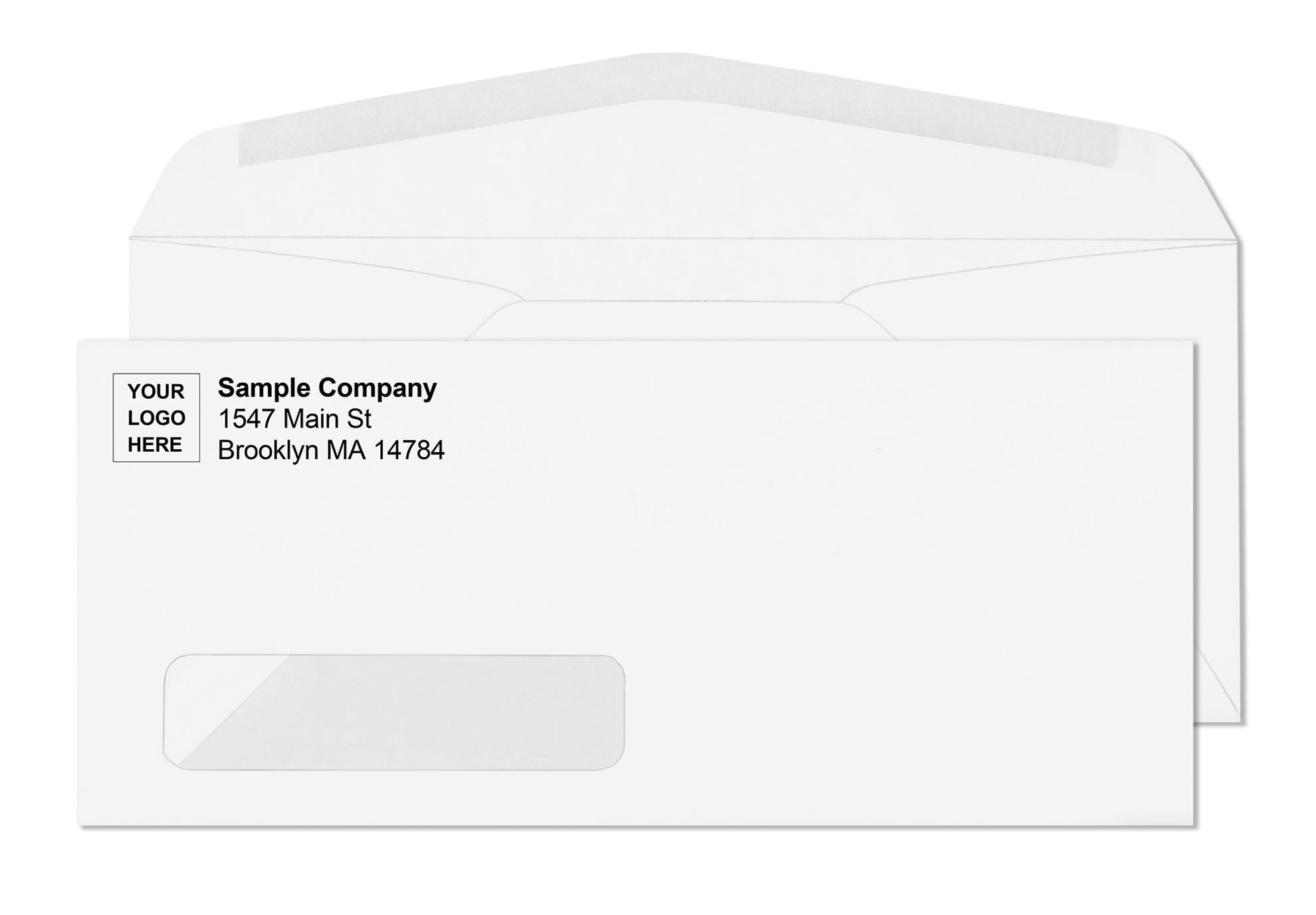
    The logo and return address are positioned above the window on the left side of the envelope face, the standard commercial position that keeps the custom printing clear of the window area. The delivery address shows through the window from the document inside. The result is a fully addressed envelope with no labels or manual addressing required.

    Custom printing is available on all #14 window envelope formats. Artwork is uploaded at no additional charge. A PDF proof is provided before production. Custom-printed orders ship within 7 to 10 business days from proof approval, and artwork stays on file for reorders at the same specification. No minimum order is required. See all custom options at custom printed envelopes.

    #10 security tinted custom printed business envelopes showing professional branded formats available at Business Envelopes since 1997


    Why Business Envelopes for Legal Size Window Envelopes

    Business Envelopes has supplied legal size window envelopes to law firms, government agencies, title companies, and financial institutions across the United States since 1997. The #14 window envelope in the catalog is built to the standard commercial window specification that aligns with US legal-size letterhead, available blank or custom-printed.

    • No minimums on any order
    • Free ground shipping to the contiguous 48 states on every order
    • Blank stock ships same or next business day
    • Custom-printed orders ship within 7 to 10 business days from proof approval
    • Logo upload at no additional charge
    • PDF proof before every custom production run
    • Artwork on file for reorders

    ★★★★★

    "This size is hard to find and I am pleased I found them, it is just so convenient! Check out their other products too!"

    Rik Stanford | Verified buyer, #12 White Window Envelopes Gum Flap

    Source: businessenvelopes.com product reviews

    Order the #14 window envelope directly at #14 White Window Envelopes Gum Flap. For all #14 formats including plain and window configurations, see #14 envelopes. For the full window envelope range across all sizes, see window envelopes. For all envelope sizes in the catalog, see all sizes envelopes.

    10x13 Envelope Postage: How Many Stamps and What It Costs in 2026

    HomeEnvelope Guides10x13 Envelope Postage

    This guide covers the complete 10x13 envelope postage picture: exact 2026 USPS rates, how many Forever stamps you need at each weight, and how Tyvek reduces per-piece cost on volume runs. It also covers the clasp envelope surcharge and when metered postage saves meaningful money. All rates reflect USPS Notice 123 effective July 12, 2026. Business Envelopes has carried 10x13 envelopes in every format since 1997.

    All Under One Roof


    Why 10x13 Envelope Postage Is Always Flat Rate

    USPS classifies mail by the physical characteristics of the sealed piece. Letter-rate mail has a maximum length of 11-1/2 inches. A 10x13 envelope is 13 inches long. It exceeds the letter-rate maximum by 1-1/2 inches and is therefore classified as a flat (large envelope) regardless of weight, contents, or flexibility.

    This is one of the most important things to understand about 10x13 envelope postage: there is no version of the 10x13 that qualifies for letter rate. A thin, lightweight, flexible 10x13 envelope still mails as a flat. A single-sheet document inside a 10x13 still mails as a flat. The size of the envelope, not the weight or flexibility of the contents, is what determines the postage class.

    The flat rate starts at $1.63 for the first ounce. Compare that to the letter rate of $0.82 for the first ounce. The 10x13 costs exactly twice the base letter rate per piece, which is the cost of the additional clearance and capacity the format provides.


    10x13 Envelope Postage Rates by Weight: 2026 USPS Rate Table


    Weight First-Class Flat Rate (2026) Forever Stamps Needed Overpayment with Stamps
    1 oz (up to 28g) $1.63 2 Forever stamps ($1.64) $0.01 overpay
    2 oz (up to 57g) $1.90 3 Forever stamps ($2.46) or exact metered $0.56 overpay with 3 stamps
    3 oz (up to 85g) $2.17 3 Forever stamps ($2.46) or exact metered $0.29 overpay with 3 stamps
    4 oz (up to 113g) $2.44 3 Forever stamps ($2.46) or exact metered $0.02 overpay with 3 stamps
    5 oz (up to 142g) $2.71 4 Forever stamps ($3.28) or exact metered $0.57 overpay with 4 stamps
    6 oz (up to 170g) $2.98 4 Forever stamps ($3.28) or exact metered $0.30 overpay with 4 stamps
    8 oz (up to 227g) $3.52 5 Forever stamps ($4.10) or exact metered $0.58 overpay with 5 stamps
    10 oz (up to 284g) $4.06 5 Forever stamps ($4.10) or exact metered $0.04 overpay with 5 stamps
    13 oz (maximum , 369g) $5.01 7 Forever stamps ($5.74) or exact metered $0.73 overpay with 7 stamps
    Over 13 oz Not eligible for First-Class flat rate USPS Ground Advantage or Priority Mail Reclassified as package

    Source: USPS Notice 123, effective July 12, 2026. Forever stamp face value: $0.82. Flat rate: $1.63 first ounce, $0.27 each additional ounce. Maximum First-Class flat rate weight: 13 ounces. Pieces over 13 ounces are reclassified as packages under USPS Ground Advantage or Priority Mail.

    The overpayment column shows why metered postage is worth considering for any volume over 50 pieces per month. At the 2 oz rate, three Forever stamps overpays by $0.56 per piece. On 500 pieces per month, that is $280 in wasted postage monthly, or $3,360 per year. For the complete postage reference guide, see postage stamps buying guide.


    How Many Stamps for a 10x13 Envelope: The Practical Answer

    Two Forever stamps is the answer for most 10x13 mailings at one ounce or less. That covers the $1.63 flat rate with one cent of overpayment. For the typical single-document mailing in a 10x13 white wove envelope, here is what one ounce actually contains:

    • The 10x13 envelope itself weighs approximately 0.4 to 0.6 ounces depending on stock weight
    • A single 8.5 x 11 sheet of 20 lb paper weighs approximately 0.17 ounces
    • Four to five sheets of 20 lb paper plus the envelope total approximately 1.1 to 1.4 ounces
    • A single-sheet document in a standard 10x13 white wove envelope typically comes in under one ounce

    The practical rule: weigh one fully assembled and sealed piece on a postal scale before committing a large run to postage. The envelope stock, closure type, and number of sheets all affect total piece weight. Two Forever stamps covers most single-document 10x13 mailings. Three Forever stamps covers most multi-sheet document packages in the 2 to 4 ounce range.


    How Tyvek Reduces 10x13 Envelope Postage on Volume Runs


    Standard 10x13 white wove envelopes are made from 24 lb paper stock. A single 10x13 white wove envelope weighs approximately 0.5 to 0.6 ounces. 10x13 Tyvek envelopes are made from DuPont high-density polyethylene fiber at 14 lb, roughly half the weight of standard paper stock. A single 10x13 Tyvek envelope weighs approximately 0.25 to 0.35 ounces.

    For programs mailing thick document packets where total piece weight is near an ounce threshold, that difference in envelope weight can shift the entire mailing down one weight bracket. A document packet that weighs 1.1 ounces in a standard 10x13 white wove envelope may weigh 0.85 ounces in a 10x13 Tyvek envelope, moving from the 2 oz flat rate of $1.90 to the 1 oz flat rate of $1.63. On 1,000 pieces, that is $270 in postage savings from switching envelope stock alone.

    Tyvek also adds tear resistance, puncture resistance, and moisture resistance that white wove stock cannot match. For legal documents, medical records, tax filings, and any mailing where arrival condition is a compliance requirement, the Tyvek advantage goes beyond postage savings. See the full Tyvek range at 10x13 Tyvek Envelopes Peel and Seal Tear Resistant Waterproof Open End and the complete Tyvek catalog at Tyvek envelopes.

    9 x 12 tyvek envelope font and back view business envelopes


    The 10x13 vs 9x12 Postage Question: Is There a Difference?

    No. A 9x12 envelope and a 10x13 envelope mail at exactly the same USPS flat rates. Both exceed letter-rate size limits. Both are classified as flats. Both pay $1.63 for the first ounce and $0.27 for each additional ounce as of July 2026. The postage class is identical.

    The choice between a 9x12 and a 10x13 is made entirely on the basis of what fits inside, not on postage cost. The 9x12 holds an 8.5 x 11 sheet flat with approximately 1/4-inch clearance on each side. The 10x13 holds an 8.5 x 11 sheet flat with approximately 1 inch of clearance on each side, holds an 8.5 x 14 legal-size sheet flat, and accommodates standard 9 x 12 presentation folders without forcing.

    Factor 9x12 Envelope 10x13 Envelope
    Dimensions 9 x 12 inches 10 x 13 inches
    USPS classification Flat (large envelope) Flat (large envelope)
    First-Class postage (1 oz) $1.63 $1.63 (identical)
    Additional ounce rate $0.27 $0.27 (identical)
    8.5 x 11 sheet flat Yes , 1/4 inch clearance Yes , 1 inch clearance
    8.5 x 14 legal sheet flat No , too long Yes , fits cleanly
    9 x 12 presentation folder No , zero clearance Yes , slides in cleanly
    Thick multi-tab packet Limited , tight fit Handles without strain

    For a complete comparison of when to choose 10x13 over 9x12 based on content capacity and use case, see the 10x13 envelope guide.

    10x13 brown kraft open end peal & seal envelopes


    The Clasp Envelope Postage Surcharge on 10x13 Formats


    10x13 brown kraft clasp envelopes carry a metal butterfly clasp on the exterior flap that allows the envelope to be opened and resealed multiple times. For interoffice routing and document filing, this makes the clasp format extremely practical. For outbound postal mail, the exposed metal clasp creates a problem.

    USPS automated sorting equipment cannot safely process envelopes with exposed metal protrusions. A 10x13 clasp envelope with the metal clasp on the exterior face qualifies as non-machinable and is assessed a surcharge on top of the base flat rate. For programs that mail 10x13 clasp envelopes into the postal system, plan for this additional cost or switch to a gummed flap or peel-and-seal 10x13 for outbound mail.

    Clasp envelope postage note: Reserve 10x13 clasp envelopes for internal routing, document filing, and interoffice programs. For outbound postal mail, use a 10x13 gummed flap, peel-and-seal, or Tyvek format to avoid the non-machinable surcharge. The white wove and Tyvek 10x13 formats have no exposed hardware and mail at the standard flat rate without surcharge.


    10x13 Envelope Postage: Volume Savings with Metered Mail

    Forever stamps at the retail counter rate are the most expensive way to pay 10x13 envelope postage at any volume above occasional single pieces. Metered postage through USPS-approved platforms applies at a lower per-ounce rate than retail stamps, and exact metered postage eliminates the overpayment that comes from rounding up to the nearest whole-stamp increment.

    Monthly Volume Retail Stamps (2 stamps = $1.64/piece) Exact $1.63 Metered Monthly Savings Annual Savings
    50 pieces $82.00 $81.50 $0.50 $6.00
    200 pieces $328.00 $326.00 $2.00 $24.00
    500 pieces $820.00 $815.00 $5.00 $60.00
    1,000 pieces $1,640.00 $1,630.00 $10.00 $120.00

    At 1 oz per piece, the overpayment is only $0.01 per piece. The real savings from metered postage come at higher weights where the gap between the nearest whole-stamp increment and the exact rate is larger. A 2 oz piece at $1.90 requires three Forever stamps ($2.46), overpaying by $0.56. At 1,000 pieces per month at 2 oz, metered postage saves $6,720 annually compared to rounding up to three stamps.


    Practical Tips for Managing 10x13 Envelope Postage

    Weigh before you buy postage for a large run

    Assemble one complete piece exactly as it will go out: envelope, all document content, fully sealed. Weigh it on a postal scale. Bring a sealed sample to a Post Office counter if you do not have a scale. Getting the weight bracket right before the full run prevents both underpayment (returned mail) and significant overpayment.


    Use Tyvek when document weight is near an ounce boundary

    If your assembled piece weighs 1.1 to 1.3 ounces in a standard wove envelope, switching to a Tyvek 10x13 may bring the total piece under 1 oz, saving $0.27 per piece at the 1 oz rate. On 500 pieces per month, that is $135 in monthly postage savings from switching envelope stock. See the full range at Tyvek envelopes.


    Use peel-and-seal or gummed flap for outbound mail programs

    For any 10x13 program entering the postal mail stream, use a gummed flap, peel-and-seal, or Tyvek format. Reserve clasp envelopes for internal routing only. This avoids the non-machinable surcharge that exposed metal clasps trigger on outbound pieces.


    Consider USPS Marketing Mail rates for high-volume programs

    For programs mailing more than 200 pieces per run to US addresses on a standard presorted mailing list, USPS Marketing Mail rates for flats are significantly lower than First-Class flat rates. Marketing Mail requires a USPS permit, minimum volume per mailing, and presort processing, but for qualifying programs the per-piece cost is meaningfully lower than First-Class. Contact your local Post Office for current Marketing Mail flat rates.


    Why Business Envelopes for 10x13 Mailing Programs

    Business Envelopes has supplied 10x13 envelopes to legal offices, healthcare facilities, accounting departments, government agencies, and businesses across the United States since 1997. Every 10x13 format in the catalog is built to USPS postal specifications, compatible with standard document formats, and available blank or custom-printed with logo and return address.

    • No minimums on any order
    • Free ground shipping to the contiguous 48 states on every order
    • Blank stock ships same or next business day
    • Custom-printed orders ship within 7 to 10 business days from proof approval
    • Tyvek, white wove, brown kraft, booklet, and open-end formats all stocked
    • Gummed flap, peel-and-seal, and clasp closures available across all formats

    See the complete 10x13 range at 10x13 envelopes. For all sizes in the catalog, see all sizes envelopes. For the complete 10x13 format guide including capacity, variants, and 9x12 comparison, see the 10x13 envelope guide. For postage guidance on smaller flat formats, see the 6x9 envelope postage guide.

    Greeting Card Envelope Sizes: The Complete US Guide

    The envelope is the first thing someone holds. Before they read the card, before they see the design, they are holding the envelope. Getting the size wrong means a bent card, a torn corner, or a piece that comes back stamped "return to sender" because it triggered a USPS non-machinable surcharge nobody knew about. This guide covers every standard greeting card envelope size, which card fits in which envelope, how postage works for each format, and the specific mistakes that cost mailers money every year.

    The one rule that applies to every greeting card envelope

    Choose an envelope that is 1/8 to 1/4 inch larger than your card in both height and width. This clearance lets the card slide in and out cleanly without bending the edges, and keeps the envelope from looking sloppy because there is too much empty space inside. A 5 x 7 inch card needs an envelope that is at minimum 5.125 x 7.125 inches. The A7 envelope at 5.25 x 7.25 inches is exactly right.

    That 1/8 inch minimum is not a suggestion. It is the practical minimum for flat insertion. Cards that are forced into a tight envelope buckle at the corners. When the envelope goes through USPS processing, a buckled card inside creates a lumpy mailpiece that machine sensors flag as non-uniform. That can push a standard letter into non-machinable territory, adding a 49-cent surcharge per piece. On 200 wedding invitations, that is $98 in unexpected postage.

    Every standard greeting card envelope size explained

    A2 envelopes (4 3/8 x 5 3/4 inches)

    The smallest standard card envelope in regular use. Fits cards up to 4.25 x 5.5 inches. Used for RSVP cards, small thank-you notes, gift enclosures, birthday cards on the smaller side, and personal correspondence. At 4.375 x 5.75 inches, the A2 falls well within USPS letter-size dimensions. One First-Class Forever stamp covers a standard single-card A2 mailing at one ounce. If you enclose a folded insert with the card, weigh the sealed envelope before assuming one stamp is sufficient.

    A6 envelopes (4 3/4 x 6 1/2 inches)

    The go-to size for 4 x 6 photo cards, modern invitations, and holiday cards. Fits cards up to 4.5 x 6.25 inches. This is also the correct size for standard 4 x 6 prints when you want to send a photo by mail without folding it. The A6 envelope at 4.75 x 6.5 inches mails at First-Class letter rate and sits comfortably within USPS dimensional limits. One Forever stamp covers it at one ounce. Most single holiday photo cards in an A6 envelope with no inserts weigh under one ounce.

    A7 envelopes (5 1/4 x 7 1/4 inches)

    The most widely used invitation envelope in the US. Fits cards up to 5 x 7 inches. Wedding invitations, birthday invitations, graduation announcements, formal event invitations, and 5 x 7 holiday cards all use A7. The A7 at 5.25 x 7.25 inches is the sweet spot between large enough to make an impression and small enough to mail at First-Class letter rate. One Forever stamp covers a basic suite at one ounce. A full wedding invitation suite with an inner card, RSVP card, and return envelope routinely weighs two ounces or more. Weigh a complete assembled, sealed sample before ordering your stamps.

    A9 envelopes (5 3/4 x 8 3/4 inches)

    The larger formal envelope. Fits cards up to 5.5 x 8.5 inches. Used for oversized announcements, formal programs, large event invitations, and anything that needs a presence that a standard A7 cannot provide. The A9 at 5.75 x 8.75 inches still mails at First-Class letter rate. One stamp covers it at one ounce. Anything over one ounce adds the standard 29-cent additional ounce rate.

    Complete card-to-envelope size matching chart

    Card size

    Correct envelope

    Envelope dimensions

    Postage rate

    4.25 x 5.5 in

    A2

    4.375 x 5.75 in

    First-Class letter

    4 x 6 in (photo)

    A6

    4.75 x 6.5 in

    First-Class letter

    4.5 x 6.25 in

    A6

    4.75 x 6.5 in

    First-Class letter

    5 x 7 in

    A7

    5.25 x 7.25 in

    First-Class letter

    5.5 x 8.5 in

    A9

    5.75 x 8.75 in

    First-Class letter


    What to use for colored greeting card envelopes

    Color is a functional choice for greeting cards and invitations, not just an aesthetic one. A white envelope in a pile of white envelopes disappears. A colored envelope gets picked up first. For birthday cards, holiday mailings, event invitations, and any correspondence where the recipient's first impression matters before they even open the piece, colored envelopes do work that plain white cannot.

    Business Envelopes carries colored envelopes in two formats: wove and starburst.

    Wove colored envelopes are solid-color dyed stock. The color runs through the material. Professional, clean, available in multiple tones. Best for organizational correspondence where the color reinforces brand identity without being visually aggressive. Custom logo and return address printing is available on wove stock.

    Starburst envelopes carry a bold multicolor pattern across the face. Designed for mailings where standing out in a pile of white is the entire objective. Used by nonprofits for fundraiser appeals, by event organizers for high-impact invitation mailings, and by direct mail programs where envelope open rate is a tracked metric. All starburst envelopes use peel-and-seal closure for fast moisture-free sealing on volume runs.

    Both formats are available in #10, #9, and #6 3/4 sizes at Business Envelopes, plus 6 x 9 and 9 x 12 for larger flat mailings.

    Self seal greeting card envelopes and when to use them

    For anyone mailing more than a handful of cards at a time, self seal envelopes are the practical choice. No moisture, no sponge, no licking. The adhesive strip is protected by a release liner until you peel and press. The envelope seals on contact and holds through postal handling.

    For holiday card runs, event invitation mailings, birthday card batches, and any mailing where you are sealing more than twenty envelopes at once, the time saving adds up fast. Self seal is also more consistent than gum flap. A gum flap that is not properly activated comes unsealed in transit. A self seal envelope that is pressed firmly is sealed for transit.

    At Business Envelopes, self seal options are available across #10, #9, #6 3/4, 6 x 9, 9 x 12, 10 x 13, and 10 x 15 formats. Custom logo and return address printing is available on all self seal styles.

    What no one tells you about greeting card postage

    This is the section most guides skip entirely. USPS has specific rules that affect card mailing costs, and getting them wrong is expensive.

    Square envelopes cost more to mail. USPS requires that the aspect ratio of a letter (length divided by height) fall between 1.3 and 2.5. A square envelope has an aspect ratio of 1:1, which falls below 1.3. It is automatically classified as non-machinable and charged a 49-cent surcharge on top of the standard First-Class rate. A square card envelope that would otherwise cost 78 cents to mail costs $1.27. On 100 pieces, that is an extra $49. Most people discover this at the post office counter after they have already ordered and addressed all 100 envelopes.

    Thick invitation suites weigh more than one stamp covers. A standard wedding suite with an outer envelope, inner envelope, invitation card, RSVP card, and pre-addressed return envelope routinely hits two ounces or more. A 4 x 6 holiday photo card in an A6 envelope is usually under one ounce. A 5 x 7 card with a vellum overlay, a belly band, and an RSVP insert is almost certainly over one ounce. Weigh a fully assembled and sealed sample before purchasing stamps for a full run. One additional ounce stamp (29 cents at current rates) is a small cost. Returning and re-mailing 200 invitations is not.

    Rigid card materials can trigger non-machinable classification. Thick cardstock above a certain rigidity cannot pass through postal sorting equipment without jamming. If your card is stiff enough that it does not flex at all when lightly held from opposite corners, it may be classified as non-machinable regardless of the envelope size. This most commonly affects cards printed on heavy board stock with laminate or thick coating. The solution is to take a sample to a post office counter and ask a postal employee to assess machinability before committing to a large mailing.

    Wax seals add thickness and can change your postage rate. A wax seal applied to the envelope flap creates a bump that, depending on size, may push the piece into non-machinable territory. If using wax seals on invitations, apply them and weigh a sealed sample before determining your postage. The piece may still mail at letter rate, or it may need to be hand-cancelled at the post office. Ask for hand-cancellation explicitly so your wax-sealed envelopes do not go through the machine and arrive cracked.

    Vertical orientation triggers a surcharge. An envelope where the height is greater than the width (taller than it is wide) is classified as non-machinable. This catches some card senders off guard when they choose portrait-orientation envelopes that are taller than they are long. Standard A-series envelopes (A2, A6, A7, A9) are all landscape orientation and avoid this issue. Custom or non-standard envelope shapes in portrait orientation will trigger the surcharge.

    Greeting card envelopes for business and organizational mailings

    For nonprofits, event organizers, and businesses sending greeting cards at volume, the choice of envelope has a measurable impact on results before the card is ever opened.

    Colored envelopes in wove or starburst format increase the visual presence of the mailing in a stack of plain white mail. This matters for holiday card campaigns, fundraiser cards, member appreciation mailings, and event invitations where being noticed in a household mail pile is part of the objective.

    Self seal envelopes reduce labor time on anything over 20 pieces. For a holiday card run of 500, the difference between lick-and-seal and peel-and-seal is roughly 30 minutes of real time and the avoidance of a genuine unpleasantness.

    Printed envelopes with a custom return address and logo add a professional presence to organizational card mailings. For nonprofits, this reinforces donor recognition of the organization's name before the piece is opened. For businesses, it keeps the mailing consistent with your brand. Custom printing ships in 7 to 10 business days from proof approval.

    For cards that need to arrive in perfect condition, such as handmade cards, layered die-cut pieces, or anything with embossed elements on the card face, a 9 x 12 catalog envelope lets the card travel flat without being inserted into a snug A-series envelope. The card mails as a flat rather than a letter, at a different postage rate, but arrives without edge damage or surface marking from envelope insertion.

    What makes Business Envelopes different for greeting card and invitation mailing

    Business Envelopes has supplied commercial envelopes to US businesses, nonprofits, event organizers, and direct mail operations since 1997. Here is what separates this catalog from a general office supply retailer when it comes to card and invitation mailing.

    Every commercial size in one place. #6 3/4, #9, #10, 6 x 9, 9 x 12, 10 x 13, and 10 x 15. White, colored wove, starburst, self seal, gum flap, peel and seal. If your mailing program uses multiple envelope types across multiple pieces, all of them ship from one supplier with one order.

    Self seal in every major format. Every commercial size at Business Envelopes is available with a peel-and-seal or flip-and-stick closure. No moisture required, no pre-sealing from humidity in storage, consistent sealing on every piece in the run.

    Colored envelopes with custom printing. Wove solid-color envelopes and starburst pattern envelopes are available with logo and return address printing. PDF proof before production. Artwork stays on file for reorders.

    Free ground shipping with no minimums. A single box of envelopes ships free to the contiguous 48 states. A pallet of mixed sizes ships free. There is no threshold to meet and no code to apply.

    No minimum order quantity. Order exactly what your mailing needs. One box, five boxes, or a full case. Bulk pricing applies automatically as quantities increase, reducing the per-unit cost without requiring a minimum commitment.

    The bottom line on greeting card envelopes

    Card size first, envelope second. Measure your card, add 1/8 to 1/4 inch in each dimension, match to the nearest standard A-series size. Weigh a fully assembled sealed sample before purchasing stamps for any mailing over 10 pieces. Never assume a square envelope mails at the same rate as a rectangular one. Never assume a multi-insert suite weighs one ounce because the card alone does.

    The envelope is not packaging. It is the first impression. A well-fitted envelope in the right color, sealed cleanly and addressed correctly, tells the recipient something about the care behind the card before they ever open it.

    Frequently asked questions 

    What size envelope fits a 5 x 7 greeting card?

    An A7 envelope (5.25 x 7.25 inches) is the correct match. It provides 1/4 inch of clearance in each dimension, which is enough for clean insertion without excess space that makes the card shift in transit.

    What size envelope fits a 4 x 6 card or photo?

    An A6 envelope (4.75 x 6.5 inches). It holds a 4 x 6 print or card flat without folding and mails at First-Class letter rate with one Forever stamp at one ounce.

    What size envelope fits a standard greeting card?

    Most greeting cards sold at retail are either A2 size (fits a 4.375 x 5.75 inch envelope) or A7 size (fits a 5.25 x 7.25 inch envelope). Check your card's dimensions: match the longer side to the envelope's length and the shorter side to the envelope's width, with 1/8 to 1/4 inch clearance on each.

    Do square envelopes cost more to mail?

    Yes. Square envelopes have an aspect ratio of 1:1, which falls below the USPS minimum of 1.3. They are classified as non-machinable and charged a 49-cent surcharge on top of standard First-Class postage. A square envelope costs $1.27 to mail instead of 78 cents.

    How much does it cost to mail a greeting card in 2025?

    A standard rectangular card in an A2, A6, A7, or A9 envelope weighing one ounce costs 78 cents (one First-Class Forever stamp) as of July 2025. Cards over one ounce add 29 cents per additional ounce. Square or non-machinable formats cost $1.27.

    Can I mail a greeting card without an envelope?

    A postcard (a single piece of cardstock meeting USPS postcard dimensions: 3.5 to 4.25 inches tall and 5 to 6 inches long, no thicker than 0.016 inches) can be mailed without an envelope at the postcard rate of 61 cents. A standard greeting card is too large for postcard rate and needs an envelope.

    What envelope should I use for wedding invitations?

    A7 envelopes (5.25 x 7.25 inches) for standard 5 x 7 invitations. A9 envelopes (5.75 x 8.75 inches) for larger formal suites. If your suite includes multiple inserts, weigh a fully assembled sealed sample before purchasing stamps.

    Do wax seals on envelopes affect postage?

    Potentially yes. A wax seal adds a raised bump to the envelope flap. If that bump creates non-uniform thickness, the piece may be classified as non-machinable and charged the 49-cent surcharge. Assemble a complete sample with the wax seal applied, weigh it, and take it to a post office counter to check machinability before committing to a full run. Request hand-cancellation if you want to preserve the wax seal on delivery.

    What is the difference between self seal and gum flap envelopes?

    Gum flap envelopes require moisture to activate the adhesive on the flap. Self seal envelopes use a pressure-sensitive adhesive strip protected by a release liner. Peel the liner, press the flap, and the envelope is sealed. No moisture, no sponge, consistent seal on every piece. For card mailings over 20 pieces, self seal is the practical choice.

    How to Mail a Letter: The Complete Step-by-Step Guide

    Mailing a letter sounds simple until something goes wrong. A returned invoice because the address was off-center. A contract that came back stamped "insufficient postage." A greeting card that triggered a non-machinable surcharge nobody expected. This guide covers every step from choosing the right envelope to getting the piece into USPS hands, with the specific details most guides skip.

    What you need before you start

    Before you seal anything, gather four things: your letter or document, the correct envelope for it, your recipient's complete address, and the right postage. Getting any one of these wrong costs you time and money on the return trip.

    The most common envelope for standard business mail is the #10 envelope (4.125 x 9.5 inches). It holds one 8.5 x 11 inch sheet folded in thirds and mails at the standard First-Class letter rate. If you are sending something that should not be folded, a 9x12 catalog envelope holds it flat. If you need the recipient address to show through the envelope face without double printing, a window envelope is the right choice for invoices and statements.

    Step 1: Choose the right envelope

    Most people grab whatever envelope is nearby. That is the first mistake. USPS processes letters through high-speed optical character recognition (OCR) machines. The envelope has to meet specific physical requirements or it gets kicked out, charged a surcharge, or returned.

    Here are the USPS physical standards for a letter to qualify for the First-Class letter rate:

    Dimension

    Minimum

    Maximum

    Height

    3.5 inches

    6.125 inches

    Length

    5 inches

    11.5 inches

    Thickness

    0.007 inch

    0.25 inch

    A standard #10 envelope at 4.125 x 9.5 inches sits comfortably within those limits. If your envelope falls outside them, even by a little, it stops being a letter and becomes either a flat or a nonmachinable piece, both of which cost more to mail.

    What triggers a non-machinable surcharge (an extra 49 cents per piece as of 2025):

    Square envelopes trigger it automatically because their aspect ratio does not fall within the 1.3 to 2.5 range USPS requires. Envelopes with clasps, strings, buttons, or rigid contents trigger it. Envelopes that are lumpy or cannot bend through sorting equipment trigger it. This is a detail most guides leave out entirely: even a standard-sized envelope with something rigid inside, like a flash drive or a key, becomes non-machinable. The object inside changes the rate, not just the envelope.

    Choosing by what you are mailing:

    For a single folded letter or invoice, use a #10 envelope. For invoices where the address should show through, use a window envelope and make sure your letterhead address block aligns with the window position before ordering in bulk. For legal documents or contracts that must arrive flat, use a 9x12 catalog envelope. For documents that genuinely cannot arrive damaged or torn, use a Tyvek envelope made from DuPont polyethylene fiber that resists tearing and moisture from the material itself, not from a coating.

    For high-volume mailings like weekly invoice runs, self seal envelopes eliminate the need to lick or moisten every flap. The adhesive strip stays protected until you peel the liner. On a run of 500 envelopes, that is a meaningful time saving.

    Step 2: Write or print your letter

    Typed letters are the standard for business correspondence. Use 10, 12, or 14 point type for the body. Smaller fonts can be hard for the recipient to read and do not scan well if the letter is ever digitized.

    For handwritten personal correspondence, write clearly. Postal staff rely on legible addresses. The body of a handwritten letter has no postal requirements, only the outside of the envelope does.

    Fold standard 8.5 x 11 paper into thirds to fit a #10 envelope. The correct fold: bring the bottom third up, then fold the top third down over it. Insert with the top of the letter facing up and toward the envelope flap. This way, when the recipient opens the envelope and removes the letter, the first thing they see is the top of your page, not the fold.

    Step 3: Address the envelope correctly

    USPS uses optical character recognition to sort mail automatically. The machine reads the address block and routes the piece. If the address is not in the right zone or is formatted incorrectly, it goes to manual processing, which slows delivery and increases the chance of misdelivery.

    Return address: Top-left corner. Your full name or company name, street address, city, state abbreviation, and ZIP code.

    Recipient address: Center of the envelope. Name on the first line, street address including any unit or suite number on the second line, city, two-letter state abbreviation, and 5-digit ZIP code (or ZIP+4 for better routing accuracy) all on the third line.

    USPS recommends all capitals, no punctuation, and left-justified alignment for the best machine readability. In practice, standard title case with proper punctuation processes correctly for most First-Class mail, but for bulk mailings, follow the USPS standard.

    Address line format the way USPS recommends it:

    JOHN SMITH
    ACME CORPORATION
    123 MAIN ST STE 400
    CHICAGO IL 60601-1234

    One thing almost no guide mentions: apartment and suite numbers go on the same line as the street address, not on the line below. A suite number on its own line below the street address causes sorting confusion in some automated systems and can delay delivery.

    For window envelopes: The delivery address must show completely through the window with at least an eighth-inch clearance on all sides. Test with your actual letterhead before committing to a large order. If the address block shifts when the letter is folded and inserted, it will not be visible through the window and the piece fails postal standards.

    Step 4: Seal the envelope

    For standard gum-seal envelopes, moisten the flap and press firmly. For self seal envelopes with a peel-and-press strip, remove the liner and fold the flap down under firm pressure. For clasp envelopes used with larger documents, close the gum flap first, then fold the clasp prongs down over it.

    One thing most guides do not tell you: If you are using a security-tinted envelope for checks or sensitive documents, the tinted pattern is on the inside liner. It blocks contents from being read when held to a light source. But the tinting only works if the envelope is sealed properly. A partially sealed flap on a check envelope defeats the security feature entirely. Run your finger firmly across the full length of the flap after closing.

    Step 5: Calculate and apply postage

    Postage for a letter depends on weight, size, and destination.

    Letter type

    Postage needed

    Standard 1 oz domestic (up to 4 sheets + envelope)

    1 Forever stamp (78 cents)

    2 oz domestic

    1 Forever stamp + 1 Additional Ounce stamp ($1.07)

    3 oz domestic

    1 Forever stamp + 2 Additional Ounce stamps ($1.36)

    Square or non-machinable 1 oz

    1 Forever stamp + non-machinable surcharge ($1.27)

    Domestic postcard

    1 Postcard stamp (61 cents)

    International 1 oz

    1 Global Forever stamp ($1.70)

    Large envelope / flat 1 oz

    $1.63

    The stamp goes in the top-right corner. One Forever stamp covers one ounce. As a rule of thumb, four sheets of standard 20 lb printer paper plus a #10 envelope equals approximately one ounce. Add a return reply envelope inside and you are likely over one ounce and need an additional ounce stamp.

    Weigh before you seal if you are unsure. A kitchen scale works fine. The difference between one ounce and 1.1 ounces is 29 cents extra postage. If you do not add it and the piece is returned, you lose the time and cost of reprinting and remailing.

    For businesses running high-volume invoice or statement cycles, the math on stamps adds up quickly. At 78 cents per piece on retail stamps versus 74 cents through a metered postage platform, a business sending 500 letters per week saves $1,040 per year just on postage. For that same volume, switching to self seal envelopes eliminates the labor cost of moistening flaps on every piece.

    Step 6: Send your letter

    Once the envelope is addressed, sealed, and stamped correctly, you have four options:

    Blue USPS collection box: The fastest option for outgoing mail. Drop it in before the posted pickup time. Most boxes have two daily pickups. Times are posted on the box itself.

    Your home or office mailbox: Place stamped, sealed mail in your mailbox and raise the red flag. Your letter carrier will take it on their next delivery. Note: carriers are not required to stop at mailboxes that do not have deliveries scheduled that day. If timing matters, use a collection box or post office.

    Post office counter: Hand it directly to a postal employee. Required for pieces over 10 ounces if using only stamps. Also the right option if you need a postmark, certified mail receipt, or special services.

    Schedule a pickup: USPS offers free package pickup at your address. For letters, this works best for businesses with regular outgoing mail volume.

    Envelope types and when to use each one

    Most guides cover addressing and postage. Very few explain how the wrong envelope type costs you money or causes delivery failure. This is the part that matters most for businesses mailing at volume.

    #10 envelopes: The US standard for all business correspondence. 4.125 x 9.5 inches. Holds a Letter sheet folded in thirds. Available plain, security tinted, window, double window, and in self-seal or peel-and-seal closures.

    Window envelopes: The address on your printed letterhead shows through the window cutout. Eliminates the need to type or print addresses on the envelope separately. Used for invoices, statements, and any piece where the recipient address is already on the enclosed document. The window must align correctly with the address block or the piece fails USPS processing standards.

    Self seal envelopes: Peel-and-press closure with no moisture required. The adhesive strip is protected by a release liner until you are ready to seal. Available in all major commercial sizes. Stores in normal office conditions without risk of pre-sealing from humidity.

    Check envelopes: Security tinted interior pattern that blocks contents from being visible when held to light. Used for payroll checks, sensitive financial documents, and anything that should not be readable through the envelope. Available in standard and double-window formats.

    Tyvek envelopes: Made from DuPont high-density polyethylene fiber. Tear-proof, puncture-resistant, and moisture-resistant from the material structure itself, not a surface coating. When a contract, legal filing, architectural drawing, or medical record genuinely cannot arrive damaged, paper is not the right material. Available in 6x9, 9x12, 10x13, and 10x15.

    Regular envelopes: Standard gum-seal commercial envelopes for everyday correspondence. The broadest category covering the full range of commercial sizes from #6 3/4 through catalog sizes.

    Colored envelopes: Available in multiple colors for events, invitations, and correspondence where visual impact matters. Use the same addressing and postage rules as standard white envelopes.

    What makes Business Envelopes different

    Business Envelopes has supplied commercial envelopes to US offices, law firms, healthcare facilities, nonprofits, and direct mail operations since 1997. Here is what separates this catalog from a general office supply retailer.

    Every format in one place. #10 plain, window, tinted, self seal, peel and seal, double window, colored, printed. Catalog sizes from 6x9 through 10x15. Tyvek. Clasp. Coin. Everything a complete mailing program needs, from one supplier.

    Custom printing that ships in 7 to 10 business days. Return address, company logo, and color printing on any envelope in the catalog. A PDF proof is provided before production. Nothing prints without your approval. Artwork stays on file for reorders so you never have to re-upload files.

    No minimums. A single box of #10s ships the same day as a pallet order. Free ground shipping on every order to the contiguous 48 states regardless of order size.

    Self seal in every standard size. Every major commercial format is available in self seal or peel and seal configuration. No moisture required, no pre-sealing from humidity in storage, no hand fatigue on large runs.

    Why the envelope type affects USPS processing

    Here is something almost no mailing guide explains in plain terms. USPS sorts mail through machines running at high speed. The machine reads the address, reads the barcode, and routes the piece. For this to work, the envelope has to behave predictably in the machine. Envelopes that are too stiff, too lumpy, wrong aspect ratio, or have exterior clasps jam the equipment or get rejected by the sorter.

    When a piece gets rejected by automated sorting, it goes to manual processing. Manual processing is slower and more expensive for USPS to operate. The non-machinable surcharge (49 cents as of 2025) exists specifically to recover that cost. The surcharge is not a penalty for you doing something wrong. It is a cost recovery mechanism that applies any time a piece requires human handling instead of machine handling.

    Understanding this explains why certain envelope choices cost more to mail:

    Square envelopes have an aspect ratio of 1:1, which falls outside the 1.3 to 2.5 range machines require. They cannot be sorted mechanically without being reoriented.

    Envelopes with exterior clasps cannot pass through standard sorting channels without catching or jamming.

    Envelopes containing rigid objects like USB drives, coins, or hard plastic cards create a thickness variation that machines cannot process.

    For most business mail, using a standard #10 envelope with properly folded contents eliminates all of these issues. The #10 was designed around the requirements of postal processing equipment. Every measurement is optimized for machine handling.

    The bottom line on mailing a letter

    The envelope is not an afterthought. Every step in this process, from the physical size of the envelope to how the address block is positioned, affects whether your letter gets to its recipient on time, at the right cost, and in good condition. The most common and expensive mistake businesses make is treating envelopes as a commodity and grabbing whatever is cheapest. A non-machinable surcharge on 500 letters per week is $12,740 in unnecessary postage over a year. A window envelope with a misaligned address block means reprinting and re-mailing an entire invoice run. Getting these details right upfront is cheaper than fixing them after.

    Frequently asked questions 

    How do I mail a letter through USPS?

    Write your letter, fold it to fit your envelope, seal and address the envelope with return address top-left and recipient address centered, apply a Forever stamp top-right, and drop it in a blue USPS collection box, your home mailbox with the flag up, or take it to a post office.

    How much does it cost to mail a letter in 2025?

    One ounce of First-Class Mail costs 78 cents as of July 13, 2025. A standard #10 envelope with up to four sheets of 20 lb paper is approximately one ounce. Each additional ounce costs 29 cents.

    Do I need a return address on a letter?

    USPS requires a return address on most mail classes. Without one, an undeliverable piece cannot be returned to you. For First-Class Mail it is not technically mandatory in all cases, but it is always recommended.

    What envelope should I use to mail a standard letter?

    A #10 envelope (4.125 x 9.5 inches) is the correct choice for a standard 8.5 x 11 sheet folded in thirds. It is the most widely used commercial envelope in the US and is built to USPS machine-processing dimensions.

    What is a non-machinable surcharge?

    An extra 49 cents charged on letters that cannot be processed by USPS automated sorting equipment. It applies to square envelopes, envelopes with exterior clasps, envelopes containing rigid objects, and pieces where the aspect ratio falls outside 1.3 to 2.5. It shows up on your postage bill whether you knew about it or not.

    Can I use a window envelope for any letter?

    Yes, as long as the recipient address on your enclosed document aligns completely with the window with at least an eighth-inch clearance on all four sides. The address block must be fully visible and cannot shift when the document is inserted. Test your letterhead layout against the window position before ordering.

    What is the largest letter I can send at the letter rate?

    Up to 6.125 inches high, 11.5 inches long, 0.25 inches thick, and 3.5 ounces. Anything heavier or thicker becomes a flat (large envelope) at a higher rate starting at $1.63.

    What should I use if the document cannot get wet or torn?

    A Tyvek envelope is the right choice. Tyvek is made from DuPont high-density polyethylene fiber that resists tearing, punctures, and moisture without any coating applied. Available in 6x9, 9x12, 10x13, and 10x15 sizes.

    Direct Mail Envelopes: How to Choose the Right Format, Size, and Design for Better Response

    HomeEnvelope GuidesDirect Mail Envelopes Guide

    This guide covers the direct mail envelopes that work: the formats, sizes, colors, closure types, and design choices that determine whether your piece gets opened. Business Envelopes has supplied commercial envelopes for direct mail programs to nonprofits, financial services organizations, healthcare billers, and retail marketers since 1997. Every format and product described here is available in the catalog with free ground shipping and no minimum order requirement.


    Why the Envelope Determines Whether Direct Mail Works

    The mailbox sorting moment is when direct mail either wins or loses. Recipients make a decision about each piece in seconds: this gets opened, this gets tossed. That decision happens before the letter inside is read. It is based entirely on the envelope, the size, the color, the print, and the feel in the hand.

    A plain white #10 envelope with a typed return address label signals routine business mail. It competes with utility bills, bank statements, and HR correspondence for attention in the same stack. For some programs, that is exactly right. A piece that looks like business mail gets treated like business mail, which means it gets opened and read by the right person in a transactional mindset.

    For acquisition campaigns, donor appeals, fundraisers, and programs where the recipient has no prior expectation of mail from the sender, the routine business mail signal is often the wrong signal. The piece blends in when it should stand out. The envelope is the lever that changes that.


    Direct Mail Envelope Sizes: What Each Format Signals and Costs

    #10 envelope: the direct mail workhorse

    The #10 envelope (4-1/8 x 9-1/2 inches) is the most widely used direct mail envelope in the United States. It holds a tri-folded 8.5 x 11 sheet plus a reply envelope, qualifies for First-Class letter postage at $0.82 per ounce in 2026, and runs through every commercial inserter machine without adjustment. For programs where professional credibility and cost efficiency matter more than visual distinction, the #10 is the correct starting point.

    According to ANA benchmarks, letter-sized envelopes achieve a 4.3% average response rate across tested programs. For financial services and healthcare mailings, where the audience expects formal correspondence, the #10 is typically the highest-performing format. See the full #10 range at #10 envelopes.

    #10 blue wove envelopes with printed logo


    6x9 envelope: standing out without paying flat rate

    The 6x9 envelope (6 x 9 inches) is physically larger than a #10 and creates immediate size distinction in the mailbox. A 6x9 envelope signals that something different is inside. When contents are thin and flexible, the 6x9 can qualify for First-Class letter rate at $0.82, making it an efficient upgrade from the #10 for programs where visual impact is worth testing. With bulkier contents, it mails as a flat at $1.63.

    For nonprofit acquisition mailings, marketing campaign letters, and programs targeting new audiences who have no prior relationship with the sender, the 6x9 delivers a size advantage over the #10 at comparable or identical postage. See all formats at 6x9 envelopes and the full postage guide at 6x9 envelope postage guide.


    9x12 catalog envelope: highest response rate, highest cost

    Oversized catalog envelopes in 9x12 (9 x 12 inches) are the highest-performing format by measured response rate. ANA benchmarks show oversized envelopes outperforming all other letter formats. The trade-off is cost: a 9x12 always mails as a flat at $1.63 for the first ounce at First-Class rates. For high-value prospect lists, major donor appeals, and campaigns where the cost per piece is justified by the value of a conversion, the 9x12 is worth the premium. For routine volume programs, the per-piece cost makes it impractical at scale.

    Format Size Postage (2026) Response Rate Benchmark Best For
    #10 letter 4-1/8 x 9-1/2" $0.82 (letter rate) 4.3% average (ANA) Billing, financial, healthcare, standard business mail
    6x9 catalog 6 x 9" $0.82 (light) or $1.63 (flat) Above #10 when visually distinct Nonprofit acquisition, marketing campaigns, donor appeals
    9x12 catalog 9 x 12" $1.63+ (always flat) Highest (oversized, per ANA) High-value prospect, major donor, premium B2B outreach
    #6 3/4 reply 3-5/8 x 6-1/2" $0.82 (enclosed unsealed) N/A (reply envelope) Nested return envelope inside outgoing #10


    Color and Visual Format: Which Direct Mail Envelopes Get Opened

    Plain white envelopes

    A plain white wove envelope signals professional, official correspondence. For billing programs, financial statements, legal notices, insurance correspondence, and healthcare documents, the plain white envelope is correct. The recipient expects formal mail in a white envelope. Using color in these contexts can actually reduce open rates by signaling that the piece is promotional rather than transactional.


    Colored envelopes

    Research across direct mail testing programs shows that unusual paper stock and colors outperform standard white in approximately 70% of tested campaigns. House-list donor appeals using colored envelopes have measured response rate improvements of 15 to 25% over identical packages in plain white envelopes, according to data from multiple direct mail testing programs. The improvement is most pronounced during competitive mailbox periods such as the year-end giving season.

    Colored envelopes work because they create visual distinction at the mailbox sorting moment before the recipient reads anything. In a stack of white and off-white envelopes, a colored envelope earns a pause. That pause is all the opportunity direct mail needs to be considered rather than discarded. See all color options at colored envelopes.

    Red starburst booklet envelopes 9x12 business envelopes


    Starburst envelopes: the direct mail acquisition standard

    The starburst envelope takes visual distinction further than solid color. A bold multicolor burst pattern printed across the face of the envelope creates the strongest mailbox impact of any standard envelope format. For nonprofit fundraiser appeals, acquisition campaigns targeting new audiences, donor house-list appeals, and any mass-mailing where standing out is the primary objective, the starburst is the tested performer.

    Starburst envelopes are available in #10, 6x9, #9 reply, and #6 3/4 reply formats, allowing matched outgoing and reply packages where the visual branding carries through from the outer to the return envelope. For the full data and usage guide, see the starburst envelopes direct mail guide.


    Window Envelopes for Direct Mail Personalization

    Window envelopes eliminate the addressing step from personalized direct mail by allowing the recipient's address on the enclosed document to show through a clear poly-film panel. This is the standard envelope format for any program using mail merge, because the address is already on the document and the window displays it without any additional printing on the envelope face.

    For direct mail programs, window envelopes provide two specific operational advantages. First, they eliminate the address mismatch risk, where a label or direct-print address on the envelope does not match the letter inside. In a high-volume mail merge, envelope-document mismatches are a compliance risk and a brand credibility problem. The window format eliminates this class of error entirely by making the document address the only address visible.

    Second, window envelopes on starburst or colored base stock allow the colorful envelope face to carry the visual impact while the document inside handles addressing through the window. This combination is the most effective format for personalized direct mail acquisition: the colored or starburst envelope earns the open, and the personalized letter inside handles the conversion. See all window formats at window envelopes.

    double window check envelopes peel & seal back and front business envelopes


    Custom Printed Direct Mail Envelopes: Logo, Return Address, and Teaser Copy

    Return address and logo printing

    A custom-printed return address and logo on the envelope face creates brand recognition at the mailbox before the piece is opened. For organizations with established brand relationships with their audience, recognized branding on the outer envelope increases open rates because the recipient knows who sent it and has a prior positive association. For acquisition mailings to cold lists, the logo signals organizational legitimacy and reduces the "junk mail" discard reflex.


    Teaser copy

    Teaser copy is a short phrase or question printed on the outer envelope face to create curiosity or urgency before the piece is opened. Examples include benefit-led statements ("Your exclusive offer inside"), deadline references ("Respond by August 15"), or questions that prompt the recipient to want the answer that is inside. Teaser copy works differently depending on the envelope base.

    On a plain white envelope, teaser copy does all the work of earning attention. On a colored or starburst envelope, the visual pattern has already earned the pause. The teaser copy then provides the specific reason to act on it. Combined with a bold envelope, teaser copy consistently outperforms either element alone in tested direct mail programs. Custom printing with teaser copy, logo, and return address is available on all standard formats at custom printed envelopes.


    Closure Types for Direct Mail Envelopes: Matching the Seal to the Operation

    The closure type on a direct mail envelope affects sealing speed, inserter compatibility, and tamper evidence. Choosing the wrong closure for your operation creates jams, inconsistent seals, and processing delays that cost time on every batch.

    Closure Type How It Seals Inserter Compatible Best For
    Gummed flap Water-activated adhesive, moistened by inserter Yes , required for most inserters High-volume automated inserter programs
    Peel-and-seal Release liner protects adhesive; peel and press No , hand-sealing only Hand-sealing at any volume; laser printer safe
    Flip-and-stick Dual adhesive surfaces bond on fold No , hand-sealing only High-volume hand sealing; fastest per-piece speed

    For direct mail programs running through automated inserter equipment, gummed flap is the only compatible closure type. Inserters are calibrated to moisten and seal gummed flaps at the end of each insertion cycle. Peel-and-seal and flip-and-stick formats do not feed through inserters correctly in standard configurations. If your program uses hand-sealing, peel-and-seal is the recommended format for consistency and speed. See all self-seal options at self seal envelopes.


    Postage for Direct Mail Envelopes: Letter Rate vs Flat Rate vs Marketing Mail

    Postage classification is determined by the sealed piece characteristics, not by what you call the mailing. Getting this wrong adds unexpected cost to every piece in the run.

    Envelope Format USPS Class 2026 Retail Rate (1 oz) Marketing Mail Rate
    #10, thin contents First-Class letter $0.82 $0.37-$0.43 (presorted)
    6x9, thin flexible contents First-Class letter $0.82 $0.37-$0.43 (presorted)
    6x9, thick or rigid contents First-Class flat $1.63 Higher flat rate applies
    9x12 catalog First-Class flat (always) $1.63+ Marketing Mail flat rate
    Exposed metal clasp (any size) Non-machinable surcharge +$0.49 surcharge Surcharge applies

    For programs mailing more than 200 pieces at once to US addresses, USPS Marketing Mail rates are significantly lower than First-Class, but require presorted mail, minimum volumes, and a USPS permit. For programs mailing fewer than 200 pieces or requiring delivery speed guarantees, First-Class is the correct class.

    Tyvek envelopes are worth considering for programs mailing documents that must arrive intact regardless of postal handling. At approximately 14 lb stock weight, Tyvek keeps total piece weight lower than standard paper envelopes, which helps stay under First-Class ounce thresholds in volume programs. See all options at Tyvek envelopes.


    Direct Mail Envelope Selection by Campaign Type

    Nonprofit donor appeals and fundraiser campaigns

    The most effective outer envelope for nonprofit donor acquisition is a colored or starburst format, sized #10 or 6x9, with the organization name and logo custom-printed on the face and teaser copy above or below the return address. The inner reply envelope should match the outer visually. A starburst reply inside a starburst outer reinforces the communication as a designed package rather than a form letter. The distinctive reply envelope also stays visible on the recipient's desk between receiving the appeal and responding to it.


    Billing, financial, and healthcare statement programs

    These programs call for plain white or security tinted window envelopes. The recipient expects official correspondence. A window envelope handles addressing automatically through the document inside, eliminating label application and reducing mismatches at scale. For programs where the contents carry sensitive data, security tinting prevents account numbers, balances, and personal information from being visible when the envelope is held to light during postal handling.


    Retail and acquisition campaigns

    Retail direct mail to cold lists benefits most from format and color distinction. The 6x9 provides size distinction over competitive #10 mail in the same delivery. Colored or starburst envelopes with teaser copy produce the highest tested open rates for cold list acquisition. Custom printing the organization name and offer hint on the outer face reduces the discard reflex by establishing the sender's identity before the piece is opened.


    B2B and professional services outreach

    High-value B2B prospect programs benefit from a clean, premium appearance rather than bold color. A 9x12 envelope with a full-color custom-printed logo and name, on 28 lb white wove stock, signals importance and investment. The oversized format sits on top of other mail in the inbox and arrives flat, which protects enclosed materials and creates the physical impression of a premium document rather than routine correspondence.


    What Customers Say About Business Envelopes for Direct Mail

    The following reviews are drawn from publicly available reviews on Trustindex (107 verified reviews, 4.8 average rating) and the businessenvelopes.com product page for starburst envelopes, as of 2026. No reviews have been fabricated.

    ★★★★★

    "People actually open these! I bought them to mail overdue invoices, and guess what!? Yes, everyone makes time to open these striking bright envelopes!!!"

    Verified buyer | #10 Starburst Envelopes Peel and Seal

    Source: businessenvelopes.com product reviews

    ★★★★★

    "We used the blue starburst for an advertising campaign and the response was overwhelming!! It definitely jumps out of the boring pile of mail!!"

    Verified buyer | #10 Starburst Envelopes Peel and Seal

    Source: businessenvelopes.com product reviews

    ★★★★★

    "The envelopes arrived immediately, and the color is true to the picture. Very vibrant. They stick well, they are sturdy, and opaque. I love them!"

    Verified buyer | #10 Starburst Envelopes Peel and Seal

    Source: businessenvelopes.com product reviews


    10x13 Envelopes: When to Size Up from 9x12, What Fits, and Clasp vs Tyvek

    The 9x12 is the standard for flat-document mailing in the United States. It holds an 8.5 x 11 sheet flat with clearance on all sides, mails at USPS flat rate, and covers the majority of flat-document programs. But there are specific situations where a 9x12 is the wrong choice: when the document stack is too thick for the 9x12 to seal cleanly, when legal-size 8.5 x 14 documents need to mail flat, when a multi-component packet includes a cover sheet plus attachments that together push against the 9x12 walls, or when interoffice routing needs a more durable envelope that opens and reseals reliably over multiple handling cycles.

    That is where the 10x13 earns its place. This guide covers the 10x13 completely: exact dimensions and what fits, the specific situations where it outperforms the 9x12, the two formats we carry (clasp and Tyvek) and how to choose between them, USPS postage classification, and the size decisions that follow from the 10x13 when even larger is needed.

    10x13 Envelope Dimensions: Exact Specs

    A 10x13 envelope measures 10 x 13 inches. Maximum enclosure size is approximately 9-3/4 x 12-3/4 inches. This provides approximately 1/4-inch clearance on all four sides of a standard 8.5 x 11 sheet mailed flat, and is large enough to hold a legal-size 8.5 x 14 sheet flat with approximately 1/4-inch clearance in height and 1-1/2-inch clearance in width.

    USPS classification: the 10x13 always mails as a flat (large envelope). At 13 inches tall, it exceeds the letter-rate maximum height of 6-1/8 inches. First-Class flat rate starts at $1.63 for the first ounce in 2026, with $0.20 per additional ounce. Maximum First-Class flat weight is 13 ounces. For comparison, a 9x12 envelope also always mails as a flat at the same starting rate. The 10x13 does not cost more in postage than a 9x12 on the same weight contents both are classified as flats from the first ounce.

    Spec 9x12 Envelope 10x13 Envelope
    Dimensions 9 x 12 inches 10 x 13 inches
    Max enclosure 8-3/4 x 11-3/4" 9-3/4 x 12-3/4"
    Holds 8.5x11 flat Yes, 1/4" clearance each side Yes, 3/4" clearance each side
    Holds 8.5x14 flat No, 14" exceeds 11-3/4" max Yes, with 1/4" clearance in height
    USPS class Always flat, $1.63 starting Always flat, $1.63 starting
    Thick packet capacity Moderate Higher 1" additional clearance each dimension

    When to Use 10x13 Instead of 9x12

    Mailing legal-size documents flat

    Legal paper (8.5 x 14 inches) is 2 inches taller than the maximum enclosure height of a 9x12 (approximately 11-3/4 inches). A legal sheet in a 9x12 either does not fit at all or must be inserted at an angle with the edges compressed against the seams, causing seam damage and delivering a wrinkled, bent document. The 10x13 interior at 9-3/4 x 12-3/4 inches holds a legal sheet flat with approximately 1/4-inch clearance in height the correct format for any program mailing 8.5 x 14 documents without folding. Law firms mailing executed contracts, real estate offices sending disclosure packages, and government agencies distributing legal-format forms use the 10x13 specifically for this reason.

    Thick multi-page packets that push against 9x12 walls

    A single 8.5 x 11 sheet in a 9x12 fits with comfortable clearance. A six-page report with a cover sheet and appendix begins creating the seam-stress conditions that lead to torn corners and distorted envelope faces on arrival. A 10-page packet in a 9x12 requires forcing the flap shut. The 10x13 provides approximately one inch of additional clearance in both dimensions enough that moderately thick document packets insert without compression, seal without seam stress, and arrive in the same condition they left.

    Catalogs, brochures, and large-format marketing materials

    Full-color printed materials with wide borders and bleeds look significantly better arriving flat and uncreased in a 10x13 than compressed with corner damage in a too-small 9x12. For catalog mailings, real estate marketing packets, insurance disclosure kits, and any program where presentation quality on arrival matters, the extra clearance the 10x13 provides is worth the marginal additional cost per piece.

    Interoffice routing that cycles through multiple departments

    The clasp format (metal clasp plus gum flap) opens and reseals reliably over multiple handling cycles without adhesive failure. For HR packets, legal review packages, and any document set that routes through three or more departments before final filing, the 10x13 clasp handles the additional clearance needed for growing document stacks between routing stops. A 9x12 clasp at full capacity seals increasingly tightly as pages are added, eventually failing to close cleanly.

    Two 10x13 Formats: Clasp vs Tyvek

    10x13 Brown Kraft Clasp the interoffice and document routing standard

    28 lb brown kraft construction with a metal clasp through a punched reinforced eyelet, plus a moistenable gum flap as secondary closure. The metal clasp opens by bending the two metal prongs back and reseals by folding them over the flap. This open-reseal cycle degrades very slowly a well-made clasp envelope handles 20 or more open-close cycles before the eyelet shows fatigue.

    The clasp is why this format is the standard for interoffice document routing. A law firm sending a multi-exhibit package through four reviewers before final filing uses a clasp envelope specifically because it reseals after each review stop without tape, additional labels, or a new envelope. The brown kraft stock is durable 28 lb (104 GSM) kraft is significantly more resistant to tearing and corner damage than standard 24 lb white wove. Browse all clasp sizes at clasp envelopes.

    The clasp format is for mailing and internal routing, not for programs where the document must arrive in pristine visual condition regardless of handling. Kraft shows handling marks and minor scuffs over time, and the gum flap leaves a slight impression on the envelope body when sealed firmly over thick contents.

    10x13 Tyvek Peel-and-Seal the non-negotiable arrival condition standard

    DuPont Tyvek is not paper. It is high-density polyethylene fiber the same material USPS uses for its own Priority Mail packaging. Tyvek does not tear, does not absorb moisture, does not wrinkle at the seams under compression, and does not develop corner weakness during postal sorting. At approximately 14 lb (roughly half the weight of 28 lb kraft), Tyvek also costs less in postage per piece at any volume where weights approach flat-rate brackets.

    Tyvek is the right choice when the document must arrive in the same condition it left, regardless of what happened to it in transit: legal contracts that must be executed with clean signatures, medical records for clinical review, architectural drawings that cannot show handling marks, tax filings with supporting schedules, and any program where damaged arrival has a real operational consequence beyond inconvenience. The Kwik-Tak peel-and-seal closure on our 10x13 Tyvek seals permanently on contact with no moisture required. Browse all Tyvek sizes at Tyvek envelopes.

    Tyvek cannot be run through a laser printer or copier. Do not attempt to print addresses or content directly on Tyvek in any desktop printer. Use adhesive address labels for addressing, or use a label printer compatible with polyethylene film materials.

    Choosing Between Clasp and Tyvek at 10x13

    Need Choose Why
    Document must arrive pristine regardless of handling Tyvek Tear-proof, moisture-proof, no seam weakness
    Envelope will be opened and resealed multiple times Clasp Metal clasp opens and reseals without adhesive failure
    Heavy document packet over 1/4 inch thick Tyvek or Clasp Both handle thick contents; Tyvek lighter per piece
    Interoffice routing with multiple stops Clasp Reseal cycle; Tyvek peel-and-seal is one-time only
    Outbound mail, single-use, arrival condition critical Tyvek Weather resistance, transit durability, no seam failure
    Budget-sensitive programs at high volume Clasp Lower per-unit cost; still far more durable than white wove
    Legal documents requiring chain-of-custody integrity Tyvek One-time peel-and-seal closure is tamper-evident; Tyvek does not degrade

    What Fits in a 10x13 Envelope: Practical Examples

    Letter-size flat (8.5 x 11 inches): fits with approximately 3/4-inch clearance each side. No folding required. Up to approximately 50 sheets of 20 lb paper.

    Legal-size flat (8.5 x 14 inches): fits with approximately 1/4-inch height clearance and 1-1/2-inch width clearance. No folding. The correct format for legal-size correspondence mailed flat.

    Multi-page report with cover sheet plus 15 exhibits: a typical audit package or legal filing that a 9x12 cannot close cleanly. Fits in 10x13 with working room for assembly and sealing.

    Catalog with 32 glossy pages: a standard saddle-stitched 8.5 x 11 catalog that would compress and corner-damage in a 9x12 fits the 10x13 with clearance.

    Architectural ARCH B drawing (12 x 18 inches): does not fit in a 10x13 (max enclosure 9-3/4 x 12-3/4 inches). For ARCH B and larger architectural drawings, use a 10x15 or custom oversized format. See clasp envelopes for 10x15 options.

    When to Step Up Further: 10x13 vs 9.5x12.5 vs 10x15

    The 9.5x12.5 envelope (9-1/2 x 12-1/2 inches) sits between the 9x12 and 10x13. It is often the right choice when a 9x12 is marginally too small for a packet but a full 10x13 provides more room than needed. For programs with document sets slightly larger than a 9x12 can handle but smaller than legal-size, the 9.5x12.5 reduces per-unit cost versus the 10x13.

    The 10x15 (10 x 15 inches) is the maximum standard size in the Business Envelopes catalog. For legal-size documents at 8.5 x 14 inches, the 10x13 provides 1/4-inch height clearance enough for a single legal sheet but tight for a legal-size packet with multiple exhibits. Use 10x15 when the 10x13 is marginally insufficient for legal-size multi-page packets or when oversized marketing materials exceed 12-3/4 inches in height. Browse 9x12 envelopes and all large formats at our catalog.

    Why Choose Business Envelopes for 10x13 Envelopes

    Business Envelopes carries the 10x13 in both formats that matter: 28 lb brown kraft clasp with metal clasp and gum flap for interoffice routing and document programs where resealing is required, and DuPont Tyvek peel-and-seal for outbound mail where arrival condition is non-negotiable. Both formats are in stock. No minimums. Free ground shipping on every order. Same or next business day on blank stock. For all large flat-mail formats from 6x9 through 10x15, browse the full range at clasp envelopes and Tyvek envelopes.

    Frequently Asked Questions

    What are the dimensions of a 10x13 envelope?

    A 10x13 envelope measures 10 x 13 inches, with a maximum enclosure size of approximately 9-3/4 x 12-3/4 inches. It holds a standard 8.5 x 11 sheet flat with about 3/4-inch clearance on each side, and holds a legal-size 8.5 x 14 sheet flat with approximately 1/4-inch height clearance.

    What is the postage for a 10x13 envelope?

    A 10x13 always mails as a USPS flat (large envelope) because it exceeds letter-rate maximum dimensions. First-Class flat postage starts at $1.63 for the first ounce in 2026, with $0.20 per additional ounce. A 9x12 and 10x13 cost the same in postage on identical weight contents both are classified as flats from the first ounce.

    Does a 10x13 hold legal-size paper?

    Yes. Legal paper measures 8.5 x 14 inches. The 10x13 interior at approximately 9-3/4 x 12-3/4 inches holds a legal sheet flat with about 1/4-inch height clearance and 1-1/2-inch width clearance. A 9x12 cannot hold legal paper flat the 14-inch height exceeds the 9x12 maximum enclosure height of approximately 11-3/4 inches.

    What is the difference between 10x13 clasp and Tyvek envelopes?

    The 10x13 clasp is 28 lb brown kraft with a metal clasp and gum flap it opens and reseals reliably for interoffice routing, document review cycles, and programs requiring multiple access. The 10x13 Tyvek is DuPont polyethylene fiber tear-proof, moisture-proof, lighter weight, and sealed permanently with peel-and-seal. Tyvek is for outbound mail where the document must arrive pristine; clasp is for programs requiring repeated opening and resealing.

    When should I use 10x13 instead of 9x12?

    Use 10x13 when: your document is legal-size (8.5 x 14 inches) and must mail flat; your packet is too thick for a 9x12 to seal cleanly; you are mailing catalogs or thick brochures where corner damage in a 9x12 is a quality problem; or you route documents through multiple departments and need an envelope that provides working clearance as pages accumulate.

    Can I print on a 10x13 Tyvek envelope?

    Tyvek cannot be run through any laser or inkjet desktop printer the material softens and deforms at laser fuser temperatures and does not accept inkjet ink consistently. Use adhesive address labels for addressing Tyvek envelopes. For custom printing with your organization name and return address, contact a commercial printer with equipment rated for polyethylene film materials.

    How many sheets of paper fit in a 10x13 envelope?

    Approximately 50 sheets of standard 20 lb (75 GSM) paper, or approximately 35 sheets of 24 lb (90 GSM) paper, lying flat without compression. For thicker document sets, ensure the total stack thickness does not exceed approximately 1/2 inch to allow clean sealing. Beyond this, consider the 10x15 or a gusseted expansion envelope.


    6x9 Envelope Postage: Letter Rate, Flat Rate, and How to Pay the Right Amount

    HomeEnvelope Guides6x9 Envelope Postage

    6x9 Envelope Postage: Letter Rate, Flat Rate, and How to Pay the Right Amount

    How much postage for a 6x9 envelope depends on one thing USPS cares about more than the size printed on the box: whether the sealed piece is thin enough to qualify as a letter. Most people assume a 6x9 is automatically a large envelope requiring extra postage. It usually is not. A flat, flexible 6x9 envelope qualifies for First-Class letter rate at $0.82 with one Forever stamp. It only jumps to the $1.63 flat rate when contents make it too thick, too heavy, or too rigid for automated postal sorting.

    Understanding 6x9 envelope postage before mailing saves real money on single pieces and significant money on volume mailings. This guide covers every factor that determines the right rate , the exact 2026 USPS rates for every weight, the hidden surcharge most buyers miss on clasp envelopes, and the practical rules for keeping a 6x9 mailing at letter rate.

    All rates on this page reflect the USPS price increase effective July 12, 2026. Business Envelopes has supplied 6x9 envelopes to US businesses since 1997 and carries the complete range of booklet, open-end, kraft, Tyvek, and clasp formats.


    #11 window envelopes with logo option business envelopes


    Why a 6x9 Envelope Can Mail as Either a Letter or a Flat

    USPS classifies mail by physical characteristics of the sealed piece, not by what the envelope size is called on the box. The letter-rate size limits are: maximum 6-1/8 inches tall, 11-1/2 inches long, 1/4 inch thick, and 3.5 ounces in weight. A 6x9 envelope at exactly 6 inches tall fits comfortably within all four of those limits by dimension alone.

    The problem comes from the contents. When a 6x9 envelope holds a thick brochure, multiple folded documents, a bound booklet, or anything rigid, the sealed piece exceeds the 1/4-inch thickness limit or becomes too stiff to bend through automated sorting equipment. At that point, USPS reclassifies it as a flat regardless of the envelope's printed dimensions. The envelope did not change. The contents pushed it into a different rate class.

    This is why two identical 6x9 envelopes can cost completely different amounts to mail. One holds a single half-folded document and mails as a $0.82 letter. The other holds a multi-page brochure and mails as a $1.63 flat. The envelope is the same. The postage is not.


    The Four Rules That Determine Your 6x9 Envelope Postage Rate

    USPS applies four tests to determine whether a sealed 6x9 piece mails at letter rate or flat rate. All four must pass for letter rate to apply.


    Rule 1: Thickness , the most common reason 6x9 envelopes pay flat rate

    The sealed piece must be 1/4 inch thick or less for letter rate. This is the test that most 6x9 pieces fail. A single half-folded sheet of 20 lb paper is approximately 0.008 inches thick , well under the limit. Four such sheets are approximately 0.032 inches , still under. A folded brochure on 80 lb coated stock, a program booklet, or three sheets plus an enclosure card can push past 1/4 inch easily. If you are unsure whether your assembled piece qualifies, measure the thickest point with a ruler before buying postage.


    Rule 2: Weight , maximum 3.5 ounces for letter rate

    A 6x9 envelope holding one to four standard sheets of paper typically weighs under one ounce. Weight becomes a concern when the mailing includes multiple sheets on heavier paper, multiple enclosures, or folded inserts. Standard 8.5 x 11 copy paper weighs approximately 0.16 ounces per sheet. Four sheets plus a standard 6x9 envelope weigh approximately 0.7 ounces combined , one Forever stamp covers it. Beyond about 20 sheets, weight alone can exceed 3.5 ounces.


    Rule 3: Flexibility , the piece must bend

    Letter-rate mail must pass through automated postal sorting equipment that bends and flexes pieces as they move through the system. A sealed 6x9 envelope that is rigid and cannot flex is classified as non-machinable and either assessed a $0.49 non-machinable surcharge (if it still meets size limits) or reclassified as a flat. Contents that cause rigidity include thick cardstock, CD cases, photo prints on glossy backing, plastic cards, and any non-flexible enclosure.


    Rule 4: Shape , must be rectangular with no protrusions

    Square envelopes trigger the non-machinable surcharge automatically. The 6x9 envelope is rectangular and avoids this. However, anything that creates a protrusion, lump, or uneven thickness across the face of the sealed piece also triggers the surcharge. Coins, irregular objects, and thick clustered enclosures all cause this.


    6x9 Envelope Postage by Weight: Complete 2026 USPS Rate Table

    Weight Letter Rate (thin and flexible) Flat Rate (thick or rigid) Stamps at Letter Rate
    1 oz (up to 28g) $0.82 $1.63 1 Forever stamp
    2 oz (up to 57g) $1.11 $1.90 1 Forever + 1 additional ounce stamp
    3 oz (up to 85g) $1.40 $2.17 2 Forever stamps
    3.5 oz (up to 99g) $1.55 $2.31 2 Forever stamps
    4 oz (up to 113g) Not eligible $2.44 Flat rate only , 3 Forever stamps or metered
    5 oz Not eligible $2.71 Flat rate only

    Source: USPS Notice 123, effective July 12, 2026. Rates shown are retail (post office counter). Metered postage is $0.05 less per ounce at letter rate ($0.77 first ounce). Additional ounce rate at letter: $0.29. Additional ounce rate at flat: $0.27.


    The Non-Machinable Surcharge on 6x9 Envelopes: What Most Buyers Miss

    Beyond the letter-rate vs flat-rate question, one specific 6x9 envelope format triggers a separate $0.49 non-machinable surcharge: the clasp envelope with an exposed metal clasp.


    Why clasp envelopes cost more to mail

    A 6x9 clasp envelope uses a metal butterfly clasp on the flap to allow repeated opening and resealing. When the clasp is on the exterior of the sealed piece, USPS automated sorting equipment cannot process it safely. The metal clasp creates a protrusion that jams sorting mechanisms. USPS assesses the non-machinable surcharge of $0.49 per piece when the clasp is present on the exterior.

    This surcharge applies even if the piece is thin, flexible, and otherwise qualifies for letter rate. A 6x9 clasp envelope with a single sheet inside would be $0.82 plus $0.49 equals $1.31 in postage. That is more expensive than a flat-rate letter at $1.63? No , but it is significantly more than the $0.82 you would pay for a peel-and-seal 6x9 with the same content.

    The practical solution is to use a 6x9 peel-and-seal envelope for postal mailing programs. The clasp envelope format is best used for internal routing, document filing, and interoffice programs where it does not enter the postal mail stream. See all self-seal options at self seal envelopes.


    #10 white tinted self sealing envelopes from business envelopes


    Which 6x9 Envelope Format Costs the Least to Mail?

    Not all 6x9 envelopes have the same postage implications. The format you choose directly affects your 6x9 envelope postage , whether you pay the base rate or trigger a surcharge.

    6x9 Format Best For Postage (1 oz, light contents) Surcharge Risk
    6x9 white booklet, peel-and-seal General mailing, statements, photos $0.82 None
    6x9 open-end, peel-and-seal Catalog-style loading, document mailing $0.82 None
    6x9 kraft booklet, peel-and-seal Eco-friendly programs, premium mailing $0.82 None
    6x9 starburst colored Marketing mail, event invitations $0.82 None if flexible
    6x9 Tyvek, peel-and-seal Durable document mailing $0.82 (Tyvek is lightweight) None
    6x9 clasp envelope Internal routing, interoffice, filing $1.31 (base $0.82 + $0.49 surcharge) Always non-machinable with exposed clasp

    For any mailing program, a peel-and-seal 6x9 is the lowest-postage option. It qualifies for letter rate with light contents and carries no non-machinable surcharge. Tyvek has an additional advantage for volume mailings. At approximately 14 lb per ream, it weighs roughly half what standard 24 lb paper stock weighs. This helps keep piece weight under the one-ounce threshold when mailing documents near the boundary. See all Tyvek options at Tyvek envelopes.


    6x9 tyvek envelopes from business envelopes


    Letter Rate vs Flat Rate: The Postage Savings on Volume Mailings

    On a single piece, the difference between letter rate and flat rate is $0.81 (from $0.82 to $1.63). That is meaningful but not dramatic. Over volume, it compounds quickly.

    Monthly Volume Letter Rate Total ($0.82) Flat Rate Total ($1.63) Monthly Savings at Letter Rate Annual Savings
    100 pieces $82 $163 $81 $972
    250 pieces $205 $407.50 $202.50 $2,430
    500 pieces $410 $815 $405 $4,860
    1,000 pieces $820 $1,630 $810 $9,720

    For organizations mailing 6x9 envelopes at monthly volume, the decision to keep contents thin enough for letter rate is an operational choice worth making deliberately. If your document needs to arrive flat and cannot be half-folded, a 6x9 is not the right envelope , use a 9x12 and budget for flat-rate postage. But if your document can be half-folded to 5.5 x 8.5 inches and is fewer than four pages, a 6x9 at letter rate is the most cost-efficient choice for a document mailing.

    For the complete 6x9 envelope range including all formats and closure types, see 6x9 envelopes. For the full size reference across all formats, see all sizes envelopes.


    Practical Tips for Reducing Your 6x9 Envelope Postage Cost

    Test Your 6x9 Envelope Postage Before a Large Run

    Assemble one complete piece exactly as it will go out: insert all documents, fold the flap, and seal. Then test two things. First, measure the thickness at the thickest point. If it exceeds 1/4 inch, you are paying flat rate. Second, try to bend the piece gently. If it is rigid, you are paying flat rate or the non-machinable surcharge. Bring a sealed sample to a Post Office counter and ask for a postage check before committing the full run.


    Use lighter paper for enclosures

    Switching from 24 lb copy paper to 20 lb copy paper for enclosures reduces both thickness and weight per sheet. For programs where the document can tolerate lighter stock, this keeps more sheets within letter-rate thresholds.


    Print double-sided to reduce page count

    A four-page letter printed double-sided on two sheets is half the thickness and half the weight of the same content on four single-sided sheets. For letter programs near the thickness limit, double-sided printing is the fastest way to reduce piece count without reducing content.


    Choose peel-and-seal over clasp for mail programs

    Reserve clasp envelopes for internal routing and document storage. For anything entering the postal system, a peel-and-seal closure eliminates the $0.49 non-machinable surcharge that clasp formats trigger. See the full guide to envelope types at booklet envelope guide.


    Use metered postage for high-volume mailings

    Metered postage costs $0.77 per ounce at letter rate in 2026, versus $0.82 for a retail stamp. For 500 pieces per month, metered postage saves $25 per month compared to buying Forever stamps at the counter. Approved platforms include USPS Click-N-Ship, Stamps.com, Pitney Bowes, and others. For a complete guide to postage options, see the postage stamps buying guide.


    Know the difference between booklet and open-end for loading speed

    A 6x9 booklet envelope opens on the long 9-inch edge, making it easy to load half-folded documents from the wide side. A 6x9 open-end envelope opens on the short 6-inch edge, similar to how a standard letter envelope loads. For hand-loading at volume, most offices find the booklet format faster. Neither format affects postage classification , both are treated identically by USPS. See the complete 6x9 product range at regular envelopes.


    6x9 Envelope Postage Summary: What You Need to Know Before Mailing

    The answer on 6x9 envelope postage is $0.82 at First-Class letter rate with one Forever stamp if the sealed piece is thin, flexible, and under 3.5 ounces. It jumps to $1.63 at flat rate if the piece is over 1/4 inch thick, rigid, or over 3.5 ounces. A 6x9 clasp envelope with an exposed metal clasp adds a $0.49 non-machinable surcharge on top of the base letter rate.

    For most standard document mailings in a 6x9 peel-and-seal envelope, one Forever stamp at $0.82 is the correct postage. Test a sealed sample before committing any volume mailing to a postage rate. When in doubt, bring the assembled piece to a Post Office counter and ask for a classification check before buying postage in bulk.