

Quick answer: Envelopes for nonprofits fall into three categories. First, the outer appeal envelope: typically a colored or starburst #10 that earns the open. Second, the reply envelope: a #9 pre-addressed reply piece or a #6-3/4 remittance envelope for donation returns. Third, acknowledgment envelopes: a standard #10 for thank-you letters and tax receipts. Color on the outer envelope increases donor open rates. The reply piece makes giving easy. Custom printing with your logo builds donor recognition. No minimum order. See all formats at colored envelopes.
Most envelope buying guides for nonprofits focus on one piece of the package: the reply envelope inside. That makes sense because the reply envelope is where the donation actually comes back. But focusing only on the reply piece misses the decision that determines whether the donor opens the package in the first place: the outer appeal envelope.
A nonprofit fundraising mail package involves at least two envelope formats working together, and often three when you count acknowledgment letters. Getting each one right for its specific job in the mailing cycle makes the full program more effective and more efficient to manage. This guide covers all three, plus the postage and ordering considerations that affect how nonprofits of any size plan their mailing program.
The Three Envelopes in a Nonprofit Fundraising Mail Package
Every nonprofit direct mail appeal involves at least two envelopes. Understanding what each one is supposed to do makes the format decision clear.
| Envelope Role | Standard Format | Primary Job | Key Decision |
|---|---|---|---|
| Outer appeal envelope | #10 (4-1/8 x 9-1/2") | Get the donor to open the piece | Color vs white, starburst vs solid, teaser copy |
| Reply envelope (inside) | #9 or #6-3/4 remittance | Make it easy for the donor to give back | #9 BRE/CRM vs #6-3/4 remittance, postage-paid vs donor pays |
| Acknowledgment envelope | #10 plain or window | Deliver thank-you letter and tax receipt | Plain vs window, white vs branded |
Not every nonprofit campaign includes all three. A simple house-list appeal may use only the outer and reply envelope. An acquisition campaign may skip the acknowledgment envelope entirely. But understanding what each format does helps when deciding which to include in a given campaign.
The Outer Appeal Envelope: The One That Has to Earn the Open
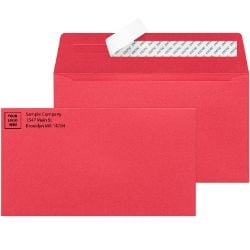
The outer appeal envelope is the first thing a donor sees. Before the appeal letter, before the reply card, before the remittance envelope , the outer envelope determines whether any of that content gets read. A donor who does not open the outer envelope never sees the message inside.
For nonprofit fundraising mail, envelope color is one of the most tested variables in direct mail. Plain white envelopes look like utility bills and corporate correspondence. Colored envelopes stand out in a stack of mail and signal that something different is inside. This is why colored and starburst envelopes are standard in donor acquisition campaigns, lapsed donor reactivation programs, and year-end giving appeals.
Colored wove envelopes for appeals
Colored wove envelopes in standard #10 format are the most common outer envelope choice for nonprofit appeals. They are available in a range of solid colors , red, blue, green, yellow, and others , and accept custom printing for logo, return address, and teaser copy in the same print run. The wove surface provides a clean print result. The color makes the piece stand out in the mailbox.
For year-end giving appeals, bold warm colors tend to perform well. For spring or summer campaigns, cooler colors often match the brand identity better. The specific color choice matters less than the decision to use color at all versus plain white.
See all colored wove formats at Colored Envelopes: Wove vs Starburst, Sizes, Direct Mail Economics and When Color Earns Its Place.
Starburst envelopes for acquisition and high-urgency campaigns
Starburst envelopes take the color concept further. Instead of a solid color, they use a multi-color burst pattern that is one of the most immediately recognizable formats in direct mail. Starburst envelopes are not subtle. They are designed to be seen from across a pile of mail, which is exactly what acquisition campaigns and lapsed donor reactivation programs need.
For established donor relationships where the organization already has strong brand recognition, solid colored envelopes often perform well enough. For cold acquisition lists or lapsed donors who have not given in 18 to 36 months, starburst envelopes provide the visual disruption that gets the piece picked up before it gets discarded. See the full starburst guide at Starburst Envelopes: When Bold Color Beats White in the Mailbox and How to Use It Right.
Custom printed outer envelopes with nonprofit logo and return address
Whether the outer envelope is colored, starburst, or white, custom printing adds the organization's logo and return address. This serves two purposes. It identifies the sender immediately so donors who recognize and trust the organization are more likely to open the piece. And it ensures returns come back correctly if the piece is undeliverable.
Custom printing on the outer envelope also opens the space for teaser copy , a short phrase printed on the envelope face below the return address that creates curiosity, urgency, or impact before the donor opens the piece. For complete custom printing specifications and artwork requirements, see Custom Printed Envelopes: What Gets Printed, How It Works and Why It Matters.
The Reply Envelope: Making It Easy for the Donor to Give
The reply envelope inside the package removes friction from the giving process. A donor who has read the appeal letter and decided to give needs a way to return the donation easily. A pre-addressed reply envelope eliminates the step of finding an envelope, writing the organization's address, and locating a stamp.
#9 reply envelope (business reply or courtesy reply)
The #9 envelope (3-7/8 x 8-7/8 inches) is the standard reply format. It fits inside a #10 outer envelope with the folded letter and reply card. The donor tears off the reply card, writes in the gift amount, inserts it in the #9 envelope, and mails it back.
Two postage options exist for the #9 reply piece. A Business Reply Envelope (BRE) is pre-authorized with USPS so the donor pays no postage , the organization pays only for pieces that come back. A Courtesy Reply Mail (CRM) envelope is pre-addressed but requires the donor to apply a stamp. BRE format increases response rates but adds cost on returned pieces. CRM costs nothing until a donor responds. For a complete breakdown of BRE vs CRM formats, see Business Reply Envelope Size: Specs, Setup, and How BRE Programs Work.
#6-3/4 remittance envelope for donation programs
The #6-3/4 remittance envelope (3-5/8 x 6-1/2 inches) is the traditional format for nonprofit donation programs. It has an extended wallet flap that provides additional space for printing gift amount options, donor instructions, or a brief thank-you message. The donor writes in a gift amount or selects from a pre-printed gift ladder, encloses a check, and returns the remittance envelope to the organization.
The #6-3/4 remittance envelope also fits inside a #10 outer envelope alongside a folded letter and reply card. For a complete guide to remittance envelope formats, sizes, and how to set up a nonprofit remittance program, see Remittance Envelopes: The Complete Guide for Nonprofits, Fundraisers and Reply Mail.
Acknowledgment Envelopes: Closing the Donor Relationship Loop
Every donation to a 501(c)(3) organization requires a written acknowledgment for the donor to claim a tax deduction on contributions of $250 or more. For smaller contributions, acknowledgment letters build donor relationships and set up the next appeal. The acknowledgment envelope is where that communication goes.
For most nonprofits, a standard #10 envelope with the organization's logo and return address custom printed on the face is the correct format for acknowledgment letters. The letter tri-folds to fit, the donor address is typed or printed on the envelope face or shows through a window, and the piece mails at First-Class postage rate for prompt delivery.
Window envelopes for acknowledgment efficiency
For organizations processing acknowledgment letters in volume, a #10 window envelope eliminates the manual addressing step. The acknowledgment letter template is designed so the donor's name and address appear in the window position. The letter folds and inserts correctly with the address visible through the window. No separate addressing, no labels. For all window formats, see window envelopes.
Security tinting for acknowledgments containing personal information
Acknowledgment letters frequently include the donor's giving history, pledge amounts, and occasionally personal information provided during the donation process. For acknowledgments that contain financial history or personal identification data, security-tinted envelopes prevent the document contents from being read through the envelope during mail transit. For complete security tinting guidance, see Security Tinted Envelopes: What the Interior Pattern Actually Does and When You Need It.
Nonprofit Postage and Envelope Format Compatibility
USPS offers a nonprofit Marketing Mail rate that is approximately 45 percent below the commercial Marketing Mail letter rate for organizations authorized under 501(c)(3) status. Understanding which envelope formats qualify for this rate , and which do not , affects both the campaign budget and the envelope ordering decision.
Which envelope formats qualify for nonprofit Marketing Mail letter rates
To mail at the nonprofit letter rate, the outer envelope must fall within USPS letter dimensions: 3.5 to 6.125 inches tall, 5 to 11.5 inches long, under 0.25 inches thick, and under 3.5 ounces total piece weight. A standard #10 envelope (4-1/8 x 9-1/2 inches) easily qualifies. Colored wove #10 envelopes and custom printed #10 envelopes all qualify.
Starburst envelopes in #10 size also qualify for nonprofit letter rate. The envelope color and pattern do not affect automation compatibility. What matters is that the barcode clear zone at the bottom of the envelope remains free of any design element and that the piece passes automated processing dimensions. Business Envelopes applies USPS compliance checks to all custom printed orders before production.
Pieces that mail as flats instead of letters
Packages that include a large gift, a premium item, or contents that require a 9x12 outer envelope do not qualify for letter rates. They mail as USPS flats at a higher postage rate. For nonprofit programs using large outer envelopes, the postage cost difference is significant and should factor into the campaign budget before the envelope format is locked in. For all large envelope formats and their postage classifications, see Direct Mail Envelopes: How to Choose the Right Format, Size, and Design for Better Response.
Nonprofit authorization is separate from envelope requirements
The USPS nonprofit postage authorization (PS Form 3624) requires the organization's IRS determination letter and takes 30 to 60 days to process. The authorization is tied to the organization's 501(c)(3) status, not to the specific envelope format. Any USPS-compliant envelope can carry nonprofit postage once the authorization is in place. For a complete guide to postage options including nonprofit rates, see Postage Stamps and Buying Options: The Complete US Guide for 2026.
Year-End Giving Season: Envelope Planning for October Through December
What to order for the year-end giving season
- Outer appeal envelope: Colored or starburst #10 with custom logo and return address for house-list appeals; plain colored for programs testing multiple formats simultaneously
- Reply envelope: #9 or #6-3/4 remittance , confirm format before ordering since the two are not interchangeable with existing reply cards
- Acknowledgment envelopes: Plain or window #10 for thank-you letters and year-end tax receipts , these ship after donations arrive, so a separate order with faster turnaround on blank stock is often the most efficient approach
For organizations mailing across multiple appeals during the year-end season (Thanksgiving, December, and year-end deadline appeals), ordering envelopes in a single larger batch reduces per-unit cost and ensures consistent supply throughout the giving season. For volume pricing and ordering guidance, see Wholesale Envelopes for Business: The Complete Buying Guide.
Common Mistakes Nonprofits Make When Ordering Envelopes
- Ordering the wrong reply envelope size. A #9 reply envelope and a #6-3/4 remittance envelope are not interchangeable. The reply cards and pledge forms designed for each format have different dimensions. Confirm which size your existing forms require before placing a reorder.
- Ordering only outer envelopes without confirming reply envelope supply. Running out of reply envelopes mid-campaign means donors who want to give by mail cannot do so easily. Always order both formats in the same planning cycle.
- Using a plain white outer envelope for acquisition campaigns. Colored envelopes and starburst envelopes consistently outperform plain white in donor acquisition. Save the plain white for formal correspondence and acknowledgment letters.
- Ordering acknowledgment envelopes too early at bulk quantity. Acknowledgment volume is hard to predict before an appeal launches. Blank stock ships same or next business day, so ordering acknowledgment envelopes after the campaign closes and you know the response volume is often the more efficient approach.
- Not verifying nonprofit postage authorization before committing to a large print run. The PS Form 3624 authorization process takes 30 to 60 days. Organizations mailing their first nonprofit Marketing Mail campaign should begin the authorization process before ordering campaign envelopes, not after.
Why Business Envelopes for Nonprofit Mailing Programs
Business Envelopes has supplied nonprofit organizations, churches, schools, and membership associations with remittance envelopes, reply envelopes, colored outer appeal envelopes, and acknowledgment envelopes since 1997. Every format used in a standard nonprofit fundraising mail package is in stock.
- Colored wove and starburst outer appeal envelopes in all standard sizes
- #9 reply envelopes and #6-3/4 remittance envelopes for donor response programs
- Custom printed envelopes with logo and return address for outer and acknowledgment formats
- Window envelopes for high-volume acknowledgment programs
- Security tinted formats for acknowledgments containing financial history
- No minimum order on any format
- Same or next business day shipping on blank stock
- Free ground shipping on every order
- PDF proof before production on all custom printed orders
- Artwork retained on file for automatic reorders
See all self-seal and gummed flap options at self seal envelopes and regular envelopes.
What Customers Say About Business Envelopes
★★★★★ Gitty, Verified Buyer | #10 White Wove Printed Envelopes
"Great quality basic envelopes at great price! Thank you!"
★★★★★ Jacob, Verified Buyer | #10 White Wove Printed Envelopes
"I am very pleased with these envelopes and will order again! Great product and shipped very well! Better than I get from local office supply and a better value!"
★★★★★ Yehudis, Verified Buyer | #10 White Wove Printed Envelopes
"Next time I need printed envelopes I know where to order. Businessenvelopes does a great job. My envelopes never came out so nice when I ordered them somewhere else. I highly recommend."