

Quick answer: An open end envelope has its flap on the short edge and a center seam running down the back. An open side envelope has its flap on the long edge and side seams along the two short edges. Open end is another name for catalog envelope. Open side is another name for booklet envelope. The practical difference: open side (booklet) envelopes are compatible with folder inserter machines; open end (catalog) envelopes are stronger for heavy document packets but cannot run through inserter equipment. Both formats are available in 9x12 and 10x13 at Business Envelopes. See open-end options at 9x12 White Open-End Printed Envelopes.
The terms open end and open side create more ordering confusion than almost any other pair of envelope terms. They appear on product listings, specification sheets, and print vendor catalogs, often without a clear explanation. Many buyers receive the wrong format because a product page said "open end" and they assumed it meant something different from what arrived.
This guide explains what each term means, where the naming confusion comes from, how the seam construction differs, and how to confirm which format your program needs before placing an order.
The Naming Confusion: Four Terms for Two Formats
- Open end = flap on the short edge = catalog envelope (these are all the same format)
- Open side = flap on the long edge = booklet envelope (these are all the same format)
The terms "open end" and "open side" are technical construction descriptions. They describe which edge of the envelope is open for loading. "Catalog" and "booklet" are the common product names used in the US envelope industry for the same two constructions. Both naming systems have been in use for decades, which is why buyers frequently encounter all four terms and are not always sure they refer to just two formats.
The confusion is compounded because individual suppliers sometimes use the terms differently. Some vendors use "open end" loosely to refer to any large envelope that loads from a wide opening. Others are precise about the technical definition. When placing an order, the most reliable confirmation is to ask which edge carries the seal flap: if it is the short edge, it is open end (catalog). If it is the long edge, it is open side (booklet).
What Is an Open End Envelope?
An open end envelope has its seal flap on the short edge of the envelope. For a 9x12 envelope, the flap runs across the 9-inch width. Documents load from the top, through the opening created when the flap is lifted. The seam construction on an open end envelope runs down the center of the back panel from the bottom fold to the throat. This is called center seam construction.
Open end = catalog envelope: the practical meaning
The name "catalog" comes from the primary historical use case: mailing printed catalogs and large flat documents that needed to be inserted from the top without folding or angling. The center seam on an open end envelope distributes the load of heavy contents across the full width of the back panel, which makes it the stronger format for thick or heavy document packets.
- Flap runs along the short (9-inch for 9x12) edge
- Center seam construction: seam runs from bottom fold to flap opening along the envelope centerline
- Documents load from the top, like a standard commercial letter envelope but larger
- Stronger seam for heavy contents: center seam distributes load across the full back panel
- Not compatible with standard folder inserter machines (inserters require side loading)
See all open-end formats at 9x12 White Open-End Printed Envelopes and 10x13 White Open-End Printed Envelopes.
What Is an Open Side Envelope?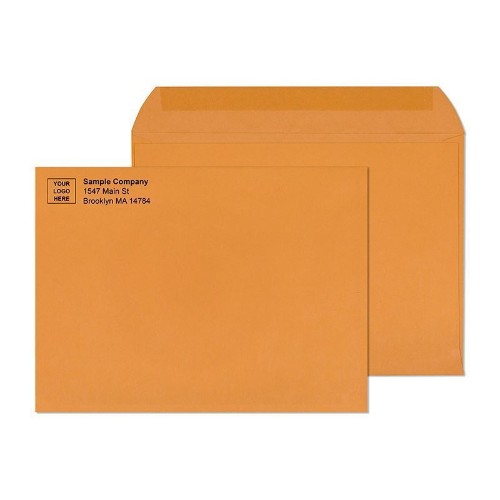
An open side envelope has its seal flap on the long edge of the envelope. For a 9x12 envelope, the flap runs along the 12-inch length. Documents slide in from the side through the wide opening created when the flap is lifted. The seam construction on an open side envelope runs along both short side edges. This is called side seam construction.
Open side = booklet envelope: the practical meaning
The name "booklet" comes from the primary use case: mailing multi-page booklets, reports, and promotional materials that benefit from the wide side opening for insertion. The side seam construction on an open side envelope is compatible with standard automated folder inserter machines, which feed envelopes with the long edge leading and insert documents from the side opening.
- Flap runs along the long (12-inch for 9x12) edge
- Side seam construction: seams run along both short side edges of the envelope body
- Documents load from the side through the full 12-inch opening
- Faster manual loading for moderate-weight documents: the full 12-inch opening allows documents to slide in without angling
- Compatible with standard folder inserter machines
See all open-side (booklet) formats at 9x12 White Booklet Printed Envelopes, 9x12 Brown Booklet Printed Envelopes, and the complete Booklet Envelope: What It Is, Every Size, and When to Use One.
Open End vs Open Side: Complete Side-by-Side Comparison
| Property | Open End (Catalog) | Open Side (Booklet) |
|---|---|---|
| Flap location | Short edge (9 inches for 9x12) | Long edge (12 inches for 9x12) |
| Seam construction | Center seam: runs down middle of back panel | Side seam: runs along both short edges |
| Document loading direction | Top (through 9-inch opening) | Side (through 12-inch opening) |
| Seam strength for heavy contents | Higher: center seam distributes load across full back panel | Standard: side seams concentrate load at two edge points |
| Folder inserter machine compatibility | No: inserters require side loading; center seam blocks this | Yes: side seam construction is designed for inserter feeding |
| Manual loading speed | Moderate: narrower 9-inch opening requires positioning documents | Faster: wide 12-inch opening allows flat slide-in |
| Common product name | Catalog envelope | Booklet envelope |
| Best use cases | Heavy document packets, thick contents, manual workflows, interoffice routing | Insertion machine programs, moderate documents, fast manual loading |
| Available sizes (Business Envelopes) | 6x9, 9x12, 10x13 | 6x9, 9x12, 10x13 |
| Available materials | White wove, brown kraft, Tyvek | White wove, brown kraft, Tyvek |
| Custom printing available | Yes , logo and return address | Yes , logo and return address |
The Seam Difference: Why Construction Matters for Your Program
The seam location is not just a manufacturing detail. It determines the structural performance of the envelope under load and whether the format can run through automated equipment. Understanding why the seams are located where they are explains the performance differences clearly.
Center seam (open end): strength for heavy contents
On an open end envelope, the two paper panels that form the front and back of the envelope body are joined by a seam that runs down the vertical center of the back panel. When the envelope contains a heavy document packet, the contents push outward against the envelope walls. The center seam distributes that outward pressure across the full width of the back panel because the seam is in the middle. This is why open end envelopes are the standard format for thick documents, bound reports, folders, and anything with significant weight or bulk.
Side seam (open side): automation compatibility
On an open side envelope, the two panels are joined by seams that run along the left and right short edges. The entire long edge is open for document loading. When a folder inserter machine processes the envelope, it feeds the piece with the long edge leading into the machine. The inserter inserts the document through the open long edge and then applies the adhesive seal to the long flap. This process only works with side seam (open side) construction, because the long edge must be open during feeding. Center seam construction has material running across the back where the inserter expects the flap to be positioned for sealing, which is why open end envelopes cannot run through standard inserter equipment.
If your program uses a folder inserter machine, you need open side (booklet) envelopes Open end (catalog) envelopes cannot be sealed by a standard folder inserter. The machine's feeding and sealing sequence requires the long edge to be open, which is the open side (booklet) format. Ordering open end envelopes for an inserter program results in a batch that exits the machine correctly stuffed but completely unsealed. For complete inserter machine envelope guidance, see Booklet Envelope: What It Is, Every Size, and When to Use One.
Which Format to Choose: A Decision Guide by Use Case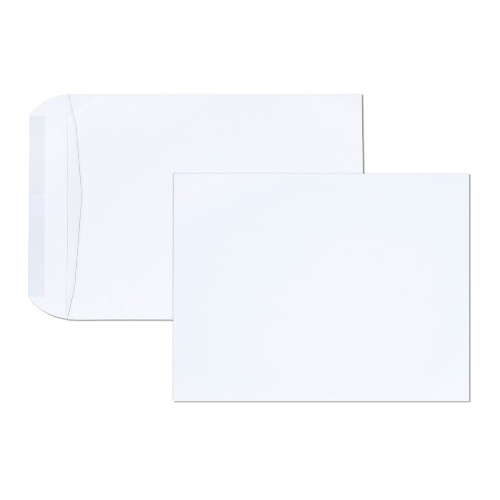
Choose open side (booklet) when:
- Your mailing program runs through a folder inserter machine
- You are loading moderate-weight documents and want faster manual insertion
- The contents are flat and uniform in thickness
- You need a format that feeds reliably through automated equipment
- The mailing volume is high and per-piece processing time matters
Choose open end (catalog) when:
- You are loading heavy, thick, or bulky document packets by hand
- Contents include folders, bound documents, multiple sheets with hardware, or anything with significant bulk
- The program is manual-only with no inserter equipment
- You need interoffice routing capability with a clasp closure that opens and reseals repeatedly
- Seam strength under postal handling stress is a priority
Open End vs Open Side Across Sizes
Both open end and open side constructions are available across the standard large envelope size range. The format decision is separate from the size decision.
| Size | Open End (Catalog) | Open Side (Booklet) | Primary Use |
|---|---|---|---|
| 6x9 | Available | Available | Smaller flat documents, marketing mail, reports |
| 9x12 | Available , white wove, brown kraft | Available , white wove, brown kraft | Standard flat document mailing, contracts, legal papers |
| 10x13 | Available , white wove, brown kraft | Available , white wove, brown kraft | Thicker packets, legal-size documents, multi-page reports |
For large envelope size guidance, see Large Envelope Sizes: 9x12, 10x13, and Every Format Explained. For 9x12 specifics, see 9x12 Envelope: Size, Uses, Formats, and When to Use It. For 10x13 specifics, see 10x13 Envelope: What It Holds, Every Variant, and When It Makes More Sense Than a 9x12.
Material Options for Open End and Open Side Envelopes

Both open end and open side constructions are available in white wove and brown kraft at Business Envelopes. The material choice adds a third dimension to the format decision.
White wove
The standard material for external business mail and custom printing programs. White wove provides a clean, professional appearance and a smooth surface that accepts logo and return address printing cleanly. Available in both open end and open side constructions with gummed flap and peel-and-seal closures. Custom printing available with no minimum order.
Brown kraft
28 lb recycled tan/brown kraft with a vellum finish. Stronger than standard 24 lb white wove due to the kraft pulping process, which preserves natural fiber bonds. The standard material for interoffice routing programs, archival workflows, and any program where durability is more important than appearance. Available in booklet (open side) and clasp formats. The clasp closure on kraft envelopes handles repeated open-close cycles for routing programs where the same envelope travels between departments. For the full kraft envelope guide, see Kraft Envelope: Every Type, Size, and When Brown Kraft Is the Right Choice.
Tyvek
For programs where even 28 lb kraft is not durable enough, Tyvek large envelopes provide synthetic fiber construction that is approximately ten times more tear-resistant than kraft and completely waterproof. For programs mailing through rough handling environments or containing materials that absolutely cannot be damaged in transit. See the full guide at Tyvek Envelopes: Why They Are Tear-Proof, Waterproof and When to Use Them.
Custom Printing on Open End and Open Side Envelopes
Custom logo and return address printing is available on all large envelope formats at Business Envelopes , both open end (catalog) and open side (booklet) in white wove. Custom printing eliminates the need for separate address labels on the envelope face and reinforces brand identity on every outgoing document piece.
The print zone on a large envelope covers the upper-left corner area on the face, keeping the delivery address zone and USPS barcode zone clear. A PDF proof is included before production begins. Artwork stays on file after the first approved order so every reorder reproduces the same result automatically. No minimum order on any custom printed format. For complete printing specifications, see Custom Printed Envelopes: What Gets Printed, How It Works and Why It Matters.
Why Business Envelopes for Open End and Open Side Envelopes
Business Envelopes has supplied both open end (catalog) and open side (booklet) large envelopes to businesses, law firms, medical offices, universities, nonprofits, and government agencies since 1997. Both formats are stocked in white wove and brown kraft across the standard 6x9, 9x12, and 10x13 size range.
- Open end (catalog) and open side (booklet) available in 6x9, 9x12, and 10x13
- White wove and brown kraft in both constructions
- Gummed flap and peel-and-seal closures on most formats
- Clasp closure available on brown kraft for routing programs
- Custom logo and return address printing with PDF proof , no minimum
- Same or next business day shipping on blank stock
- Free ground shipping on every order
For volume ordering guidance, see Wholesale Envelopes for Business: The Complete Buying Guide.
What Customers Say About Business Envelopes Large Envelopes
★★★★★ Jacob, Verified Buyer | 9x12 White Open-End Printed Envelopes
"Very happy with these envelopes! These arrived in pristine condition. They are just great for mailing letter sized documents."
★★★★★ Rikki, Verified Buyer | 9x12 White Booklet Printed Envelopes
"I use these for both mailing and filing. They hold a lot of paperwork and are great quality."
★★★★★ Jacob, Verified Buyer | 9x12 White Booklet Printed Envelopes
"Everything arrived in great shape exactly as we ordered. Thank you."