

Last updated: October 2026
The #11 envelope is one of the most underused sizes in business mailing. It sits just above the standard #10 in height and length, which makes it useful when a #10 feels too tight for your contents but you do not want to jump to a flat-rate envelope. If you are mailing #11s and need to know whether they qualify for letter-rate postage, how much a stamp costs, or exactly what fits inside, this guide covers all of it using current USPS rates effective July 12, 2026.
In This Guide
- Quick Summary
- What Is a #11 Envelope?
- Exact Dimensions
- Does a #11 Qualify for Letter-Rate Postage?
- How Much Does It Cost to Mail a #11 Envelope?
- How the #11 Compares to Other Business Envelope Sizes
- Types of #11 Envelopes Available
- What Documents Fit in a #11 Envelope?
- Common Uses for #11 Envelopes
- Mailing Tips for #11 Envelopes
- Shop #11 Envelopes
Quick Summary
A #11 envelope measures 4‑1/2 x 10‑3/8 inches and qualifies for First-Class letter-rate postage. As of July 12, 2026, a one-ounce mailing in a #11 costs $0.82 with a Forever stamp or $0.78 with a postage meter. The #11 is the best choice when your contents are slightly too full for a #10 but you want to stay at the letter rate without moving to an oversize envelope.
- Outer dimensions: 4‑1/2 x 10‑3/8 inches
- Interior dimensions: 4‑1/4 x 10‑1/8 inches
- Paper weight: 24 lb white wove
- Postage class: First-Class letter (up to 3.5 oz)
- 2026 stamp rate (1 oz): $0.82 | Metered: $0.78
- Available in: plain white, window white, and brown kraft
What Is a #11 Envelope?
The #11 envelope is a standard business envelope in the number-series sizing format. The number refers to a specific size within the USPS commercial envelope system, not a gauge or paper weight. At 4‑1/2 x 10‑3/8 inches, the #11 is slightly larger than the #10 (4‑1/8 x 9‑1/2 inches) and slightly smaller than the #12 (4‑3/4 x 11 inches).
The number-series business envelopes follow a consistent pattern: each successive number steps up in both height and length. The #10 is the most widely used business size in the United States. The #11 and #12 are the next two sizes up in the same family. All three qualify for First-Class letter-rate postage.
The #11 is longer and taller than a #10, which means it holds more without the contents being crammed. When a standard letter with a brochure or a second insert is a tight fit in a #10, the #11 provides the additional room without requiring a move to a flat-rate envelope class.
#11 Envelope Dimensions: Outer and Interior Sizes
Knowing both the outer and interior dimensions of a #11 envelope matters for two different reasons. The outer size determines USPS postage classification. The interior size determines what you can fit inside.
| Measurement | Dimension | Notes |
|---|---|---|
| Outer length | 10‑3/8 in (10.375 in) | Used for USPS size classification |
| Outer height | 4‑1/2 in (4.5 in) | Used for USPS size classification |
| Interior length | 10‑1/8 in (10.125 in) | Maximum document length before folding |
| Interior height | 4‑1/4 in (4.25 in) | Maximum folded document height |
| Paper weight | 24 lb wove | Standard business envelope stock |
Outer dimensions are measured flap-down on the front face. Interior dimensions account for the folded seams on all sides.
The 1/4-inch difference between outer and interior dimensions on each side is standard for business envelope stock. The envelope's folded and glued seams reduce the usable interior space by that margin.
For comparison, a #10 envelope has an interior of approximately 4 x 9‑1/4 inches. The #11 gives you an additional 1/4 inch of height and 7/8 inch of length on the inside, which is enough to make a meaningful difference when contents are dense.
Does a #11 Envelope Qualify for First-Class Letter-Rate Postage?
Yes. A standard #11 envelope qualifies for First-Class letter-rate postage at USPS. The USPS letter-rate classification requires that an envelope fall within these limits:
- Minimum size: 3‑1/2 x 5 inches
- Maximum size: 6‑1/8 x 11‑1/2 inches
- Maximum thickness: 1/4 inch (0.25 in)
- Maximum weight: 3.5 ounces
At 4‑1/2 x 10‑3/8 inches, the #11 sits well within the 6‑1/8 x 11‑1/2 inch maximum on both dimensions and above the 3‑1/2 x 5 inch minimum. A stuffed #11 containing standard paper will not exceed the 1/4-inch thickness limit in most cases.
When a #11 Might Not Mail at Letter Rate
Two situations can push a #11 out of the standard letter-rate class:
Weight over 3.5 ounces. If the total weight of the envelope plus contents exceeds 3.5 ounces, USPS reclassifies the piece as a flat (large envelope). The flat rate starts at $1.69 for the first ounce and increases from there. Weigh your stuffed envelope before mailing if you are uncertain.
Non-machinable contents. If the envelope contains something rigid, such as a thick card, a keycard, or a folded item that makes the envelope lumpy or uneven, USPS may apply a non-machinable surcharge of $0.49. For standard paper inserts, this does not apply. The surcharge is for pieces that cannot be processed through automated sorting equipment.
For most standard business mail, a #11 with paper contents mails at the regular First-Class letter rate with no surcharge.
How Much Does It Cost to Mail a #11 Envelope in 2026?
The current USPS First-Class letter rates took effect on July 12, 2026. These are the rates that apply to a #11 envelope:
| Postage Method | First Ounce | Each Additional Ounce | Max Weight at Letter Rate |
|---|---|---|---|
| Forever stamp | $0.82 | +$0.29 | 3.5 oz |
| Metered mail | $0.78 | +$0.29 | 3.5 oz |
| Non-machinable surcharge | +$0.49 | N/A | Added to letter rate if applicable |
| Flat rate (if over 3.5 oz) | $1.69 | Varies | Up to 13 oz |
How Many Stamps Does a #11 Envelope Need?
For most business mailings, one Forever stamp is enough. A standard business letter in a #11 envelope typically weighs less than 1 ounce. Here is a general breakdown:
- A #11 envelope (empty) weighs approximately 0.5 ounces
- One sheet of standard 20 lb paper weighs approximately 0.16 ounces
- Two sheets plus envelope: approximately 0.82 ounces (under 1 oz, one stamp)
- Five sheets plus envelope: approximately 1.3 ounces (two stamps)
- Eight sheets plus envelope: approximately 1.78 ounces (two stamps plus extra postage)
If you regularly mail packets that include multiple inserts, a small postage scale removes the guesswork. Under-postaged mail is returned to sender, which can cause significant delays in time-sensitive business correspondence.
Metered Mail vs. Stamps for High-Volume #11 Mailings
The metered rate saves $0.04 per piece compared to a Forever stamp. For a mailing of 1,000 pieces, that is $40 in postage savings. For 5,000 pieces, it is $200. If your office sends several hundred or more #11 envelopes per month, a postage meter pays for itself relatively quickly.
For a full comparison of postage costs across all common envelope sizes, see the how many stamps do I need guide.
How the #11 Envelope Compares to Other Business Envelope Sizes
Understanding where the #11 fits in the full lineup helps you choose the right size for your specific mailing. The four standard business number envelopes all qualify for First-Class letter rate.
| Envelope | Outer Size | Interior Size (approx.) | Postage Class | Common Use |
|---|---|---|---|---|
| #10 | 4‑1/8 x 9‑1/2 in | 4 x 9‑1/4 in | First-Class letter | Standard business letters |
| #11 | 4‑1/2 x 10‑3/8 in | 4‑1/4 x 10‑1/8 in | First-Class letter | Bulkier packets, DM inserts |
| #12 | 4‑3/4 x 11 in | 4‑1/2 x 10‑3/4 in | First-Class letter | Bulky correspondence |
| #14 | 5 x 11‑1/2 in | 4‑3/4 x 11‑1/4 in | First-Class letter | Legal-size documents (tri-fold) |
| 9x12 | 9 x 12 in | 8‑3/4 x 11‑3/4 in | First-Class flat | Unfolded letter-size documents |
The highlighted row is the #11. All four number envelopes qualify at the First-Class letter rate.
The key decision between sizes usually comes down to what you are enclosing:
- A single letter with no extra insert fits a #10.
- A letter plus a reply envelope or small insert fits a #11.
- A thicker packet or a letter with a larger brochure may need a #12.
- Tri-folded legal-size (8.5 x 14-inch) paper needs a #14.
- Anything that cannot be folded at all belongs in a 9x12 envelope.
See the complete lineup at the envelope sizes chart guide or browse all envelope sizes.

Types of #11 Envelopes Available
BusinessEnvelopes.com carries three #11 styles. All use 24 lb wove stock and the same 4‑1/2 x 10‑3/8 inch outer dimension. Each is available blank or with custom printing.
#11 Plain White Envelopes
The standard #11 in bright white wove stock. Gum flap closure that moistens with water or a damp sponge. Laser and inkjet printer safe, so you can print directly on the envelope for a return address or run a window-matching address label. Suitable for all standard business correspondence.
Custom printing is available with a return address, logo, or both. Orders include a PDF proof before production begins, and custom orders ship 7 to 10 business days after proof approval. Plain orders ship from existing stock.
See the full product details at #11 white wove printed envelopes.
#11 Window White Envelopes
The same 4‑1/2 x 10‑3/8 inch size with a left-side window. The poly-film window allows the recipient's name and address printed on the enclosed document to show through, so you never need to hand-address or label the envelope. Machine insertable, which matters for offices that use automatic mail inserters. Laser safe.
The window style is standard in billing and invoice mailing, where the same document serves as both the mail piece content and the address block. It also eliminates the risk of inserting the wrong letter in the wrong addressed envelope, which is a common error in high-volume manual mailing.
See the full product at #11 window white wove printed envelopes.
#11 Brown Kraft Envelopes
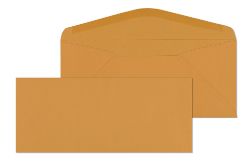
The same dimensions in brown kraft stock. Gum flap, no window. Brown kraft has a natural, heavier appearance that reads differently from standard white business mail. It is a common choice in direct mail where a natural or artisan look is part of the brand, in promotional mailings, and in any situation where the envelope is meant to stand out in the recipient's mail stack.
Available plain or with custom printing. See the full product at #11 brown kraft envelopes gum flap.
| Style | Closure | Window | Color | Best For |
|---|---|---|---|---|
| Plain white | Gum flap | None | Bright white | General business correspondence |
| Window white | Gum flap | Left-side poly window | Bright white | Billing, invoices, statements |
| Brown kraft | Gum flap | None | Brown kraft | Direct mail, promotions |
What Documents Fit in a #11 Envelope?
The #11 interior measures 4‑1/4 inches tall and 10‑1/8 inches long. Any document or packet that folds down to within those dimensions fits inside without forcing the flap or bending the contents awkwardly.
| Document | Folded Size | Fits in #11? | Notes |
|---|---|---|---|
| Standard 8.5 x 11 in letter (one page) | 3.67 x 8.5 in (tri-fold) | Yes | Easy fit with room to spare |
| Standard 8.5 x 11 in letter (two pages) | 3.67 x 8.5 in (tri-fold) | Yes | May approach weight limit with thick paper |
| Letter with #9 reply envelope | Letter tri-folded, BRE flat | Yes | Common in nonprofit and billing mail |
| Letter with small brochure | Both tri-folded | Yes | Weigh before mailing; may exceed 1 oz |
| Legal-size 8.5 x 14 in document (tri-fold) | 4.67 x 8.5 in | No | Height (4.67 in) exceeds interior (4.25 in) |
| Legal-size document (four folds) | 3.5 x 8.5 in | Yes | Extra fold reduces readability |
| Unfolded 8.5 x 11 in document | Not folded | No | Use a 9x12 for flat mailing |
Tri-fold means folding the document into three equal sections. Most business letters fold to approximately 3.67 inches tall when tri-folded.
One of the most common uses of the #11 over the #10 is when a single letter with an enclosed reply envelope is a tight fit in a #10. A standard #9 reply envelope (3‑7/8 x 8‑7/8 inches) fits flat in a #11 alongside the tri-folded letter with comfortable room.
For documents that should not be folded, the better choice is a 9x12 envelope, which keeps letter-size paper completely flat without creasing.
Common Uses for #11 Envelopes
The #11 envelope fills a specific role in business mailing: it provides more interior room than a #10 while staying within the First-Class letter-rate size limits. Offices that regularly send #11s tend to fall into a few common categories.
Nonprofit and Charitable Fundraising Mail
Many nonprofit organizations use the #11 for appeal mailings. A typical package includes a two-page letter, a donation reply slip, and a pre-addressed #9 business reply envelope. The extra room in the #11 accommodates all three pieces without cramming. The brown kraft version also gets used in nonprofit direct mail where an earthy aesthetic reinforces the organization's message.
Subscription and Membership Renewals
Renewal notices often include a letter, a remittance slip, and a return envelope. These three-piece packages fit comfortably in a #11. The window version eliminates the addressing step entirely when the remittance slip carries the recipient's address near the top.
Multi-Page Correspondence
When a business letter runs two or three pages, the combined thickness of tri-folded pages is a tighter fit in a #10 than it is in a #11. Professional services firms, financial advisors, consultants, and others who send multi-page letters frequently stock #11s for this reason.
Direct Mail with an Insert
Direct mail campaigns that include a letter plus a folded brochure, coupon, or offer sheet use the #11 when the #10 is too snug. The window version works especially well here: the letter carries the address block near the top, it slides into the envelope address-first, and the recipient's name shows through the window. No label application needed.
Insurance and Financial Services Mail
Policy documents, benefit summaries, and explanations of benefits are often longer than a single page. When these need to be mailed with a cover letter, the #11 provides the space needed without forcing a move to a flat-rate envelope.
Mailing Tips for #11 Envelopes
Weigh Every Stuffed Envelope Before Mailing High-Volume Batches
A postage scale removes guesswork and prevents two problems: under-postage (which causes mail to be returned to sender) and over-postage (which wastes money). For a single one-page letter, one Forever stamp is always safe. For packets with multiple inserts, weigh a sample before the full run.
Know When to Switch to Metered Postage
If your office mails more than 200 to 300 pieces per month, a postage meter saves money. The metered rate is $0.04 less per ounce than the stamp rate. For a run of 500 pieces per month, that is $20 saved monthly, or $240 per year. For 2,000 pieces per month, the savings are $80 per month.
Use Window Envelopes for Any Mailing with Printed Addresses
If the document inside already carries the recipient's address (a statement, an invoice, a form letter from a merge), use the window version. It eliminates the addressing step entirely and removes the risk of mismatched envelopes and letters. The #11 window envelope is machine-insertable, which matters if your office has a mail inserter.

Order Custom-Printed Envelopes for Branded Mail
A return address and logo printed directly on the envelope removes the extra step of applying a return address label and gives outgoing mail a more professional appearance. Custom printing is available on all three #11 styles. A PDF proof is provided before production on every custom order.
Test a Sample Before a Large Run
If you are switching from #10 to #11 for a direct mail campaign, test a sample batch first. Confirm that the window aligns correctly with your document's address block (for window envelopes) and that the folded contents lie flat in the envelope without bulging the flap closed.
Store Envelopes Flat in a Dry Environment
Gum-flap envelopes are moisture-activated. Storing them near a coffee machine, in a humid storeroom, or in a damp basement can cause the gum to activate prematurely or cause sheets to stick together. A cool, dry cabinet or drawer keeps the stock in good condition.
Shop #11 Envelopes
All three #11 styles are available at BusinessEnvelopes.com. Orders ship with free ground shipping and no minimum quantity requirement. Custom-printed orders include a PDF proof before production and ship 7 to 10 business days after proof approval.
- #11 White Envelopes (plain) - 24 lb bright white wove, gum flap
- #11 Window Envelopes - Left-side poly window, machine insertable, laser safe
- #11 Brown Kraft Envelopes - Gum flap, no window
Looking for a different size? The envelope sizes chart guide covers every standard business and mailing envelope with dimensions, postage class, and use cases. You can also browse the complete selection at all envelope sizes.