 FREE Shipping

Presorted First Class Mail: Rules, Envelopes and Steps
Last updated: November 12, 2026
If your business mails hundreds of invoices, statements or notices every month, you have probably seen "PRSRT FIRST-CLASS" printed in the corner of envelopes from banks and utilities. That marking means the mailer sorted the mail before handing it to USPS and earned a lower presort price in return.
This guide explains what presorted First-Class Mail is, who qualifies, how it compares with USPS Marketing Mail, and how to set up your envelopes so a presort mailing runs through postal equipment without surcharges or rejected pieces.
Quick Summary
Presorted first class mail (written by USPS as Presorted First-Class Mail) is First-Class Mail that the sender sorts by ZIP Code and prepares in trays before handing it to USPS, in exchange for lower postage than single-piece stamps. A mailing needs at least 500 pieces, accurate addresses updated for moves, a mailing permit or approved payment method, and machinable letter-size envelopes such as #10 and #9 envelopes.
- 500 pieces is the minimum: presorted and automation First-Class mailings need at least 500 pieces, which can go to any mix of ZIP Codes.
- It keeps First-Class benefits: delivery in 1 to 5 days, forwarding and return of undeliverable mail are included.
- Bills and statements must go First-Class: invoices, statements and personal information cannot be sent as Marketing Mail.
- Addresses must be current: USPS requires Move Update processing within 95 days before the mailing date.
- Envelopes must be machinable: rectangular, within letter size limits and free of clasps or strings.
- Automation prices need a barcode: the lowest prices require an Intelligent Mail barcode on every piece.
| Requirement | What USPS asks for |
|---|---|
| Minimum volume | 500 pieces per mailing |
| Sorting | Grouped by ZIP Code into trays, to the level the price requires |
| Address quality | Move Update within 95 days and ZIP Code accuracy standards |
| Barcode | Intelligent Mail barcode for automation prices |
| Payment | Permit imprint, postage meter or precanceled stamps |
| Drop-off | The Post Office or business mail entry unit where the permit is held, never a street collection box |
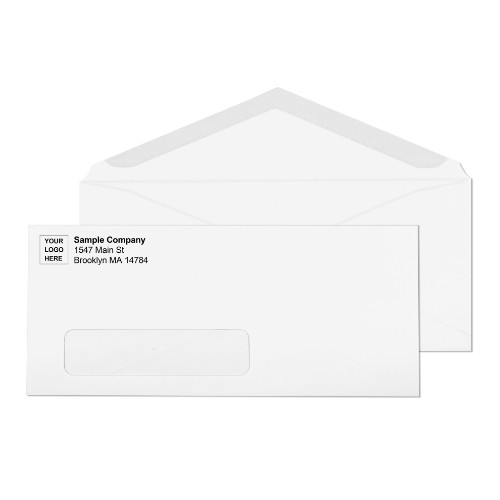
Planning a presort mailing? Shop #10 window envelopes for invoices and statements, including laser safe styles, or request a quote for custom printed envelopes in volume.
What is in this guide
- What is presorted First-Class Mail?
- Who should send presorted First-Class Mail instead of Marketing Mail?
- How does presorted First-Class compare to USPS Marketing Mail?
- What are the requirements to qualify?
- What envelope sizes work for presorted and automation letters?
- How should window envelopes be set up for presort mailings?
- How do you pay postage for presorted mail?
- How do you send a presorted First-Class mailing, step by step?
- Should you presort in-house or use a mail service provider?
- Why businesses choose Business Envelopes for presort mailings
What Is Presorted First-Class Mail?
Presorted First-Class Mail is a USPS price category for First-Class Mail that the mailer has sorted by ZIP Code before entering it. Because the sender does part of the sorting work, USPS charges less per piece than it does for single-piece mail with stamps. The mail still receives full First-Class service.
You will usually see it marked as "PRSRT FIRST-CLASS" or "PRESORTED FIRST-CLASS MAIL" on the envelope, in the postage area or the permit imprint.
What does "presorted" actually mean?
Presorted means the mail is grouped by ZIP Code and placed into letter trays labeled for their destinations. Pieces headed to the same 5-digit ZIP Code go together, then pieces for the same regional processing center, and finally mixed trays for everything else. USPS describes this as sorting mail to the finest extent required for the price you claim.
Presorted vs automation: what is the difference?
Presorted (also called nonautomation) mail is sorted by ZIP Code but does not carry a qualifying barcode. Automation mail is sorted and also carries an Intelligent Mail barcode on every piece, which lets USPS equipment read and route it without human help. Automation earns the lowest prices, so most business mailers aim for it.
Who Should Send Presorted First-Class Mail Instead of Marketing Mail?
Any business sending 500 or more letters at once that contain bills, statements or personal information should use presorted First-Class Mail. USPS rules require that content to go First-Class, so Marketing Mail is not an option for it, whatever the volume.
Which mail must go First-Class?
- Bills and invoices: including statements of account and payment reminders.
- Personal information: anything specific to the recipient, such as account details or medical and payroll information.
- Handwritten or typewritten matter: personal correspondence.
- Anything marked "Postcard": postcard-marked pieces must travel as First-Class Mail.
Typical presort First-Class mailers
Utilities, property managers, medical billing offices, banks, credit unions, insurance agencies, membership organizations and any business sending monthly statements to a large customer base. If your billing run is approaching 500 pieces, presort is worth a look.
How Does Presorted First-Class Compare to USPS Marketing Mail?
Presorted First-Class Mail is faster, includes forwarding and returns, and can carry bills and personal information. USPS Marketing Mail costs less but is slower, needs at least 200 pieces or 50 pounds, and is meant for advertising and promotional content.
| Feature | Presorted First-Class Mail | USPS Marketing Mail |
|---|---|---|
| Minimum volume | 500 pieces | 200 pieces or 50 pounds |
| Allowed content | Anything, including bills and personal information | Advertising, flyers, catalogs and newsletters |
| Delivery standard | 1 to 5 days | 3 to 10 days |
| Forwarding | Included for up to 12 months | Only with an ancillary endorsement, fees may apply |
| Return of undeliverable mail | Included | Only with an ancillary endorsement, fees may apply |
| Weight per letter | One price up to 3.5 oz | Varies by price category |
Neither delivery standard is guaranteed, but First-Class Mail moves on a faster schedule. For a closer look at promotional mailings, see our direct mail envelopes guide.
Can you include a marketing insert with a statement?
Yes. A promotional insert can travel inside a First-Class statement. Because presorted letters pay one price up to 3.5 ounces, many businesses add a flyer or offer to their billing mail without raising postage, as long as the piece stays within weight and thickness limits.
What Are the Requirements to Qualify for Presorted First-Class Mail?
To qualify, a mailing must meet four groups of USPS rules: volume, address quality, barcoding for automation prices, and mail preparation. Each rule is set out in the Domestic Mail Manual.
How many pieces do you need?
You need at least 500 pieces of First-Class Mail in a single mailing. The pieces do not need to go to the same ZIP Code. If you mix postcards and letters, each group must meet its own 500-piece minimum unless you prepare them as a combined mailing.
What address quality rules apply?
- Move Update: addresses must be updated for customer moves within 95 days before the mailing, using an approved method such as NCOALink.
- ZIP Code accuracy: addresses must be checked with CASS-certified software within the time window USPS sets in the Domestic Mail Manual.
- Complete addresses: include suite and apartment numbers so mail is not returned as undeliverable.
Do you need an Intelligent Mail barcode?
You need an Intelligent Mail barcode (IMb) on every piece to claim automation prices. Presorted nonautomation prices do not require one, but they cost more. USPS offers a free tool for small business mailers, Intelligent Mail for Small Business Mailers, that helps create barcodes, tray labels and postage statements.
Is there an annual fee?
Yes. An annual presort mailing fee applies once every 12 months at each Post Office where you mail. USPS waives it for qualifying Full-Service mailings. Check current fees with your local business mail entry unit before your first mailing.
What Envelope Sizes Work for Presorted and Automation Letters?
Presorted and automation letters must be machinable, which means rectangular, flexible and within letter size limits. The #10 envelope is the standard choice because its 4-1/8 x 9-1/2 inch size sits comfortably inside the automation range.
| Measurement | Minimum | Maximum |
|---|---|---|
| Height | 3-1/2 inches | 6-1/8 inches |
| Length | 5 inches | 11-1/2 inches |
| Thickness | 0.007 inch (0.009 inch if over 4-1/4 x 6 inches) | 1/4 inch |
| Weight | None stated | 3.5 ounces |
| Aspect ratio (length divided by height) | 1.3 | 2.5 |
Why are #10 and #9 envelopes the standard choice?
A #10 envelope has an aspect ratio of about 2.3, which falls inside the 1.3 to 2.5 range, and it holds a folded 8-1/2 x 11 statement. A #9 envelope, at 3-7/8 x 8-7/8 inches, fits inside a #10 as a return envelope, which is why billing mailers pair the two. Our automated mailing envelope guide covers equipment compatibility in more depth.
What makes an envelope nonmachinable?
- Square or near-square shapes: an aspect ratio under 1.3 or over 2.5.
- Clasps, strings or buttons: any closure device that can jam equipment.
- Rigid or uneven contents: keys, pens or lumpy inserts.
- Vertical addresses: an address that runs parallel to the short side.
Nonmachinable pieces cannot be part of an automation mailing. See our nonmachinable envelope guide for examples.
How Should Window Envelopes Be Set Up for Presort Mailings?
Window envelopes are ideal for presort mail because the address and barcode print once on the statement. USPS sets clear rules so the address and barcode stay readable through the window during processing.
- Keep everything visible: the full address and barcode must show through the window as the insert moves, with at least 1/8 inch of clear space.
- Use a clear window cover: nontinted clear film or glassine, glued on all edges.
- Position the window correctly: the bottom edge must be at least 1/2 inch above the envelope's bottom edge, and the window must run parallel to the long side.
- Leave barcode clearance: barcodes need clear space inside the window on the sides, top and bottom.
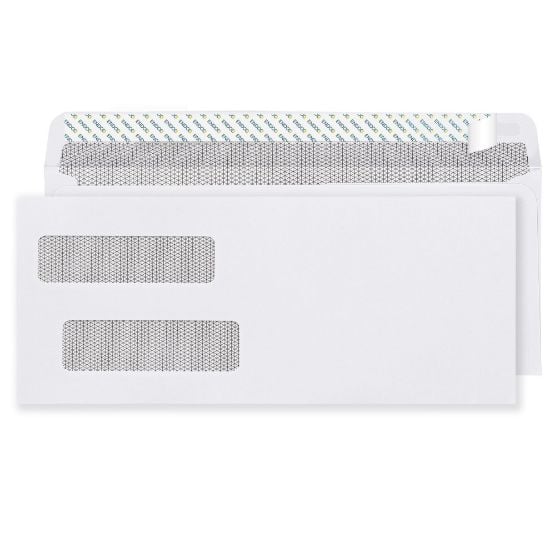
Double window envelopes are common for statements because the return address and recipient address both print on the document. Our window envelope alignment guide explains how to position the address block.
How Do You Pay Postage for Presorted Mail?
Presorted First-Class Mail can be paid three ways: a permit imprint, a postage meter, or precanceled stamps. Most high-volume business mailers use a permit imprint because it removes the need to apply postage piece by piece.
| Method | How it works | Best for |
|---|---|---|
| Permit imprint (indicia) | A printed box on the envelope; postage is deducted from an account | Large recurring mailings and preprinted envelopes |
| Postage meter | A meter strip or imprint applied to each piece | Businesses that already run a mailing machine |
| Precanceled stamps | Special stamps that do not need canceling | Mailers who want a stamped look |
Because a permit imprint is printed on the envelope itself, many businesses have it added when they order printed envelopes. Ask our team about including yours. Our metered mail vs stamps guide compares the everyday options.
How Do You Send a Presorted First-Class Mailing, Step by Step?
Sending a presorted mailing takes planning, but the steps are the same every month once you set them up.
- Confirm volume: make sure the mailing has at least 500 First-Class pieces.
- Clean the list: run CASS and Move Update processing on your addresses.
- Choose machinable envelopes: standard #10 window or plain envelopes that meet automation limits.
- Get a permit or payment method: apply at your Post Office or set up a meter.
- Print addresses and barcodes: use presort software or the free USPS small business tool.
- Sort and tray the mail: group pieces into labeled trays by ZIP Code level.
- Complete the postage statement: submit it electronically or on paper.
- Take it to the entry point: deliver the trays to the Post Office or business mail entry unit where your permit is held. Presorted mail cannot go in a street collection box.
Should You Presort In-House or Use a Mail Service Provider?
Presorting in-house makes sense when you mail large volumes on a regular schedule and can invest in software and staff time. A mail service provider makes sense when your volume is smaller or irregular, because providers combine mail from many clients to reach deeper sort levels.
- In-house: full control over timing and content, but you manage permits, software, sorting and the annual fee.
- Mail service provider: less work and often access to commingled presort prices, but you share control of the schedule.
- Either way: you still choose the envelopes, so make sure they are machinable and printed correctly.
Whichever route you take, consistent, correctly sized envelopes keep your mailing moving. Ask your provider for their envelope specifications before you order, and see our window envelopes guide for the styles most providers accept.
Why Businesses Choose Business Envelopes for Presort Mailings
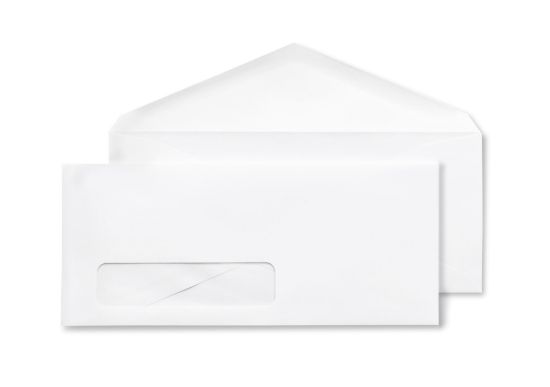
#10 window envelopes for every setup. Laser safe styles run through office laser printers, and diagonal seam styles give a classic business look.
Single and double window styles. Our double window envelopes suit invoices and statements, and #9 envelopes work as return envelopes.
Custom printing in volume. Put your logo and return address on every envelope.
Free ground shipping, no minimum. Ground shipping is free site wide with no minimum order, with a few regions excluded at checkout.
Planning a large mailing? Call 845-781-7678, email sales@businessenvelopes.com or contact our team.