
Walk into any billing department, accounts payable office, or healthcare administration team in the United States and you will find the same thing in the supply cabinet: window envelopes. The reason is simple. A window envelope displays the recipient's address from the document inside through a clear poly-film panel on the front face. No label. No handwriting. No separate addressing step. For any operation sending recurring correspondence at volume, eliminating the addressing step on every piece is a real operational improvement and it eliminates the category of errors that comes with it: wrong labels, smeared print, peeled labels, and mismatched addresses.
But there is more to window envelopes than most buyers realize. Different window positions, multiple sizes, security options, recyclability differences in the window film, software compatibility nuances, and the alignment failure modes that create returned mail and privacy exposures. This guide covers all of it.
The window is a rectangular opening cut into the front face of the envelope and covered with a thin transparent film. When the document inside is folded correctly and inserted, the recipient's name and address lines up directly behind the window. The postal carrier reads the address through the film. The envelope requires no additional addressing.
The film must be transparent and clear to meet USPS requirements. USPS DMM regulations require that the full delivery address remain completely visible through the window throughout the insert's full range of movement inside the envelope, with a minimum 1/8-inch clearance between address text and all four edges of the window opening at all points of insert movement. Every window envelope we carry is manufactured to these specifications.
For this system to work reliably on every piece, two things must be consistent: where the address block appears on your printed document, and how the document is folded and inserted. If either varies, the address drifts relative to the window. We cover how to test this before a large run in the alignment section below.
Most buyers do not know there are two different materials used for envelope windows, and that choice affects how the envelope can be disposed of after use.
Glassine is a thin, semi-transparent paper-based material. Envelopes with glassine windows can typically be recycled with standard paper because the window material is cellulose-based and compatible with paper pulping processes. Glassine windows look slightly matte compared to polypropylene.
Polypropylene is a clear plastic film. Envelopes with polypropylene windows cannot be processed in standard paper recycling without first removing the plastic film. If your organization has sustainability requirements or recycling targets, polypropylene windows complicate the envelope's end-of-life disposal unless you remove the window material before recycling the paper body.
For most recipients this distinction is invisible both look like a clear envelope window. But for procurement teams with environmental commitments, it is worth asking your supplier which material they use. If curbside recyclability of the full envelope matters for your program, confirm glassine window construction before ordering.
One transparent panel in the lower-left area shows the recipient's delivery address. Your return address is either pre-printed on the envelope or handled through custom envelope printing. Single window is the standard for invoice mailing, statement programs, marketing letters with personalized addresses, and general business correspondence where only the delivery address needs to display. The #10 single window is the most ordered commercial envelope in the US.
Two panels: one upper showing your return address, one lower showing the recipient's delivery address. Both come from the printed document inside. The envelope face carries no printing at all. Used for check mailing, payroll, and accounts payable where both address fields are already printed on the document. The check-format double window is specifically positioned to show the payee address while keeping routing numbers, account numbers, and check amounts behind the opaque envelope body a deliberate security design. See all formats at double window envelopes.
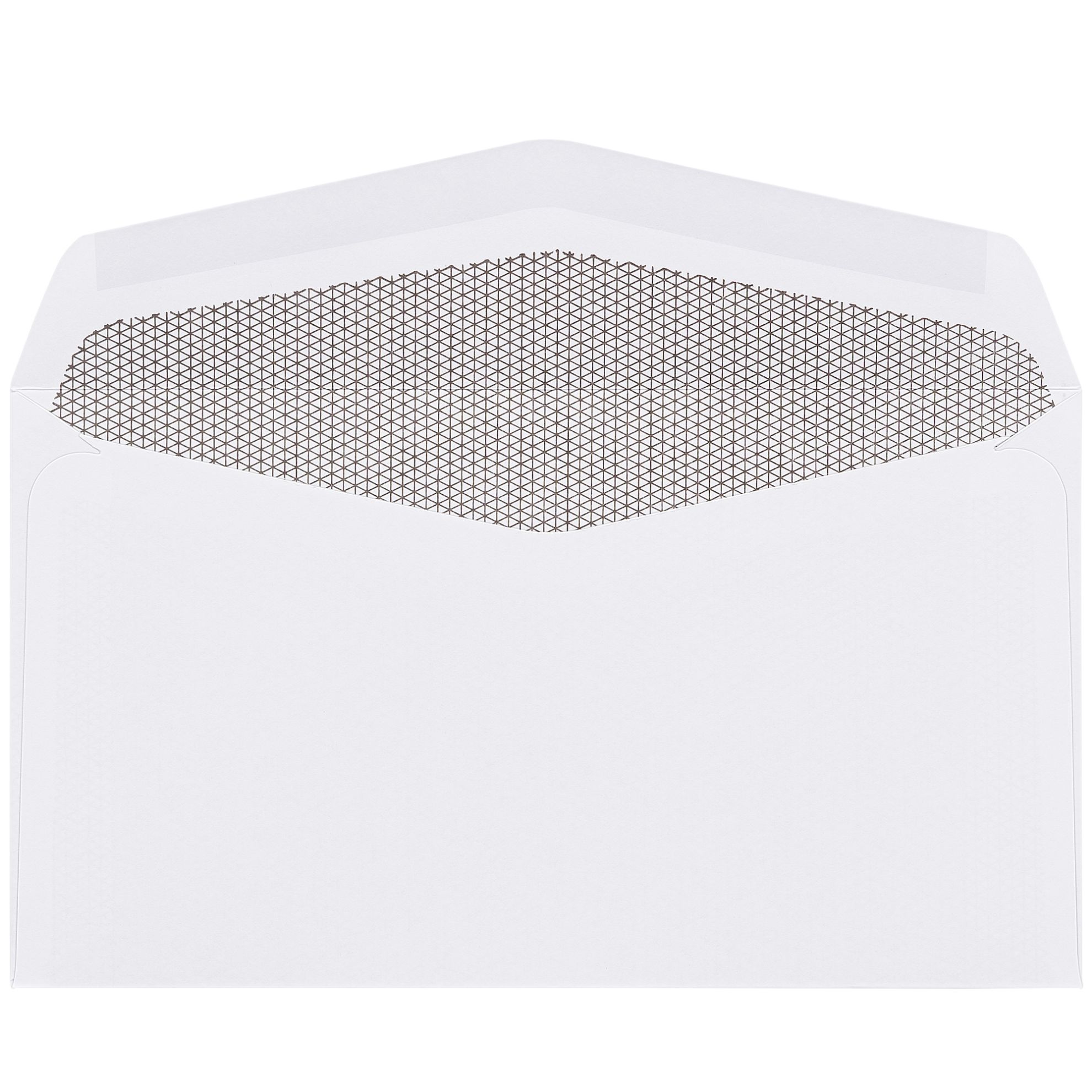
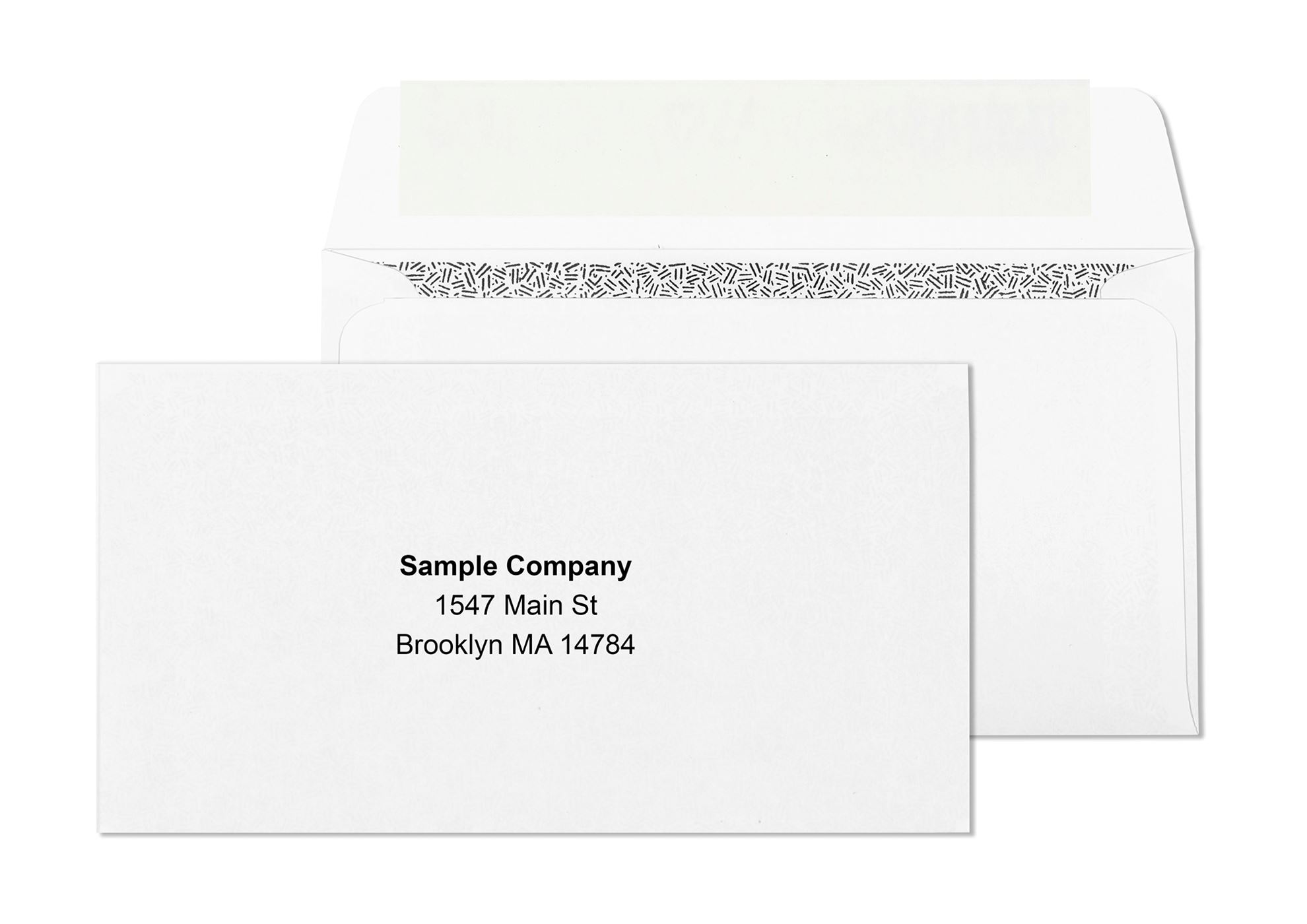
Window format with a patterned interior that blocks document contents from showing through the envelope body when held to light. The window remains clear. The tinted interior hides everything except what is deliberately positioned in the window panel. Standard for financial statements, healthcare correspondence, insurance documents, payroll, and any mailing where document privacy during transit is part of the operational requirement.
The window spans most of the envelope face, displaying the enclosed creative or document before the recipient opens the piece. Used in direct mail programs and catalog delivery where the visual impact of showing contents through the envelope is part of the campaign strategy. The 9x12 full-view window booklet at Business Envelopes is this format, displaying up to 7 x 9-3/4 inches of the enclosed document through a large clear panel.
| Size | Dimensions | Window Position | Primary Use |
|---|---|---|---|
| #9 | 3-7/8 x 8-7/8" | Standard left | Return/reply envelope inside outgoing #10; also tinted security for sensitive return mail |
| #10 | 4-1/8 x 9-1/2" | 7/8" from left, 1/2" from bottom | Standard for invoices, statements, billing, payroll, letters |
| #11 | 4-1/2 x 10-3/8" | Standard left | Slightly larger than #10, fits thicker letter packets and multi-page statements |
| #14 | 5 x 11-1/2" | Standard left | Legal-size correspondence that does not fold to #10 dimensions |
| 9 x 12 full-view | 9 x 12" | Large panel, most of face | Direct mail, catalogs, diplomas, headshots contents visible before opening |
The standard window position on a #10 envelope is 1-1/8 x 4-1/2 inches, positioned 7/8 inch from the left edge and 1/2 inch from the bottom. This is the position that QuickBooks, Xero, FreshBooks, Sage, Microsoft Word mail merge, and virtually all US billing platforms default to. When a document is printed from any of these systems and tri-folded, the address block lands behind the window without any formatting change. The software and the envelope are calibrated to the same standard.
Not every window envelope from every supplier uses this exact position. If you switch suppliers, change software, or use a custom document template, always run the 10-sample alignment test before a large batch.
Print ten documents exactly as they will look in the production run. Fold each one using the same fold method. Insert and seal each one. Hold each to a bright light source and check four things:
First, is the full delivery address visible through the window, with no characters cut off at any edge? Second, is there at least 1/8-inch clearance between the address text and all four sides of the window opening? Third, does the address stay correctly positioned when you tilt the sealed envelope and lightly shake it? Fourth, is any sensitive information visible through the window panel or through the envelope body (account numbers, balances, patient data, Social Security numbers)?
Ten samples catch the variance that one or two cannot. Slippery paper stock, a fold that is off by 1/4 inch, a document that runs slightly longer than expected all of these shift the address block relative to the window, and they show up inconsistently across a small sample. If even two of ten samples fail any of the four checks, fix the template or insert method before running the full batch.
Most billing and accounting software places the address block in the correct window zone. What they do not help you design around is what sits near the window zone on your document. Here is the risk: account numbers, outstanding balances, patient record numbers, and other sensitive data that appear just above or below the address block on a statement can drift into the window zone if the insert shifts in transit or they can show through the envelope body on lighter-weight paper stocks.
The professional standard for any document mailed in a window envelope is to keep sensitive data at least one inch away from the address block in all directions. This creates a buffer zone around the address that prevents drift exposure. If your current statement template places an account number directly above the address line, that is a privacy design issue worth correcting before the next mailing cycle. No competitor's buying guide mentions this. Most billing departments discover it only when a customer calls.
Gum flap (moistenable) is required for mailing machine inserters. Every major commercial mailing machine applies moisture to activate gum flap envelopes during automated insertion and sealing. If your operation uses mechanical inserting equipment, gum flap window envelopes are the only compatible format.
Peel-and-seal has a release liner protecting the adhesive. Pull the liner, press the flap, sealed on contact. For hand-sealing at moderate to high volume. The liner protects adhesive in storage, making this the right choice when envelopes are stocked before a run. The tamper-evident property of peel-and-seal is worth noting: if a sealed peel-and-seal envelope is reopened, the flap tears visibly. This matters for any mailing where envelope integrity on arrival is part of the professional standard.
Flip-and-stick has no liner, bonds on contact with a fold-and-press motion. Slightly faster per piece when processing immediately. Not compatible with mailing machine inserters. See all self-seal formats at self seal envelopes.
| Scenario | Window | Regular | Why |
|---|---|---|---|
| Monthly invoices, standard template | Yes | No | Address on document; window eliminates addressing step |
| Variable-format mailings (different page counts) | No | Yes | Insert shift risk too high with variable formats |
| Payroll checks (QuickBooks/ADP) | Double window | No | Both addresses on check; double window eliminates both steps |
| Financial/medical correspondence | Security tinted | Either | Security tint protects sensitive data from light transmission |
| Personal/variable letters | No | Yes | Personalized content does not always position address correctly |
| Direct mail with personalized address | Yes | No | Mail merge positions address consistently; window handles it efficiently |
| Maximum visual privacy | No | Yes | No window exposure risk; combine with security tint if needed |
Clinics, hospitals, insurance carriers, and billing services send enormous volumes of EOBs, lab results, patient invoices, and HIPAA-regulated correspondence. HIPAA requires covered entities to protect protected health information (PHI) during transmission. Security-tinted window envelopes are the recognized professional standard for this category. The window provides addressing efficiency; the tinted interior ensures that patient information, account numbers, and medical data are not readable through the envelope body. For any healthcare organization that has not evaluated its envelope stock against HIPAA transmission protection requirements, security-tinted window envelopes are the appropriate starting point.
Teams processing physical checks (payroll, vendor payments, expense reimbursements) depend on double window envelopes aligned to their accounting software. When a check from QuickBooks, ADP, or Intuit already has both addresses printed, the double window handles the complete addressing task in one step. See double window envelopes for all compatible formats.
Law offices, accounting firms, banks, and financial institutions deal in time-sensitive confidential documents. Security-tinted window envelopes with peel-and-seal tamper-evident closure are the default for client-facing correspondence in these sectors. The tamper-evident seal provides basic chain-of-custody protection: if an envelope arrives visibly disturbed, the recipient can identify it before opening.
Mail merge programs produce documents with each recipient's address in a consistent position. Window envelopes handle the addressing at scale, eliminating labels and the inconsistency they introduce. For campaigns where envelope open rate matters, the tinted or colored window formats at colored envelopes combine addressing efficiency with visual impact.
Business Envelopes has supplied window envelopes to billing departments, healthcare offices, accounting firms, and direct mail operations since 1997. Our window position is manufactured to the industry standard that QuickBooks, Sage, and all major US billing platforms default to not close to it. Our poly-film does not wrinkle, distort, or create postal readability issues under laser printer heat. Our security tint covers the full interior including fold zones, where cheaper security patterns leave gaps. Every format single window, double window, security tinted, gum flap, peel-and-seal, flip-and-stick, plain, custom printed is available without minimums and ships free across the contiguous 48 states.
Browse the full window envelope range at businessenvelopes.com/window-envelopes or start with the #10 envelope collection for the most commonly ordered format. For flat-document mailing in window format, see the 9x12 full-view window.
A window envelope has a clear poly-film panel on the front face. When the enclosed document is folded and inserted correctly, the recipient's address on the document lines up behind the window and displays through it. No label, no addressing step. The postal carrier reads the address through the film.
Glassine is paper-based and can be recycled with the envelope in standard paper recycling. Polypropylene is a clear plastic film that must be removed before paper recycling. For organizations with sustainability targets, glassine windows are the environmentally preferable choice.
Yes. Standard #10 window envelopes align with the default address block position in QuickBooks, Xero, Sage, and most US billing platforms. When a document is printed and tri-folded, the address lands in the window. Always run the 10-sample test before any batch run to confirm alignment with your specific template and paper stock.
Single window shows the delivery address only. Double window has two panels showing both return address and delivery address from the document inside. Double window is used for check mailing and payroll where both addresses are pre-printed on the check or voucher.
HIPAA requires covered entities to protect patient health information during transmission. Security-tinted window envelopes prevent document contents from being read through the envelope body when held to light, and are the recognized professional standard for sensitive medical correspondence. Most healthcare billing operations use them as their default for all patient-facing outgoing mail.
No. Standard mailing machine inserters are designed for moistenable gum flap envelopes and apply water to activate the adhesive during the automated insertion and sealing cycle. Peel-and-seal and flip-and-stick closures are for hand-sealing operations. If you use mechanical inserting equipment, order gum flap envelopes.
Business Envelopes carries window envelopes in #9 (3-7/8 x 8-7/8"), #10 (4-1/8 x 9-1/2"), #11 (4-1/2 x 10-3/8"), #14 (5 x 11-1/2"), and 9x12 full-view formats. All meet USPS window placement requirements for automated processing.
The average American household receives approximately 454 pieces of direct mail per year. A standard white #10 envelope blends into that stream without pausing anyone. A starburst envelope does not blend in. The bold multicolor pattern on the envelope face creates visual distinction at the exact moment the recipient is sorting mail before they have read anything you wrote, before they have opened anything you sent. That moment of visual distinction is the entire competitive advantage of a starburst envelope. Everything else the letter, the ask, the response device only matters if the envelope gets opened.
This guide covers the complete starburst envelope picture: what they are, every size available, the documented response rate data that tells you when color is worth the premium, the USPS compliance rules that most sellers omit, teaser copy strategy, and when a starburst envelope is the wrong choice regardless of how attractive it looks.
A starburst envelope is a standard business or catalog envelope with a bold, multicolor starburst or burst pattern printed across the face. The pattern is printed on the envelope stock itself, not applied as a label or sleeve. Unlike a solid-color wove envelope (which carries a single dyed color), the starburst pattern is visually aggressive saturated, high-contrast, multi-color. It signals: "Open this. It is different from everything else in your mailbox."
Starburst envelopes are not for every program. They are specifically optimized for direct mail acquisition, year-end donor appeals, fundraiser campaigns, and any mass-mailing context where standing out in a competitive mail pile is the primary objective and where the audience is expected to respond to this type of visual signal positively.
| Size | Dimensions | Postage Class | Best Use |
|---|---|---|---|
| #6 3/4 Starburst | 3-5/8 x 6-1/2" | Letter (if stamp-required) | Donor reply envelope inside #10 outgoing matched visual package with #10 starburst outer |
| #9 Starburst | 3-7/8 x 8-7/8" | Letter | Reply envelope inside #10 outgoing; donor response for matched starburst packages |
| #10 Starburst | 4-1/8 x 9-1/2" | Letter | Standard outgoing direct mail and fundraiser appeal envelope; most common starburst use |
| 6x9 Starburst | 6 x 9" | Letter (on light contents) or Flat | Larger-format direct mail outgoing; stands out more than #10 by format size alone |
| 9x12 Starburst | 9 x 12" | Always Flat ($1.63) | High-impact catalog mailings, large-format campaigns, full-face visual impact for premium donors |
All starburst formats are available with peel-and-seal closure. Custom printing is available on all starburst sizes for return address, organization name, and teaser copy. Browse all colored and starburst options at colored envelopes.
The outer envelope is consistently the most tested and most impactful variable in direct mail packages. According to data from multiple direct mail testing programs reviewed by Moceanic (a direct mail strategy consultancy) and corroborated by the 2025 ANA/DMA Response Rate benchmarks:
Unusual paper stock and colors outperform standard white in direct mail acquisition approximately 70% of the time across tested programs. The more competitive the mailbox environment (year-end giving season, high-frequency household), the stronger the color envelope's relative performance advantage over white.
Direct mail overall achieves open rates of up to 91% per USPS research, compared to 20-30% for email. But that 91% average includes a wide range unopened direct mail is overwhelmingly pieces that did not earn attention at the mailbox sorting moment. The envelope is the entire variable at that moment.
Nonprofit house list donor appeals using unusual envelope stock and color have measured response rate improvements of 15-25% over identical packages in standard white envelopes in multiple A/B tests. Cold acquisition mailings show smaller improvements color helps at acquisition, but less dramatically than on house lists where the audience already has a relationship with the sender.
For operations mailing over 1,000 pieces at a time, a 15% response rate improvement typically offsets the per-unit starburst premium within a single mailing cycle. For very small volume (<200 pieces), the math is less clear the per-unit premium is real and the response lift on small samples has too much statistical noise to measure reliably.
The program is nonprofit fundraising or direct mail acquisition, where emotional response and visual distinction drive conversion. The mailing occurs during high-competition mailbox periods (October through December year-end giving season is the single most important period). The audience is general public or warm donor house list where colorful mail signals "this is interesting" rather than "this is low-quality." The program tests response rate and can compare starburst vs white on a controlled split.
The audience is professional B2B where high-energy consumer visuals read as low-credibility. The correspondence is confidential, financial, or legal where the professional expectation is a white business envelope. The recipient relationship requires a formal or restrained visual presentation (executive correspondence, law firm correspondence, premium client communications). The mailing volume is too small to test response rate improvement, and the per-unit premium cannot be justified by proven lift in your specific program.
Starburst envelopes can carry teaser copy in the printed area a short phrase or question on the envelope face that creates urgency or curiosity before the recipient opens the piece. Teaser copy works differently on starburst vs white envelopes. On a white envelope, teaser copy must do all the visual work of stopping attention. On a starburst, the bold pattern has already done the visual stopping the teaser copy then provides the specific reason to open.
Effective teaser approaches for starburst envelopes: a direct benefit statement ("Your gift provides 30 school meals"), an urgency trigger ("Matching funds expire December 31"), a specific impact number ("$25 saves one acre"), or a genuine question about something the reader cares about. Avoid: generic "Important Information Inside" (too vague), your full organization mission statement (too long for the envelope face), or promotional language that signals pure marketing ("GREAT DEAL INSIDE").
The no-teaser approach is also effective on starburst. In controlled testing across multiple direct mail programs, envelopes with no teaser (blank face except return address) outperform envelopes with teasers approximately 75% of the time because the mystery of not knowing what is inside creates its own opening impulse. The starburst pattern provides the visual stop; the blank message creates the curiosity. This combination is a strong tested default for starburst programs that have not run their own teaser copy tests.
Starburst envelopes that will be addressed for mailing must meet the same USPS OCR compliance requirements as any other envelope. Two rules apply specifically to colored or patterned envelopes:
Barcode clear zone: The bottom 5/8 inch (0.625 inches) of the envelope face is reserved for the Intelligent Mail Barcode that USPS sorting equipment applies. No printing, design elements, pattern, or starburst colors should appear in this zone. Most commercially produced starburst envelopes are manufactured with this clear zone preserved but confirm with your supplier that the starburst pattern does not extend into the bottom 5/8 inch before ordering.
Address contrast: USPS OCR equipment requires sufficient contrast between the delivery address text and the background behind it. A dark-ink address on a starburst background may not provide adequate contrast for reliable machine scanning if the pattern elements behind the address are saturated or dark. The professional solution: use a window envelope format for starburst programs, displaying the address from the enclosed document through a clear poly-film window rather than printing or labeling the address directly on the patterned face.
For any starburst mailing where you must print the address directly on the face (for example, for EDDM flat mailings), apply a white address label in the delivery address zone to ensure OCR contrast compliance. Confirm with your postal clerk before any large starburst run where the address appears directly on the patterned envelope face.
The most effective starburst configuration for donor programs and direct response campaigns is a matched visual package: a starburst #10 or 6x9 outgoing envelope paired with a starburst #9 or #6 3/4 reply envelope inside. When the donor opens the starburst outer and finds a matching starburst reply envelope already inside, the visual consistency communicates that this is a complete, designed communication not a form letter. The enclosed starburst reply envelope also remains visually distinct in the recipient's desk or counter for the days between when they open the appeal and when they finally respond a subtle ongoing call to action that a plain white return envelope cannot provide.
For the complete outgoing package to complement starburst envelopes, browse #10 envelopes, 6x9 envelopes, and custom printed envelopes for logo and teaser copy printing on any format.
Starburst (multicolor burst pattern) and solid wove color (single dyed color through the paper) serve different visual communication functions and are not interchangeable.
Starburst signals urgency, excitement, and visual drama. It reads as commercial direct mail deliberately and unambiguously so. It maximizes visual attention in a mail pile. It performs best in contexts where the audience expects this type of communication and responds to it positively (donor appeals, consumer promotions, acquisition campaigns).
Solid wove color signals brand identity, organizational personality, and institutional association. An amber kraft or a deep blue wove reads as deliberate brand communication rather than promotional urgency. It distinguishes from white without screaming. For membership organizations with established brand colors, professional associations, and any context where the audience should feel informed and respected rather than excited, solid wove color is the more appropriate choice. Browse solid wove colors at colored envelopes.
Business Envelopes has supplied starburst envelopes to US nonprofits, direct mail operations, political campaigns, and membership organizations since 1997. Our starburst pattern is printed on the envelope stock directly (not a label or sleeve overlay), with the USPS barcode clear zone preserved at the bottom 0.625 inches of the envelope face. Available in #6 3/4, #9, #10, 6x9, and 9x12 formats, all with peel-and-seal closure. Custom printing with return address and teaser copy on all formats. No minimums. Free ground shipping. Printed orders ship in 7 to 10 business days from proof approval. See the full catalog at all items.
Starburst envelopes are used for direct mail acquisition, nonprofit fundraiser appeals, donor house-list mailings, political campaigns, and any mass-mailing program where standing out in a competitive mailbox is the primary objective. The bold multicolor pattern creates visual distinction at the mailbox sorting moment before the recipient reads anything which drives higher open rates compared to standard white envelopes in these contexts.
Business Envelopes carries starburst envelopes in #6 3/4 (3-5/8 x 6-1/2 inches), #9 (3-7/8 x 8-7/8 inches), #10 (4-1/8 x 9-1/2 inches), 6x9 (6 x 9 inches), and 9x12 (9 x 12 inches). All available with peel-and-seal closure and custom printing options.
In controlled A/B tests across nonprofit and direct mail programs, unusual envelope stock and colors outperform standard white in approximately 70% of tested programs. House list donor appeals using colored envelopes have shown 15-25% response rate improvements in multiple tested programs. The improvement is larger in competitive mailbox environments (year-end giving season) and on warm house lists than on cold acquisition mailings.
The starburst pattern makes direct address printing challenging for USPS OCR compliance the patterned background may not provide sufficient contrast for machine scanning. The professional solution is to use a window format (address shows through from the enclosed document) or apply a white label in the delivery address zone. Confirm OCR compliance with your postal clerk before any large run where the address appears directly on the patterned face.
Starburst envelopes have a bold multicolor burst pattern printed on the face they signal urgency and visual drama, ideal for direct mail and donor appeals. Solid wove colored envelopes are dyed a single color through the paper they signal brand identity and organizational personality, ideal for membership correspondence and programs where distinguished rather than dramatic presentation is the goal.
Testing shows no-teaser envelopes outperform teasers approximately 75% of the time. The starburst pattern already creates visual stopping power; the mystery of a blank envelope face drives curiosity and opens. If you add teaser copy, make it specific and impactful: a direct benefit statement or urgency trigger, not a generic "Important Information Inside." Run your own A/B test before scaling a teaser approach.
Yes. Custom printing (return address, organization name, teaser copy) is available on all starburst sizes. PDF proof before production. Artwork stored on file for reorders. Ships in 7 to 10 business days from proof approval. Free ground shipping on every order, no minimums.
The #10 envelope is the most ordered commercial envelope in the United States, and for good reason it is the only format that handles folded 8.5 x 11 correspondence at USPS First-Class letter rate, works with every major accounting and billing platform out of the box, and comes in enough style variations to cover every office mailing need from plain white correspondence to check mailing with two-panel address display. If you mail business letters, invoices, statements, payroll, or fundraiser appeals, the #10 is almost certainly already part of your operation. This guide covers every dimension, every style, every flap type, and a handful of things about #10 envelopes that no supplier's product page bothers to explain.
A #10 envelope measures 4-1/8 inches tall by 9-1/2 inches wide (4.125 x 9.5 inches), or 105 x 241 mm in metric. The interior workspace is approximately 4 x 9-1/4 inches, giving a standard tri-folded 8.5 x 11 sheet roughly 1/8-inch clearance on each side. That 1/8-inch clearance is intentional engineering: tight enough that the document does not shift visibly in transit, loose enough that machine insertion works cleanly at speed.
The "#10" designation has nothing to do with the envelope's dimensions. It comes from a commercial numbering system developed by William Irwin Martin and published in the Stationers' Handbook of 1876. Before Martin's work, every envelope manufacturer assigned their own size labels, creating chaos for businesses trying to order consistently across suppliers. Martin introduced a numbered classification that standardized the industry. The number 10 is simply a catalog identifier from that 1876 system it has persisted unchanged for 150 years because the 4.125 x 9.5 inch format it describes became the de facto standard for US business correspondence.
The standard fit is an 8.5 x 11 sheet of paper folded into thirds (tri-folded), producing a panel approximately 3-11/16 x 8-1/2 inches. One to three sheets of standard 20 lb bond paper, tri-folded, weigh approximately 0.3 to 0.5 ounces. The envelope itself weighs roughly 0.18 ounces. A two to three sheet mailing stays comfortably under one ounce, the single-stamp First-Class threshold at $0.78.
| Contents | Fits? | Weight Note |
|---|---|---|
| 1 sheet, tri-folded (20 lb) | Yes | ~0.25 oz total piece well under 1 oz |
| 3 sheets, tri-folded (20 lb) | Yes | ~0.55 oz total one stamp |
| #9 reply envelope + 1-sheet letter | Yes | ~0.55 oz total standard billing setup |
| Folded business check + voucher | Yes | Use double window for address alignment |
| 5 sheets, tri-folded (20 lb) | Tight | ~0.80 oz may exceed 1 oz with heavy paper |
| 8.5 x 11 sheet, half-folded | No | 5.5" width exceeds interior use 6x9 |
| 8.5 x 11, unfolded | No | Use 9x12 envelope |
Most buyers order envelopes for years without knowing what the parts are called. Understanding the anatomy matters when you are comparing construction quality or specifying print placement.
The body is the main rectangular panel. The flap is the triangular or straight section at the top that folds down to seal. The throat is the opening of the envelope the space between the flap and the body when the envelope is open. The seam is where the body panels are bonded together, either along the sides (side seam construction) or along the center of the back panel (center seam or diagonal seam construction). The seam overlap is the width of the bonded zone.
For #10 commercial envelopes, side seam construction is the standard. Side seams run parallel to the envelope's long edge, which allows the body to lie flat during high-speed machine insertion. Center seam and diagonal seam construction, common on heavier catalog envelopes, do not feed cleanly through automated inserting equipment. If your office uses a mailing machine inserter, confirm that the envelope you order specifies side seam or machine insertable construction.
The flap is where most buyers stop reading the spec sheet, which means they sometimes order the wrong format for their workflow.
Commercial flap (V-flap): The pointed triangular flap is the standard for American business correspondence. It closes cleanly under postal sorting pressure, feeds reliably through mailing machines, and provides a clean gum strip surface. This is the flap on virtually every #10 envelope in routine office use.
Square flap (wallet flap): A straight-edge flap that runs the full width of the envelope. More modern aesthetic, popular for marketing and branded correspondence where the envelope's visual presentation matters. The larger flap face provides more surface area for custom printing. Not ideal for automated inserting equipment.
Policy flap: The policy envelope opens on the short edge rather than the long edge, like a catalog envelope in commercial envelope dimensions. Documents are inserted from the side rather than the top. Used in insurance correspondence and some legal applications. Not stocked at Business Envelopes but worth knowing when a client specifies it.
The number refers to the weight of 500 sheets of the paper at its base size. Higher weight means thicker, stiffer paper with better opacity and a more premium feel in hand.
20 lb bond is the lightest common option. Slightly translucent when held to light, which is why security tinting matters if the document carries sensitive data. Adequate for routine correspondence where document privacy is not a concern.
24 lb wove is the most common commercial grade. Better opacity than 20 lb, smooth wove surface accepts laser printing cleanly, handles machine insertion reliably. This is the standard for the security-tinted and window formats in our catalog.
28 lb is the premium business weight. Noticeably stiffer, better opacity, more substantial feel when the recipient opens the piece. Used for formal correspondence, law firm letters, and any communication where the physical quality of the envelope is part of the brand signal.
24 lb white wove with a moistenable gum flap and V-flap. The default for routine business correspondence. Available blank or with custom logo and return address printing. Laser and inkjet compatible. Standard for law firm cover letters, HR correspondence, and everyday outgoing business mail.
Same 24 lb wove with a patterned interior that blocks document contents from showing through the envelope body when held to light. The tinting pattern is applied to the interior only the exterior looks identical to plain white. Standard for financial statements, payroll, medical records, and any document where contents carry sensitive personal or account data. Security tint is not uniform across the industry: pattern density varies by manufacturer. Our security tint provides full interior coverage with no gaps at the fold lines.
Security tint interior with a peel-and-seal closure. The protected liner keeps the adhesive stable in storage before use, making this the right choice when envelopes are stocked weeks before a mailing run. Bonds on contact when the liner is removed. No moisture station, no sponge, no variable seal quality across a batch.
Security tint with a flip-and-stick closure for the fastest per-piece sealing on high-volume runs where envelopes are processed immediately. No liner to remove. Fold the tab, press the flap, sealed. Used by billing departments and insurance offices running statement batches where every second per piece matters. Note: flip-and-stick closures are not compatible with standard mailing machine inserters, which require moistenable gum flap envelopes. If you run a mechanical inserter, use gum flap.
Clear poly-film window at standard left position: 1-1/8 x 4-1/2 inches, 7/8 inch from left edge, 1/2 inch from bottom. This position is the USPS and industry standard that QuickBooks, Xero, FreshBooks, Sage, and virtually all US billing platforms default to. When a document is printed and tri-folded correctly, the recipient's address lands in the window without any formatting change. Browse all window formats at window envelopes.
Window format with security tint interior. The window shows only the address; the tinted body blocks everything else from transmitted light. Standard for billing departments sending statements with account numbers or balances visible on the document face.
Two poly-film panels. Upper window shows your return address from the document; lower window shows the recipient address. Both addresses come from the printed document inside. Eliminates all addressing on both sides of the envelope. Available in check-format (sized for printed checks, lower window positioned to show payee address while hiding routing and account numbers behind the opaque body) and invoice format (sized for #10 invoices and statements). These formats are not interchangeable verify before ordering. See all formats at double window envelopes.
Solid-color wove in assorted colors (gum flap) and bold starburst pattern (peel-and-seal) for direct mail programs and fundraiser appeals where open rate depends on the envelope standing out in a mail pile. Custom printing available on all colors. See the full range at colored envelopes.
A #10 envelope sits comfortably within USPS First-Class letter rate dimensions: 3.5 to 6.125 inches tall, 5 to 11.5 inches long, maximum 1/4 inch thick, maximum 3.5 oz. Standard #10 with tri-folded paper content mails at $0.78 per ounce (first ounce), $0.29 per additional ounce up to 3.5 oz.
The nonmachinable surcharge of $0.49 applies when a piece cannot pass through automated postal sorting. Triggers for a #10 include: rigid contents that create a lump or bump in the envelope face, square or other non-rectangular shapes, clasps or buttons, envelopes that are too stiff or too flexible to process cleanly, and contents that cause uneven thickness across the piece. A coin, an unclipped business card, a USB drive, or any small rigid object that is not pressed flat against the folded document will trigger the surcharge. Secure flat objects against the document before inserting to avoid it.
The international DL envelope (4.313 x 8.625 inches, or 110 x 220 mm) is the European equivalent of the #10 for mailings to international clients and partners. It holds an A4 sheet (the international equivalent of 8.5 x 11) folded into thirds. DL envelopes are not stocked at Business Envelopes but worth noting for clients with international correspondence programs.
Before any batch run using window envelopes, run this test. Print ten documents exactly as they will appear in the full run. Fold each one the same way. Insert each into an envelope and hold it up to a bright light source. Check: is the full delivery address visible through the window with at least 1/8-inch clearance on all four sides? Does the address stay in position when you tilt and lightly shake the envelope? Is any sensitive data visible through the window or through the envelope body?
Ten samples catch the variance that one sample misses. Slippery paper, a fold that is 1/4 inch off, and temperature-induced paper expansion all shift the address block. If even two of your ten samples show a partially blocked address or visible account data, fix the template before printing the full run. This test takes five minutes. A 500-piece batch with misaligned windows is a day's work to fix.
Gum flap envelopes rely on moisture-activated adhesive. Most suppliers leave it there. Here is the problem: if you stack gum flap envelopes in a supply room or delivery truck during summer months, heat combined with ambient humidity can partially activate the gum flap adhesive before you use the envelope. The result is a batch that seals inconsistently or partially pre-seals during storage. For high-volume operations that stock large quantities of gum flap envelopes months in advance, peel-and-seal is the technically safer choice because the release liner protects the adhesive from ambient conditions until the moment of intentional activation. This is not a rare problem in regions with hot, humid summers it is a recurring mailroom complaint that peel-and-seal format eliminates entirely.
Business Envelopes has supplied commercial envelopes to US offices, nonprofits, healthcare facilities, law firms, and billing departments since 1997. The full #10 lineup plain, tinted, window, double window, colored, starburst, custom printed is all in one place with no minimums and free ground shipping on every order across the contiguous 48 states. Blank stock ships same or next business day. Custom printed orders ship in 7 to 10 business days from proof approval, with artwork stored on file for frictionless reorders.
We carry only commercial-grade 24 lb wove stock, not the lighter paper that warehouse suppliers substitute to hit lower price points. Our security tint provides full interior coverage, including the fold zones where cheaper security patterns leave gaps. Our window poly-film is laser-safe and does not distort or wrinkle under standard laser printer output temperatures. Browse the full lineup at businessenvelopes.com/10-envelopes or the complete catalog for every size we carry. For other envelope sizes that work alongside #10s in a complete mailing program, see window envelopes, self seal envelopes, and colored envelopes.
A #10 envelope measures 4-1/8 x 9-1/2 inches (4.125 x 9.5 inches), or 105 x 241 mm. The interior workspace is approximately 4 x 9-1/4 inches. It holds a standard 8.5 x 11 sheet tri-folded into thirds and mails at USPS First-Class letter rate on contents under 3.5 oz.
The designation comes from a commercial numbering system developed by William Irwin Martin and published in 1876. Before that system, envelope manufacturers used inconsistent labels. Martin standardized the industry with numbered designations. The number 10 is a historical catalog identifier, not a reference to any dimension.
A commercial flap has a pointed V-shape and is the standard for business mail. It feeds cleanly through mailing machine inserters and provides reliable postal sorting compatibility. A square flap has a straight edge across the full width and is more commonly used for marketing and branded correspondence where visual presentation matters, but is not compatible with automated inserting equipment.
Rigid contents that create a lump in the envelope face, clasps or metal fasteners, an unclipped business card or small rigid object not pressed flat against the document, an envelope that is too stiff or too flexible to process through sorting equipment, or a piece that is square-shaped. The surcharge is $0.49 as of current USPS rates. A standard tri-folded letter in a #10 does not trigger it.
Yes. Standard #10 window envelopes are designed to align with the default invoice and statement address block positions in QuickBooks, Xero, Sage, and most US billing platforms. The standard window position (7/8 inch from left, 1/2 inch from bottom) matches what these platforms output by default. Always run the 10-sample test before any batch run to confirm alignment with your specific template and paper.
Peel-and-seal has a release liner protecting the adhesive strip on the flap. You pull the liner and press the flap down. Best when envelopes are stocked in advance because the liner protects the adhesive from humidity and heat in storage. Flip-and-stick has an adhesive panel on the envelope body and a short tab that folds over it. No liner to remove, slightly faster per piece when processing immediately. Neither is compatible with standard mailing machine inserters, which require moistenable gum flap envelopes.
A security tinted envelope has a patterned print applied to the interior paper surface that blocks transmitted light, preventing document contents from being read through the envelope wall when held to a light source. The tinting is a printed pattern on the paper itself, not a coating applied over the surface, so it does not wear off or degrade. Quality varies between manufacturers in pattern density and fold-zone coverage. Our security tinted envelopes provide full interior coverage including the fold zones.
A postage stamp is one of the smallest purchases in business, yet getting it wrong delays payments, returns legal documents, and stalls time-sensitive correspondence. This guide covers every current USPS stamp type, where to buy them, and how to match the right postage to the right envelope so nothing comes back to you.
Pair every letter with the right #10 envelope and you eliminate the two most common mailing mistakes in one step.
USPS introduced the Forever stamp in 2007. The idea is simple: a Forever stamp always covers the current First-Class rate for a one-ounce domestic letter, no matter what you paid for it. A stamp bought years ago still mails a letter today at the current rate. You never need to buy adjustment stamps to top up old stock.
This makes Forever stamps the smart choice for any business that keeps stamp inventory. Stock up before a rate increase and every stamp in your drawer is still full-value postage. For most standard mailings, a Forever stamp on a #10 envelope is all you need.
First-Class Forever Stamps
The standard stamp for domestic one-ounce letters. Works for standard-size letters, greeting cards in A7 envelopes, and any flat mailpiece weighing one ounce or less. Available in sheets of 20, booklets of 20, and rolls of 100, 500, or 3,000 for high-volume mailers. Rolls are the practical choice for offices running weekly invoice or statement cycles through self seal envelopes.
Additional Ounce Stamps
Every ounce over the first adds to the cost of a First-Class letter. If you regularly mail multi-page documents, contracts, or anything with a return-reply enclosure, weigh the piece before assuming a single stamp covers it. An undelivered overweight letter costs far more in reprinting and delays than the extra stamp.
Postcard Stamps
Postcards mail at a lower rate than standard letters. To qualify for postcard rate, the piece must be between 3.5 × 5 inches and 4.25 × 6 inches and no thicker than 0.016 inches. Anything outside those dimensions mails as a letter at the full First-Class rate.
Global Forever Stamps
One Global Forever stamp covers a one-ounce letter to any country in the world. Canada, UK, Germany, Australia, Japan: all covered at one flat rate. Like the domestic Forever stamp, it never expires and always covers the then-current international one-ounce rate. For letters over one ounce internationally, weigh and calculate at a USPS counter or through Click-N-Ship.
Semipostal Stamps
Semipostal stamps cost slightly more than a standard Forever stamp. The extra amount above the First-Class rate goes to a designated charitable fund. They work as valid postage just like any other stamp.
Where to buy postage stamps
USPS Post Office
Every post office sells stamps at face value in singles, booklets, sheets, and rolls. Self-service kiosks at many locations let you buy stamps by credit card without waiting in line. The post office is the only place to buy specialty stamp rolls over the counter.
USPS.com Postal Store
The official USPS website carries over 100 stamp designs including themed collections, commemorative issues, and limited releases. Orders are mailed to your address. A good option if you want a specific design for wedding invitations or event mailings.
Grocery stores and pharmacies
CVS, Walgreens, Walmart, Target, and most major grocery chains sell Forever stamp booklets at face value through the USPS Stamps to Go program. Convenient for small purchases but selection is limited to standard booklets.
Amazon
Amazon sells USPS stamps in booklets and rolls through the official USPS store and authorized third-party sellers. Buy only from the official USPS listing or sellers with verified ratings to avoid counterfeits.
Online postage platforms
Stamps.com, Pitney Bowes PitneyShip, and USPS Click-N-Ship let you purchase and print postage directly from your computer. Metered rates through these platforms are typically lower than retail stamp rates. For businesses mailing more than 50 letters per week, the savings add up faster than the monthly platform fee.
The stamp type you need depends on three things: weight, destination, and envelope size.
Standard #10 business letter: One First-Class Forever stamp covers a single sheet folded in thirds inside a standard #10 envelope. Add one additional ounce stamp for every ounce over one.
Window envelopes for invoices: One stamp per piece unless contents weigh over one ounce. Many businesses running high invoice volumes switch to metered postage to reduce cost per piece. Pair with window envelopes so the printed address shows through without double printing.
9×12 catalog envelopes with flat documents: Most single-sheet mailings in a 9×12 catalog envelope need one Forever stamp plus one additional ounce stamp at minimum. Always weigh before you seal.
A7 greeting card envelopes: Standard greeting cards usually need one stamp unless you include inserts or heavy cardstock.
International mail: Use one Global Forever stamp for any one-ounce letter to any country. Domestic stamps alone do not cover the international rate.
Oversized or square envelopes: Square envelopes trigger a non-machinable surcharge at USPS. This applies to any envelope with an aspect ratio between 1:1 and 1:1.3.
Checks and sensitive documents: Use check envelopes with security tinting so contents are not visible through the envelope. For documents that cannot arrive damaged, Tyvek envelopes are tear-proof, puncture-resistant, and moisture-resistant — worth the upgrade for legal filings, medical records, and contracts.
Business Envelopes has been supplying commercial envelopes to US offices, law firms, healthcare facilities, nonprofits, and direct mail operations since 1997. Here is what sets the catalog apart from general office supply retailers.
Depth of selection. Most office supply stores carry three or four envelope formats. Business Envelopes carries every commercial size from #6 3/4 through 10×15, in plain white, security tinted, window, double window, colored, Tyvek, kraft clasp, self-seal, and peel-and-seal configurations. If your mailing program has a specific format requirement, it is in the catalog.
Custom printing with real turnaround times. Return address, company logo, and full-color printing on any envelope in the catalog. PDF proof before production, nothing prints without your approval. Finished stock ships within 7 to 10 business days from proof approval.
Self-seal options in every standard size. Every major format at Business Envelopes is available in a self-seal configuration. The adhesive strip is protected until you peel the liner — no pre-sealing from humidity in storage.
Tyvek for documents that cannot arrive damaged. When a contract, legal filing, or medical record genuinely cannot arrive with a torn corner or moisture damage, Tyvek envelopes made from DuPont high-density polyethylene fiber are the right choice. Available in 6×9, 9×12, 10×13, and 10×15.
Free ground shipping on every order. No minimums, no thresholds. Every order ships free to the contiguous 48 states.
Why the right envelope matters as much as the stamp
A correctly stamped letter in the wrong envelope creates its own problems. An overweight mailing in an undersized envelope gets returned. A window envelope where the address block does not align with the cutout requires hand-addressing or reprinting. A paper envelope carrying a moisture-sensitive document arrives damaged.
The most common mismatches worth knowing:
Using a standard #10 for a two-page letter without checking the weight. Two sheets of 24 lb bond in a standard #10 envelope typically comes in just over one ounce. Add a return address enclosure and it is clearly over. One additional ounce stamp fixes it.
Using domestic stamps on international correspondence. The domestic rate does not cover international postage. A letter sent to London or Toronto with only a Forever stamp will be returned or delivered postage-due.
Using a paper catalog envelope for documents that need to arrive pristine. Thick reports, architectural drawings, and legal filings belong in a Tyvek envelope or clasp envelope, not a standard paper mailer.
Frequently asked questions
A Forever stamp always covers the current First-Class rate for a one-ounce domestic letter. It never expires and never needs to be topped up after a rate increase.
No. Forever stamps have no expiration date and are always valid for one ounce of First-Class domestic postage regardless of when they were purchased.
One Forever stamp plus one additional ounce stamp covers most single-document mailings in a 9×12 catalog envelope. Always weigh the sealed envelope to confirm.
No. Domestic stamps alone do not cover the international rate. Use a Global Forever stamp or buy the correct international postage at a USPS counter or through Click-N-Ship.
USPS charges extra for letters that cannot be processed by automated equipment. Square envelopes and pieces with an unusual aspect ratio all trigger the surcharge.
USPS post offices, grocery stores, pharmacies, and Amazon all sell stamps at face value. Online postage platforms offer lower metered rates but require a monthly subscription fee that only makes sense for businesses mailing regularly at volume.
For standard business letters, a #10 envelope is the correct match. For invoices, use a window envelope. For unfolded documents, use a catalog envelope. For sensitive documents, use Tyvek envelopes.
Standard paper sizes in the United States follow a system different from virtually every other developed country in the world. While most nations use the ISO 216 international standard built around metric measurements, the US uses an inch-based system anchored to Letter size (8.5 x 11 inches). That difference matters practically for anyone printing, designing, mailing, or ordering supplies for a US business operation. Import a document template from Europe and the margins will be off. Order paper from an international supplier without specifying US Letter and you'll get A4. Print a legal contract on Letter stock when the firm expects Legal size and the text may not fit.
This guide covers every standard paper size used in the US with exact dimensions in inches and millimeters, the history behind the system, how US sizes compare to international A-series sizes, and which envelope fits each paper format for mailing.
Before covering individual sizes, understanding why two separate systems exist explains a lot of common confusion.
North America, including the US, Canada, and parts of Mexico, is the only area of the first world that doesn't use the ISO 216 standard paper sizes. Instead, the US uses Letter, Legal, Executive, and Tabloid paper sizes standardized under ANSI (American National Standards Institute). The rest of the world uses the ISO A-series.
The ISO 216 international system was designed with mathematical precision: every size in the A-series has the same aspect ratio (1:1.414, or 1:√2), and each size is exactly half the area of the previous one. Fold an A3 sheet in half and you get A4. Fold A4 in half and you get A5. The sizes cascade predictably.
ANSI US paper sizes were formally defined in 1992, well after the ISO standard had already been internationally adopted. US Letter format paper was originally defined as a national standard in 1921 and was formally adopted by the US government in the 1980s. The US system did not use the same aspect ratio logic. Letter (8.5 x 11 inches) has an aspect ratio of approximately 1.294. Legal (8.5 x 14 inches) has a ratio of 1.647. The sizes do not cascade the same way, which is why scaling a US document between sizes requires reformatting rather than a simple percentage adjustment.
The three most common standard US paper sizes are Letter (8.5 x 11 inches), Legal (8.5 x 14 inches), and Tabloid/Ledger (11 x 17 inches). Specialized applications use ANSI engineering sizes or Architectural sizes.
|
Paper Size |
Inches |
Millimeters |
Primary Use |
|
Letter / ANSI A |
8.5 x 11 |
216 x 279 |
Business correspondence, invoices, reports |
|
Legal |
8.5 x 14 |
216 x 356 |
Legal documents, contracts, agreements |
|
Tabloid / ANSI B |
11 x 17 |
279 x 432 |
Newspapers, brochures, fold-out layouts |
|
Ledger |
17 x 11 |
432 x 279 |
Tabloid in landscape orientation |
|
Executive |
7.25 x 10.5 |
184 x 267 |
Personal stationery, executive letterhead |
|
Statement / Half-Letter |
5.5 x 8.5 |
140 x 216 |
Receipts, small invoices, brochure inserts |
|
ANSI C |
17 x 22 |
432 x 559 |
Technical drawings |
|
ANSI D |
22 x 34 |
559 x 864 |
Engineering plans, large drawings |
|
ANSI E |
34 x 44 |
864 x 1118 |
Blueprints, largest standard ANSI size |
|
Junior Legal |
8 x 5 |
203 x 127 |
Note pads, short-form documents |
The standard paper size in North America is Letter, measuring 8.5 x 11 inches (216 x 279 mm). Letter is the default for business correspondence, school documents, and general copy paper. It's what US printers are set to by default, what word processors open with by default, and what the US commercial envelope system was built around.
The #10 envelope at 4-1/8 x 9-1/2 inches holds a Letter sheet tri-folded into three equal horizontal panels, each panel approximately 3.67 x 8.5 inches. The 9x12 envelope holds a Letter sheet completely flat with clearance on all sides. The 6x9 booklet envelope holds a Letter sheet folded in half (5.5 x 8.5 inches) flat.
Letter replaced the older "foolscap" format that US offices used through the early 20th century. It's been the dominant US paper size for over a century and its dimensions remain the reference point for every other size in the commercial system.
Legal size paper measures 8.5 x 14 inches (216 x 356 mm), three inches longer than Letter. Typically used for legal documents, contracts, and formal paperwork that benefits from extra page length without breaking across two sheets. Law firms, government agencies, insurance processors, and healthcare billing departments continue to use Legal size for documents where page breaks would interrupt dense content.
A Legal sheet tri-folded into thirds produces a panel of approximately 4.67 x 8.5 inches - too wide for a standard #10 envelope but fits cleanly inside a #14 envelope (5 x 11-1/2 inches). The #14 is the largest standard commercial letter envelope and qualifies for USPS First-Class letter-rate postage, making it the cost-efficient format for Legal-size correspondence mailed at volume. When a Legal document cannot be folded, the 10x13 envelope holds it flat with clearance on all sides.
Tabloid measures 11 x 17 inches (279 x 432 mm), exactly double the dimensions of Letter. Its area is exactly twice that of Letter, which means a Letter sheet placed edge to edge with itself covers one Tabloid sheet exactly. This doubling relationship makes Tabloid the natural fold-out companion to Letter in print design: a brochure that folds from Tabloid to Letter, or a newsletter that presents as two Letter-size pages side by side.
Tabloid and Ledger describe the same paper in different orientations. Tabloid is portrait (11 wide, 17 tall). Ledger is landscape (17 wide, 11 tall). Newspapers, architectural drawings, large format promotional pieces, and technical documentation use this size regularly.
Executive paper measures 7.25 x 10.5 inches (184 x 267 mm), slightly narrower and shorter than Letter. Historically associated with executive letterhead and personal stationery programs where the smaller format conveyed a more private, personal correspondence style than standard Letter. Less common in modern offices but still used for personal stationery and formal executive correspondence. A tri-folded Executive sheet fits inside a standard #10 envelope with adequate clearance.
Statement (also called Half-Letter or Memo) measures 5.5 x 8.5 inches (140 x 216 mm), exactly half a Letter sheet cut horizontally. Used for short correspondence, printed receipts, small invoices, and document inserts where a full Letter sheet would feel oversized. A Statement sheet fits flat inside a 6x9 booklet envelope with clearance on all sides - the standard format for short-form medical billing inserts, small donor response enclosures, and receipt-style correspondence.
For anyone working across US and international markets, the Letter vs A4 comparison is the most practically important.
|
ISO A-Series |
Inches |
Millimeters |
Common US Equivalent |
|
A0 |
33.1 x 46.8 |
841 x 1189 |
No direct US equivalent |
|
A1 |
23.4 x 33.1 |
594 x 841 |
No direct US equivalent |
|
A2 |
16.5 x 23.4 |
420 x 594 |
No direct US equivalent |
|
A3 |
11.7 x 16.5 |
297 x 420 |
Tabloid (close, not exact) |
|
A4 |
8.27 x 11.69 |
210 x 297 |
Letter (close, not exact) |
|
A5 |
5.83 x 8.27 |
148 x 210 |
Statement (close) |
|
A6 |
4.13 x 5.83 |
105 x 148 |
No direct US equivalent |
A4 measures 8.27 x 11.69 inches (210 x 297 mm). US Letter measures 8.5 x 11 inches (216 x 279 mm). A4 is 0.24 inches narrower and 0.69 inches taller. A document formatted to fill a Letter page will have its right margin clipped when printed on A4. A document formatted for A4 will have extra white space at the bottom when printed on Letter.
For documents circulating in both US and international markets, format to A4 first, since it's the narrower format - Letter margins are wider and will absorb the difference. Designing to Letter first risks content falling outside A4's printable area.
Each ISO A-series size is exactly half the area of the next larger size. The mathematical relationship: each step divides by the square root of 2 (approximately 1.414). A0 has an area of exactly 1 square meter. This mathematical precision is why ISO sizes scale perfectly between each other. ANSI sizes don't share this property.
This is the practical connection that most paper size guides don't cover. The paper size determines which fold works, the fold determines which envelope to order, and the envelope determines the USPS postage class on every piece you mail.
|
Paper Size |
Fold Method |
Correct Envelope |
USPS Class |
|
Letter (8.5 x 11") |
Tri-fold |
#10 envelope (4-1/8 x 9-1/2") |
Letter rate |
|
Letter (8.5 x 11") |
Half-fold |
Letter or flat by thickness |
|
|
Letter (8.5 x 11") |
No fold - flat |
Flat rate |
|
|
Legal (8.5 x 14") |
Tri-fold |
#14 envelope (5 x 11-1/2") |
Letter rate |
|
Legal (8.5 x 14") |
No fold - flat |
Flat rate |
|
|
Statement (5.5 x 8.5") |
No fold - flat |
Letter or flat by thickness |
|
|
Executive (7.25 x 10.5") |
Tri-fold |
Letter rate |
The most important postage fact in this table: any sealed piece exceeding 6-1/8 x 11-1/2 x 1/4 inch thick mails as a USPS flat at the higher flat-mail rate, regardless of what paper is inside. The 9x12 and 10x13 formats always mail as flats. The #10 and #14 always qualify for letter rate on contents under 3.5 ounces. Getting this match right before a mailing program is built locks in the right postage class for every cycle.
For a detailed breakdown of fold types and matching envelope sizes, see the complete guide to what size envelope fits an 8.5 x 11 paper sheet.
Paper size and paper weight are separate specifications that work together when ordering or specifying stock for printing and mailing programs. US paper weight uses a basis weight system measured in pounds, based on how much 500 sheets of the standard-size sheet for that paper category weighs.
For copy and bond paper in Letter and Legal sizes:
One important clarification: the same physical paper can have different basis weight designations depending on the paper category. 20 lb bond and 50 lb offset are the same physical weight. They reference different standard sheet sizes in their category, producing the same actual thickness despite the different numbers. For practical mailing purposes, bond weight is the designation to use when specifying envelope stock.
For envelope stock, 24 lb white wove is the standard across most commercial business envelopes. The self-seal envelope range includes 24 lb and 28 lb stock across all standard commercial sizes. Paper weight affects how an envelope feels in the hand, how it runs through laser printers without jamming or curling, and how well it holds up during postal sorting.
Standard paper sizes in the US center on Letter, Legal, and Tabloid, with ANSI engineering sizes covering larger technical applications. The system traces to the early 1920s and operates independently from the ISO A-series standard the rest of the world uses. Letter is the default for all everyday US business correspondence. Legal handles contracts and legal documents needing extra page length. Tabloid covers large-format printing where double the Letter area is needed.
Each standard paper size connects directly to a specific envelope format for mailing. Letter tri-folded into a #10 envelope mails at USPS First-Class letter rate. Legal tri-folded into a #14 envelope also mails at letter rate - the most cost-efficient option for legal correspondence at volume. Flat documents, whether Letter in a 9x12 envelope or Legal in a 10x13 envelope, always mail at flat rate.
Getting that paper-to-envelope match right before building a mailing program determines the postage class and the operational efficiency on every piece across every cycle. Business Envelopes has carried every envelope format matched to every standard US paper size since 1997, blank or custom printed, with free shipping and no minimum order. Request a quote to price a custom print program across the envelope formats your paper size and mailing workflow requires.
The three most common are Letter (8.5 x 11 inches), Legal (8.5 x 14 inches), and Tabloid (11 x 17 inches). ANSI engineering sizes extend from ANSI C (17 x 22 inches) to ANSI E (34 x 44 inches) for technical drawing applications.
US Letter measures 8.5 x 11 inches (216 x 279 mm). A4 measures 8.27 x 11.69 inches (210 x 297 mm). A4 is 0.24 inches narrower and 0.69 inches taller. Documents designed for Letter will have content cut off when printed on A4, and vice versa.
US Letter was standardized in 1921 and formally adopted by the US government in the 1980s before ISO 216 was universally adopted internationally. The ANSI system was formally defined in 1992. The US retained its existing standards rather than adopting the international metric system.
Tri-folded into thirds: the #10 envelope at USPS letter rate. Folded in half: the 6x9 booklet envelope. Completely flat and unfolded: the 9x12 envelope at flat rate.
Tri-folded into thirds: the #14 envelope (5 x 11-1/2 inches) at USPS First-Class letter rate. Flat and unfolded: the 10x13 envelope at flat rate.
Both are the same physical size at 11 x 17 inches. Tabloid is portrait orientation (11 wide, 17 tall). Ledger is landscape orientation (17 wide, 11 tall). The names refer to the orientation, not different paper products.
Statement size is 5.5 x 8.5 inches, exactly half a Letter sheet. Used for short invoices, receipts, and inserts. It fits flat inside a 6x9 booklet envelope without folding.
24 lb bond refers to the basis weight of the paper: how much 500 sheets of the standard bond-category sheet size weighs. 24 lb bond is heavier than standard 20 lb copy paper and is the standard weight for professional business correspondence and commercial envelope stock.
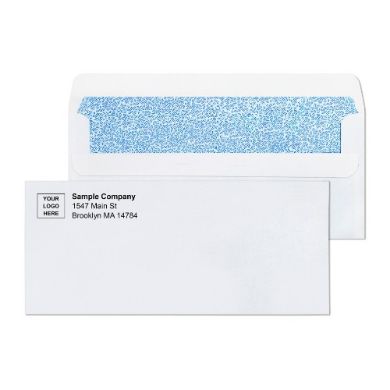
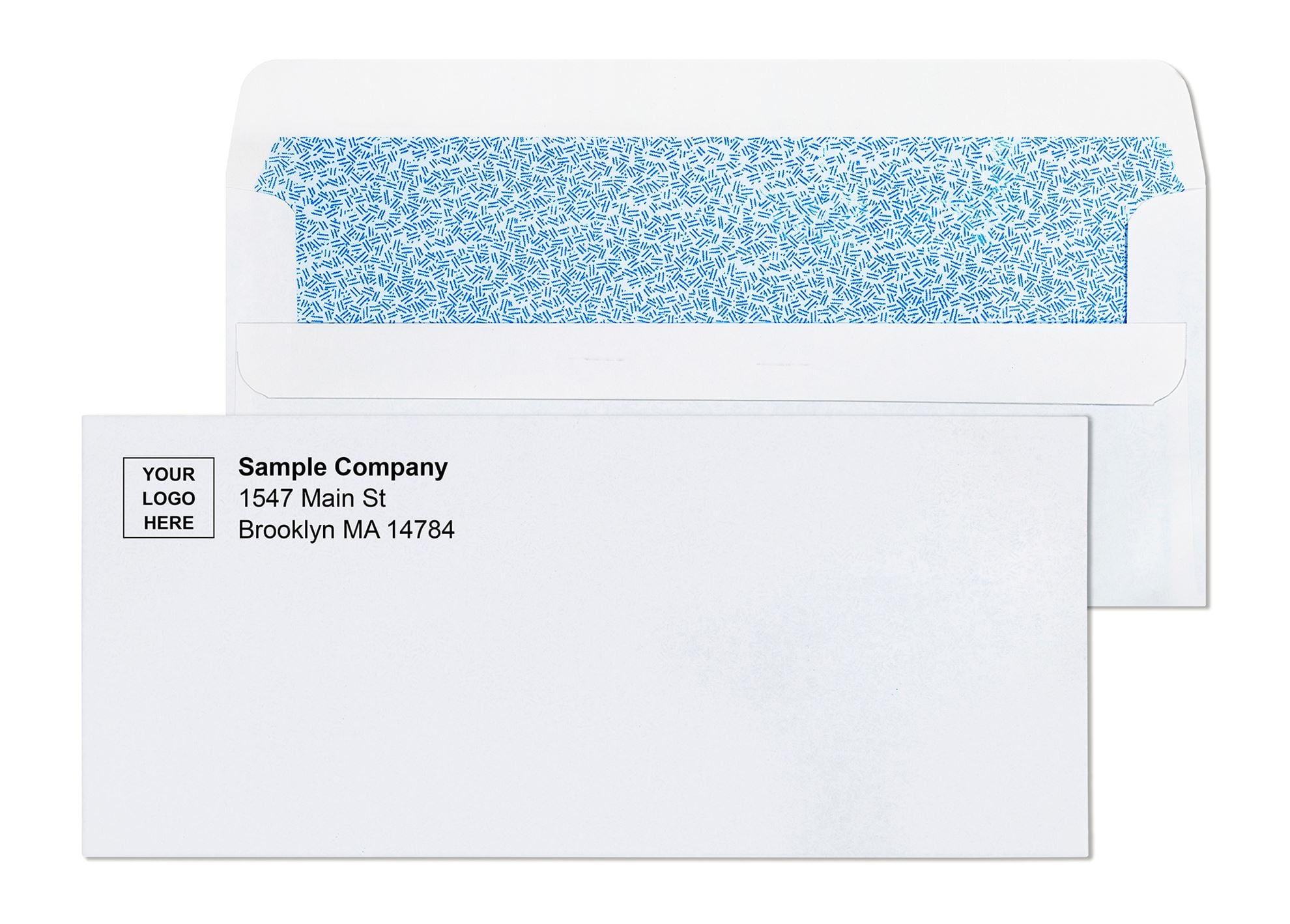
Custom window envelopes eliminate two manual steps from your mailing workflow in one format. The transparent poly-film window displays the recipient's delivery address from the document inside, so no addressing step is needed on the envelope face. The custom print adds your company logo, name, and return address to the upper-left area of the face, so no label or separate return addressing step is needed either. Every piece that goes out is fully branded and fully addressed without anyone writing, printing, or sticking anything on the envelope.
For billing departments, law offices, healthcare billing operations, and any organization mailing invoices or statements at recurring volume, custom window envelopes are the format that makes the mailing workflow systematic rather than manual. This guide covers how the print and window work together, every format available, what to specify before ordering, and how to test alignment so the first batch goes out correctly.
The most common question buyers have before ordering custom window envelopes is whether the logo print and the window interfere with each other. They don't. The two elements occupy separate zones on the face.
The standard window patch on a commercial envelope measures 1-1/8 inches by 4-1/2 inches, positioned 7/8 inch from the left and 1/2 inch from the bottom. That window sits in the lower-left area of the face.
Custom printing on window envelopes occupies the upper-left: company name, logo, and return address. The print zone is above and to the left of where the window sits. The window is below and to the right of where the print sits. On the same face, in separate zones, without overlapping. That zone separation is why custom window envelopes work -branding at the top, automatic address display at the bottom, nothing interfering with either.
Custom printing for window envelopes includes logos, return address, and other business information, all printed in the upper-left zone that does not overlap with the address window below.
The difference between a custom printed window envelope and a plain window envelope with a label matters for both presentation and operational efficiency.
A plain window envelope with a stick-on return address label handles the same functions mechanically. But adhesive labels shift, peel in warm conditions, and visually communicate that the organization uses workarounds rather than established mailing infrastructure. For any recipient who handles significant incoming mail volume, labels on business envelopes are immediately noticeable.
Custom window envelopes with pre-printed logos and return addresses eliminate the need for labels while keeping every mailing clean and professional. Pre-printed envelopes look more professional, save time on every mailing cycle, and create a consistent branded impression across every outgoing piece.
Custom window envelopes with direct printing produce a permanent, clean result that doesn't shift, peel, or vary between mailing cycles.
The standard format. 4-1/8 x 9-1/2 inches, single window in the lower-left, available in plain white wove and security tinted stock. Holds a standard 8.5 x 11 letter sheet tri-folded with the address landing behind the window automatically. Custom printing occupies the upper-left with logo and return address.
The custom printed #10 window envelope is what billing departments, healthcare offices, law firms, and financial services organizations use as their standard outgoing format. QuickBooks, Xero, FreshBooks, and most US billing software format address blocks to align with this window position automatically.
Custom window envelopes in the #10 size are available in gum flap for automatic insertion equipment and peel-and-seal or flip-and-stick for manual batch sealing.
Two windows instead of one. The upper-right window displays the sender return address from the document inside. The lower-left window displays the recipient delivery address. No labels, no addressing on the envelope face -both address fields pull from the printed check, statement, or invoice inside.
Custom printed double window envelopes include logo and company name printed above both windows on the face. For accounts payable programs running QuickBooks, Sage, and Quicken check printing, custom window envelopes in the double window format are the operational standard -both addresses display automatically, and the branded logo appears on every outgoing check mailer.
Security tinted custom window envelopes carry a reflex blue or dark geometric pattern printed on the interior. When the sealed envelope is held to a light source, that pattern blocks the document contents from showing through the paper. Only the address block behind the clear poly-film window remains readable from outside.
The security tint is an interior pattern that blocks document contents from showing through the paper wall when held to light. Custom printing sits on the exterior face. The tint is on the interior. Both work independently on the same envelope. Amazon
Security tinted custom window envelopes are the correct specification for any mailing carrying account numbers, check amounts, payroll data, patient identifiers, or any sensitive financial or medical information that shouldn't be visible through the envelope in transit.
Slightly smaller than the #10 at 3-7/8 x 8-7/8 inches. Fits inside a standard #10 outgoing mailer as the return reply piece. Custom printing on a #9 custom window envelope pre-addresses the return side of the mailing program. The recipient doesn't address the return envelope -they insert their response and mail it back.
Same window position and custom print zone layout as the #10, in larger commercial letter sizes. The #11 (4-1/2 x 10-3/8 inches) and #12 (4-3/4 x 11 inches) handle thicker multi-sheet enclosures that consistently overstuff a #10. Custom window envelopes in these sizes suit programs with larger document packets that still require automatic address display.
Browse all sizes at the window envelope hub.
Getting four things right before the order prevents reproof cycles and production delays.
Format: Single or double window, size, plain or security tinted stock. For most billing and invoice programs, #10 single window security tinted is the correct starting point.
Artwork: Logo in vector EPS or high-resolution PDF format. Return address in your brand font. The custom print occupies the upper-left zone of the envelope face -build the artwork file specifically for that area, not for the full face.
Ink: Black and white for most business correspondence programs. Full color for programs where logo brand colors are a priority on every outgoing piece.
Closure: Gum flap for automatic insertion equipment. Peel-and-seal or flip-and-stick for manual batch sealing. The complete self-seal envelope range covers both closure options with custom printing across all custom window envelope sizes.
The custom print on a window envelope is fixed during production. What can shift is the address block position on your document template relative to the window position on the envelope. One alignment test before the batch run prevents the entire run from going out wrong.
Print one invoice or statement from your template. Fold it using the Z-fold method (fold the bottom third up, then fold the top third back in the opposite direction -this positions the address panel facing outward). Insert the folded document into the custom window envelope face-up with the address panel facing the window side. Hold the sealed envelope to a light source.
Confirm the full delivery address appears inside the window with clear margins on all four sides. Confirm no financial data, account numbers, or document content is readable through the envelope body outside the window area. If the address position is off, adjust the address block in your document template and retest before running the full batch.
For custom window envelopes programs mailing through accounting software, the standard #10 window position aligns with default invoice templates from QuickBooks, Xero, and FreshBooks. Non-default templates may require a print position adjustment.
Custom window envelopes at Business Envelopes require no minimum order. You order the quantity your mailing program needs. Once artwork is approved and on file, every reorder of any custom window envelope format reproduces without re-submitting files or running a new proof cycle.
Custom orders ship within 7 to 10 business days from proof sign-off. Blank window stock ships same or next business day. Free shipping on every order.
For organizations running custom window envelopes alongside custom printed plain envelopes or return envelopes, one approved design file covers all formats. Request a quote for the full program across every format your mailing operation uses.
Custom window envelopes solve the two most repetitive steps in any recurring business mailing: addressing the delivery address and applying the return address. The window handles the delivery address automatically from the document inside. The custom print handles the return address and logo permanently on the face. Both functions work on the same envelope without interfering because they occupy separate zones -upper-left for the print, lower-left for the window. Every custom window envelope that goes out is fully branded, fully addressed, and ready to seal without any manual steps. Business Envelopes has carried custom window envelopes across every commercial size since 1997, with no minimum order and free shipping on every format.
Window envelopes with your company logo and return address printed directly on the face during production. The transparent window displays the recipient's address from the enclosed document automatically. No labels or manual addressing required on either the delivery or return address.
The print zone and the window zone are in separate areas. The standard window sits in the lower-left at 1-1/8 x 4-1/2 inches, 7/8 inch from the left and 1/2 inch from the bottom. Custom printing occupies the upper-left above that zone. They don't overlap.
#9, #10, #11, and #12 commercial letter sizes, available in single window and double window configurations, in plain and security tinted stock, at Business Envelopes.
A custom window envelope with a reflex blue interior pattern that blocks document contents from showing through the paper when held to light. The window still displays the address. The tint protects everything else. Custom print adds the logo on the face.
Yes. The standard #10 window position aligns with QuickBooks, Xero, and FreshBooks invoice templates automatically. For custom or modified templates, test one printed piece before a full batch run to confirm address alignment.
A custom window envelope with two windows -one for the recipient's delivery address and one for the sender's return address. Both addresses pull from the document inside. Standard for check mailing and accounts payable programs where both addresses are pre-printed on the check or statement.
No. Business Envelopes has no minimum order requirement on custom window envelopes. Artwork stays on file for all future reorders without re-submitting files.
Custom orders ship within 7 to 10 business days from proof approval. Blank window envelope stock ships same or next business day.
Folding a letter for a #10 envelope takes about ten seconds when you know the layout. What takes longer to figure out is the distinction between the two tri-fold methods - the C-fold and the Z-fold - and why only one of them works correctly with a window envelope. Get the fold wrong on a window envelope program and the address block ends up hidden instead of visible through the film. This guide covers every standard fold type, which envelope each one pairs with, and the specific Z-fold technique required for window envelope address alignment.
The tri-fold divides an 8.5 x 11 sheet into three equal horizontal panels. When folded, each panel measures approximately 3.67 x 8.5 inches - clean clearance inside the #10 envelope (4-1/8 x 9-1/2 inches) on all sides.
This is the standard fold for US business correspondence: invoices, billing statements, payroll letters, legal notices, cover letters, and everyday outgoing mail.
Two tri-fold variations exist and the choice matters for window envelopes:
C-fold (letter fold): Fold the bottom third up first, then fold the top third down over it. All three panels stack flat in the same direction. Used for standard plain envelopes where address direction doesn't matter.
Z-fold: Fold the bottom third up first, then fold the top third down in the opposite direction - when viewed from the side, the letter makes a Z shape. Required for window envelope programs. The Z-fold positions the address panel facing outward in mailing orientation so it shows through the transparent film.
Fold the 8.5 x 11 sheet in half across its 11-inch dimension. The result is a 5.5 x 8.5 inch folded piece. This does not fit in a #10 envelope - the folded width of 5.5 inches exceeds the #10's 4-inch interior. It fits cleanly in a 6x9 booklet envelope with clearance on all sides.
For documents that cannot arrive creased - contracts with signatures, certificates, proposals, photography - the full 8.5 x 11 sheet inserts flat into a 9x12 envelope with clearance on all sides. No folding, no crease lines on arrival.
|
Fold Type |
Folded Dimensions |
Correct Envelope |
USPS Class |
|
Tri-fold (C or Z) |
~3.67 x 8.5 in |
#10 (4-1/8 x 9-1/2 in) |
Letter rate |
|
Tri-fold legal paper |
~4.67 x 8.5 in |
#14 (5 x 11-1/2 in) |
Letter rate |
|
Half-fold |
5.5 x 8.5 in |
6x9 booklet |
Letter or flat (by thickness) |
|
No fold |
8.5 x 11 in |
9x12 or 10x13 |
Flat rate |
A window envelope relies on the address block being in exactly the right position after folding and insertion. The standard window on a #10 envelope measures 1-1/8 x 4-1/2 inches, positioned 7/8 inch from the left and 1/2 inch from the bottom. The Z-fold positions the address on the outward-facing center panel so it sits directly behind that window.
For this to work reliably, the address block must be in the correct position on the document template before the fold. For standard #10 window envelopes, the address block typically sits 2 to 2.5 inches from the top of the page, left-aligned starting about 1 inch from the left edge. Most US billing software, QuickBooks, Xero, and FreshBooks already format invoices to this position.
Test alignment before any batch run:
If alignment is off, adjust the address block position in the document template and retest before the full batch.
For programs where both return address and delivery address appear in windows, a double window envelope displays both from the document inside without any envelope addressing step.
For a C-folded letter into a plain #10: insert the closed-fold edge first with the text facing outward. The folded panels protect the text during insertion.
For a Z-folded letter into a window envelope: the closed-fold edge enters first, with the address panel facing toward the window side of the envelope. The address faces the window as the letter slides in.
Legal-size paper at 8.5 x 14 inches needs a longer envelope when folded. The #14 envelope at 5 x 11.5 inches holds a legal sheet tri-folded into thirds and qualifies for USPS First-Class letter postage. An 8.5 x 14 sheet tri-folded produces a panel of approximately 4.67 x 8.5 inches - fits the #14's interior with clearance on all sides.
For organizations mailing legal-size correspondence at letter rate rather than flat rate, the tri-fold into a #14 is the correct setup. Mailing an unfolded 8.5 x 14 sheet in a 10x13 envelope always mails at flat rate. The #14 tri-fold saves the postage difference on every piece across every mailing cycle.
Fold type determines which envelope you use, and envelope size determines postage class.
Tri-fold into a #10: USPS First-Class letter rate. The most cost-efficient postage class for business mail.
Tri-fold into a #14 (legal paper): Also First-Class letter rate. The #14's dimensions fall within letter-rate maximums.
Half-fold into a 6x9: The 6x9's outer dimensions technically fall within letter-rate size limits, but contents pushing the sealed piece over 1/4 inch thick push it into flat-rate territory. A single half-folded sheet usually stays under the threshold. A brochure or multi-page insert often doesn't. Test one fully assembled piece before assuming letter rate.
No fold into 9x12 or larger: Always flat rate. No exceptions.
For any program that standardizes on a specific fold and envelope combination, pre-printed custom stock through the self-seal envelope range means the team works with consistent envelopes and closures across the full program. Request a quote to price a multi-format program together.
Folding a letter for an envelope comes down to matching the fold to the envelope and getting the fold direction right for window programs. Tri-fold for a #10, half-fold for a 6x9, no fold for a 9x12. C-fold for plain envelopes, Z-fold for window envelopes where the address must face the film. Test one piece before every window envelope batch run - alignment errors at scale are expensive to correct. Business Envelopes carries every envelope size matched to every fold type in this guide, blank or custom printed, with free shipping and no minimum order.
Place the letter face-up in portrait orientation. Fold the bottom third up to cover the center third and crease. Then fold the top third down over both panels (C-fold) for a plain envelope, or fold it back in the opposite direction (Z-fold) for a window envelope.
Both are tri-folds. A C-fold folds all panels in the same direction, used for plain envelopes. A Z-fold reverses the second fold direction, creating a Z shape - required for window envelopes where the address block must face outward through the film.
A 6x9 booklet envelope. A half-folded sheet produces a 5.5 x 8.5 inch piece that fits the 6x9 interior cleanly. A half-folded sheet is too wide for a #10 envelope.
Z-fold. The bottom third folds up first, then the top third folds back in the opposite direction. This positions the address block on the outward-facing center panel so it shows through the transparent window film.
Yes. Tri-fold into a #10 or #14 qualifies for letter rate. Half-fold into a 6x9 may qualify for letter rate if contents are thin. No fold into 9x12 or larger always mails at flat rate.
Tri-fold the 8.5 x 14 sheet into thirds and insert it into a #14 envelope (5 x 11.5 inches). The #14 qualifies for USPS First-Class letter rate, making it the cost-efficient alternative to mailing an unfolded legal sheet at flat rate.
The 10x13 envelope is one inch larger than a 9x12 envelope on each dimension. That extra inch solves specific problems the 9x12 can't handle cleanly: thick multi-tab document packets, legal-size 8.5 x 14 sheets mailed flat, presentation folders with multiple loose inserts, and content stacks where the 9x12 capacity is consistently at its limit. Knowing when the 10x13 is the right upgrade -rather than just a larger version of the same thing - is what makes the format decision useful instead of arbitrary.
The 10x13 envelope measures 10 inches wide by 13 inches tall, with interior clearance of approximately 9-3/4 x 12-3/4 inches. Like the 9x12, the 10x13 exceeds USPS letter-rate size limits on both dimensions. Both are classified by USPS as flats (large envelopes), which means flat-mail postage applies regardless of content weight. This is important for anyone switching from a #10 letter-rate program: the 10x13 always costs more per piece to mail than a #10, and so does the 9x12. When comparing the two flat formats, postage class is the same - the decision is purely about what fits.
The 9x12 handles the majority of flat-document programs because it holds an 8.5 x 11 sheet flat with adequate clearance. The 10x13 earns its place in four situations:
Legal-size 8.5 x 14 sheets mailed flat: An 8.5 x 14 document cannot lie flat in a 9x12. The 10x13 holds it with nearly an inch of clearance on each side. For law firms, government agencies, and insurance processors mailing legal-size documents that cannot be folded, the 10x13 is the minimum format that works.
Thick multi-tab document packets : A tabbed document set with dividers, multiple attachment sections, and a cover letter can push the 9x12 gum flap to its seating limit. The 10x13's extra clearance handles that stack without straining the flap.
Presentation folders : A standard letter-size presentation folder measures 9 x 12 inches-exactly the outer dimensions of a 9x12 envelope, giving zero clearance. Loading a presentation folder into a 9x12 requires forcing it, which damages the corners. The 10x13 lets the folder slide in cleanly.
Programs where 9x12 content is consistently overstuffed : If the team is regularly forcing envelopes to seal on thick content, the 10x13 is the correct next step up.
24 lb white wove, opens on the short 10-inch edge, center seam construction, moistenable gum flap. The 10x13 white open-end gum flap is the workhorse for document workflow insertion and any operation using automatic insertion equipment. Inserter machines moisten and seal gum flap stock mechanically — gum flap is the required closure if a mailing machine processes the envelope. Center seam provides extra structural strength for heavier content stacks. Top-loading orientation suits document-workflow insertion.
Same 24 lb white wove with side seam construction, opens on the long 13-inch edge. The 10x13 white booklet gum flap suits side-load programs and operations that prefer the wide-opening format for faster hand-loading. Side seam construction provides an uninterrupted face for branded direct mail where full-face printing is part of the program.
Open-end center seam with a pressure-sensitive adhesive closure. Silicone release liner protects the adhesive until you peel it away and press the flap down. The 10x13 peel-and-seal open-end uses 28 lb stock rather than 24 lb, adding structural rigidity for heavier content packets. Right for manual batch programs where envelopes are stuffed before the mailing date -the liner keeps the adhesive inactive in storage, so pre-stuffed envelopes staged for later dispatch seal as cleanly as envelopes processed immediately.
Booklet side-seam construction with peel-and-seal closure. The 10x13 peel-and-seal booklet combines the wide-opening booklet format with a no-moisture self-seal closure. Right for branded direct mail programs that are stuffed and staged before dispatch, where the print face needs to be clean for full-face graphics or logo treatment.
|
Situation |
9x12 |
10x13 |
|
8.5 x 11 sheet flat |
✅ Fits with clearance |
✅ Fits with extra clearance |
|
Legal-size 8.5 x 14 flat |
❌ Too small |
✅ Fits cleanly |
|
Standard presentation folder |
❌ No clearance |
✅ Fits cleanly |
|
Multi-tab document packet |
Tight at high count |
✅ More comfortable |
|
USPS postage class |
Flat rate |
Flat rate (same) |
|
Custom printing |
✅ Available |
✅ Available |
The 9x12 envelope remains the right format for standard flat-document programs. The 10x13 is the correct upgrade when contents consistently test the 9x12's limits, or when legal-size sheets or presentation folders are part of the standard mailing.
Law firms and legal services: The standard for legal-size document mailings, executed agreements, and thick contract packets that must arrive flat.
Government agencies: Regulatory notices, permit applications, and multi-page compliance documents on legal-size letterhead when they cannot be folded.
Healthcare and insurance: Claims documentation, prior authorization packets, and explanation-of-benefits correspondence that exceeds 9x12 capacity regularly.
Corporate communications and HR: Annual report distributions, benefit election packets with multiple loose inserts, and thick employee communication pieces.
Marketing and design agencies: Campaign kits with a presentation folder, a brochure, a letter, and reply materials- the 10x13 handles the folder cleanly where the 9x12 can't.
Logo and return address printing is available on every 10x13 configuration with no minimum order. Artwork prints directly on the envelope face. Once approved and on file, every reorder reproduces without re-submitting files. Custom orders ship within 7 to 10 business days from proof approval. Blank stock ships same or next business day. Free shipping on every order.
The full self-seal envelope range covers peel-and-seal configurations for the 10x13 and all related sizes. Request a quote for volume programs across the 10x13 and 9x12 formats together.
The 10x13 envelope is the upgrade for programs where the 9x12's clearance is consistently insufficient. Legal-size sheets, flat, thick tabbed document packets, presentation folders, and multi-insert content stacks that routinely strain a 9x12 all belong in the 10x13. The postage class is the same - both are USPS flats. The format decision comes down to what's going inside and whether the 9x12's clearance handles it cleanly every time. Business Envelopes has carried both formats since 1997, blank or custom printed, with free shipping and no minimum order on every configuration.
Any document up to approximately 9-3/4 x 12-3/4 inches flat - including 8.5 x 11 sheets with generous clearance, legal-size 8.5 x 14 sheets flat, standard presentation folders, and thick multi-tab document packets.
One inch larger on each dimension. Both hold 8.5 x 11 sheets flat. The 10x13 also fits legal-size 8.5 x 14, presentation folders, and thicker content stacks that are tight in a standard 9x12. Both mail at USPS flat rate.
No. It exceeds USPS letter-rate size limits on both dimensions and always mails as a flat, regardless of content weight.
Booklet opens on the long 13-inch edge with side seams -faster for hand-loading and compatible with automated insertion. Open-end opens on the short 10-inch edge with center seams - stronger for heavier content stacks.
When contents are legal-size (8.5 x 14), when mailing a standard presentation folder (9 x 12 inches), when multi-tab packets are consistently tight in a 9x12, or when the team is regularly forcing 9x12 flaps to seat on overstuffed content.
Yes. Logo and return address printing is available on every 10x13 variant with no minimum. Artwork stays on file for all future reorders without re-submitting files.
Kraft envelopes are the brown-toned, sturdy flat-document mailers that have been standard in US offices and mailrooms for over a century. The material - long-fiber recycled brown kraft paper - is what separates them from standard white wove. Heavier, tougher, more resistant to tearing in postal handling, and built for documents that need reliable protection without premium packaging. The clasp format makes them re-sealable, which is why they're the default for interoffice routing and archival workflows where the same envelope opens and closes multiple times.
Most buyers have used brown kraft envelopes without thinking much about the choice. This guide covers when kraft is the right call, when white wove is better, every size and variant in the catalog, and the USPS postage detail that affects any kraft clasp mailing program.
Brown kraft envelopes are made from a strong, long-fiber paper stock using the kraft pulping process - a chemical treatment that preserves the natural lignin bonds in wood fiber and produces a tougher sheet than standard white paper. The envelopes are made with SFI-certified 28 lb recycled tan/brown kraft, a strong, long-fiber stock with a vellum finish that resists tearing better than standard white wove at the same paper weight.
The natural brown color comes from unbleached pulp. White paper goes through a bleaching process that, while producing a cleaner surface, removes some of the long-fiber strength that makes kraft durable. That strength difference is what matters when envelopes go through multiple automated handling points, through interoffice routing between departments, or into archival storage accessed repeatedly over time.
Brown kraft envelopes come in three structural configurations. The choice follows the same operational logic as white wove flat-document formats.
Booklet style opens on the long edge with side seam construction. Fast to load from the wide side. Compatible with automated insertion equipment. The better format for mailing programs using inserter machines or prioritizing loading speed on manual runs.
Open-end (catalog) style opens on the short edge with center seam construction. Loads from the top. Stronger structural integrity for thicker content stacks - center seam handles packet weight more reliably than side seam at high sheet counts.
Clasp style adds a metal brad closure through a reinforced hole in the flap. The brad folds down after each use and can be re-opened and re-closed repeatedly. Gummed flap and clasp work together - the gummed flap seals for transit, the clasp adds structural security. Reusable format, standard for interoffice routing and document archiving.
6x9 Brown Kraft: Holds a 5.5 x 8.5 booklet flat, or an 8.5 x 11 sheet folded in half. The compact routing and mailing format for smaller document sets. Available in booklet and clasp configurations.
9x12 Brown Kraft: The workhorse of the brown kraft catalog. Holds a standard 8.5 x 11 sheet flat. Available in three confirmed configurations:
9-1/2 x 12-1/2 Brown Kraft Clasp: A quarter-inch larger than the standard 9x12 on each dimension. Extra clearance for thicker document stacks that are consistently tight in a standard 9x12. The standard re-sealable routing format for thick multi-page packets that pass through several handlers.
10x13 Brown Kraft: Available in clasp and gum flap formats. Holds legal-size 8.5 x 14 sheets flat, thick presentation folders, and multi-tab document packets that need more clearance than a 9x12 provides. The format for law firms, government agencies, and compliance departments with thick outgoing legal document programs.
10x15 Brown Kraft Clasp: The largest standard brown kraft format. Handles oversized documents, wide-format prints, and extra-large content stacks where the 10x13 doesn't provide enough clearance.
Browse the complete 9x12 envelope range to compare brown kraft and white wove configurations side by side.
This is the operational detail that catches organizations off guard when they start mailing clasp envelopes through USPS. Metal clasp closures make an envelope non-machinable under USPS automated sorting standards. The piece requires manual handling, and USPS applies a non-machinable surcharge per piece on top of standard flat-mail postage.
For interoffice routing where clasp envelopes never go through USPS, this doesn't matter at all. For outgoing mail programs where clasp envelopes are posted through USPS, the surcharge adds cost on every piece.
The practical solution: use a gum flap or peel-and-seal booklet or open-end format for outgoing external mail, and reserve the clasp format for internal routing and archival use. The self-seal envelope range covers peel-and-seal configurations across all standard flat-document sizes for programs that need a no-moisture closure on outgoing mail.
The choice is operational, not just aesthetic.
Brown kraft is the right choice when:
White wove is the right choice when:
For programs that need both - internal routing in kraft and external mailing in white wove - the 9x12 envelope range covers both materials in one catalog. For documents where arrival condition is non-negotiable and neither white wove nor brown kraft provides sufficient protection, Tyvek envelopes are tear-proof, puncture-resistant, and moisture-resistant across the same flat-document sizes.
Request a quote for volume pricing across the full brown kraft and white wove lineup together.
Brown kraft envelopes earn their place in document routing and mailing programs because of what the material does: resists tearing, handles rough postal sorting, survives repeated open-and-close cycles in clasp format, and stores cleanly in archival conditions. The size choice, from 6x9 compact through 10x15 oversized, follows the same logic as white wove flat-document formats. Match the envelope to what's going inside and how many times it needs to be opened. The one operational detail to plan around is the USPS non-machinable surcharge on clasp closures for outgoing mail - easy to handle once it's on the radar. Business Envelopes has carried every brown kraft format since 1997, blank or custom printed where applicable, with free shipping and no minimum order.
FAQs
An envelope made from 28 lb brown kraft paper, a strong long-fiber stock manufactured using the kraft pulping process. More tear-resistant than standard white wove and the standard format for flat-document mailing, interoffice routing, and archival document storage.
Standard sizes are 6x9, 9x12, 9-1/2 x 12-1/2, 10x13, and 10x15 inches, available in booklet, open-end, and clasp configurations at BusinessEnvelopes.com.
A clasp envelope has a metal brad closure through a reinforced hole in the flap. The brand folds down to hold the flap closed without adhesive and can be opened and re-closed many times. Used for interoffice routing, records management, and archival filing.
Yes. Metal clasp closures are classified as non-machinable by USPS, which adds a surcharge per piece on top of standard flat-mail postage. For outgoing external mail, a gum flap or peel-and-seal format avoids the surcharge.
Brown kraft suits interoffice routing, document storage, re-sealable transit of thick content stacks, and programs where durability outweighs presentation on arrival. White wove suits external client-facing correspondence, custom-printed branded mailings, and programs with window addressing.
Yes, on booklet and open-end formats. For programs requiring sharp full-color printing, white wove provides a cleaner print surface. Kraft vellum finish accepts printing but with slightly less color precision than white wove.
The 6x9 envelope is the compact flat-document format in the US mailing system. It holds a 5.5 x 8.5 booklet or brochure flat, a half-folded 8.5 x 11 sheet, or a small document set without forcing a tri-fold. That makes it the right format when contents are too thick or too large for a standard #10 but don't need the full 9x12 treatment.
What most buyers find out after ordering is that the 6x9 has a specific USPS postage quirk that its larger flat-document siblings don't share. Understanding it before you order can save real postage costs over a recurring mailing program. This guide covers the full 6x9 format, every variant, and the postage decision you need to make before committing to it at volume.
The 6x9 envelope measures 6 inches tall by 9 inches wide, with the interior accommodating contents up to approximately 5.75 x 8.75 inches. The 6x9 booklet envelope opens on the long 9-inch edge with side seam construction, making it compatible with automated mail insertion equipment and ideal for brochures, booklets, and small flat-document programs. Business Envelopes
What fits cleanly inside:
What doesn't fit well: full unfolded 8.5 x 11 sheets. Those belong in a 9x12 envelope where the clearance works correctly. Trying to insert an unfolded 8.5 x 11 into a 6x9 means forcing a fold or creasing the corners, which defeats the purpose of mailing flat.
This is the fact that most buyers learn after the mailing runs, not before it. The 6x9 envelope sits directly at the boundary between USPS First-Class letter rate and First-Class flat rate.
USPS letter-rate requirements are: envelope no more than 6-1/8 inches high, 11-1/2 inches long, and 1/4 inch thick, with contents under 3.5 ounces. The 6x9 at 6 inches tall clears the 6-1/8 inch maximum height requirement. It's within bounds. Amazon
The problem is the 1/4 inch thickness limit. Flat document mailers in the 6x9 format carry a thickness constraint: any contents pushing the sealed envelope over 1/4 inch thick push the piece out of letter-rate classification and into flat-rate territory. Business Envelopes
A single half-folded sheet typically stays well under 1/4 inch. A 20-page saddle-stitched booklet, a tri-panel brochure with a glossy cover, or a small document set with multiple inserts often doesn't. For any 6x9 program where the contents include more than two or three sheets, test one fully assembled sealed piece with a postal scale and a thickness gauge before committing to letter-rate postage calculations. Running a high-volume mailing at letter rate that should be classified as flat creates a postage underpayment that USPS collects at delivery.
For the majority of 6x9 mailing programs, planning around flat-rate postage is the safer approach. The 6x9 can earn letter rate - but it takes deliberate content management to stay under the threshold consistently.
Every 6x9 envelope comes in one of two opening configurations, and the choice affects how quickly your team processes a mailing.
Booklet style opens on the long 9-inch edge. The flap runs along the wider dimension. You load documents by sliding them in from the side, which is the natural motion for inserting flat pieces and the loading configuration that automated insertion equipment is designed around. Booklet envelopes use side seam construction throughout, which provides a clean, flat face ideal for printing full-face designs and logos directly on the envelope body. Business Envelopes
Open-end style opens on the short 6-inch edge. The flap is at the top. Documents load straight down from the top edge, which suits top-load insertion of thicker content stacks. Open-end construction uses a center seam running down the face, which provides extra structural strength for heavier content packets but means the center seam interrupts full-face print designs. Business Envelopes
For most 6x9 programs: booklet for fast hand-loading or automated insertion, open-end for thicker content packets where structural strength matters more than insertion speed.
24 lb bright white wove, 9-inch opening, moistenable gum adhesive on the flap. The baseline format for 6x9 mailing programs and the correct specification for automatic insertion equipment. Pitney Bowes, Neopost, and similar inserter machines moisten and seal gum flap stock mechanically. If any part of your operation runs a mailing machine, gum flap is the required closure.
The 6x9 white booklet gum flap handles everyday brochure and document mailings where manual sealing or inserter processing is the workflow.
Same 24 lb white wove, 9-inch opening, with a pressure-sensitive adhesive strip on the flap protected by a silicone release liner. Peel the liner away and press the flap down. Bonds on contact, no moisture required.
The 6x9 peel-and-seal booklet uses 28 lb stock rather than 24 lb, which provides extra rigidity for heavier inserts. This is the format for programs where envelopes are stuffed before the mailing date and sealed later. The liner keeps the adhesive inactive in storage - a box of stuffed envelopes sitting for two days seals just as cleanly as one sealed immediately.
White wove, 6-inch opening, gum flap. Loads from the top rather than the side. Stronger center-seam construction handles thicker document sets without the envelope body stretching or compromising. For 6x9 programs where the content stack is consistently at the thick end of the format's capacity, open-end center seam is more reliable than booklet side seam.
The 6x9 white open-end gum flap suits catalog-style document programs with heavier inserts.
Same open-end construction with a peel-and-seal closure instead of gum. The 6x9 open-end peel-and-seal suits thick-content programs that are staged before mailing and sealed manually without an inserter.
DuPont Tyvek material instead of paper stock. Tear-proof, puncture-resistant, moisture-resistant. The Tyvek 6x9 uses a Kwik-Tak contact closure that bonds the same way as standard peel-and-seal - no moisture, press to seal - but on material that survives rough postal handling, wet weather, and sharp objects that would compromise a paper envelope entirely.
Browse the full Tyvek envelope range for all Tyvek formats including 6x9. For documents where arrival condition is non-negotiable, this is the format.
Direct mail marketers use the 6x9 for campaigns where the mailing piece is a custom-designed brochure or self-mailer at 5.5 x 8.5. The envelope carries full-face custom printing and the booklet inside creates the marketing impression before the recipient reads a word.
Nonprofits and associations use the 6x9 for membership materials, event programs, and small publications that don't warrant the full 9x12 flat-mail format but are too bulky for a #10.
Photo and portrait studios use the 6x9 for delivering 5 x 7 prints to clients. The format protects the print during postal handling without requiring the full 9x12 format.
Small businesses and professional services use the 6x9 for presentation packets: a cover letter, a brochure, and a business card or reply card in a clean format that feels more substantial than a #10 without the formality of a 9x12.
Healthcare and wellness providers use the 6x9 for patient education materials in the 5.5 x 8.5 booklet format - a format that's common for folded care instructions, pamphlets, and event invitations.
Logo, return address, and full-face custom printing is available on every 6x9 configuration with no minimum order. Booklet side-seam construction provides a clean flat face without a center seam breaking up the print area - a real advantage for branded direct mail pieces that carry graphics or full-color designs on the envelope body itself.
Once your design is approved and on file, every reorder reproduces without re-submitting files or running a new proof cycle. Custom orders ship within 7 to 10 business days from proof sign-off. Blank stock ships same or next business day. Free shipping on every order.
The full self-seal envelope range covers every peel-and-seal configuration across all standard flat-document sizes in one place. For programs running 6x9 and other sizes together, request a quote to price the full program.
The 6x9 envelope handles the mailing programs that sit between a #10 and a 9x12: compact flat pieces, half-folded documents, small booklets, and photo prints that need a clean professional presentation without the bulk and postage of a larger flat mailer. The postage classification sits at the letter/flat boundary, which means content thickness is the variable to watch before committing to letter-rate assumptions on any 6x9 program. Booklet for side-load insertion, open-end for heavier top-load content, gum flap for inserter machines, peel-and-seal for manual batch programs. Business Envelopes has carried every 6x9 configuration since 1997, blank or custom printed, with free shipping and no minimum order.
A 5.5 x 8.5 booklet or brochure flat, a half-folded 8.5 x 11 sheet, 5 x 7 photo prints, or small multi-insert document sets. The interior clearance is approximately 5.75 x 8.75 inches.
The outer dimensions technically fall within letter-rate limits. Whether it qualifies depends on content thickness. Contents pushing the sealed piece over 1/4 inch thick push it into flat-rate territory. Test a fully assembled piece before assuming letter rate on a program with thick inserts.
Booklet envelopes open on the long 9-inch edge with side seam construction, compatible with automated insertion equipment. Open-end envelopes open on the short 6-inch edge with center seam construction, providing extra structural strength for heavier content stacks.
Documents where arrival condition is non-negotiable. Tyvek is tear-proof, puncture-resistant, and moisture-resistant. The Kwik-Tak closure bonds on contact without moisture. Used for documents that can't arrive torn, wet, or compromised by rough postal handling.
Yes. Full-face logo and return address printing is available on every 6x9 configuration with no minimum. Artwork stays on file for all future reorders without re-submitting files.
When contents are 5.5 x 8.5 or smaller in their mailed format, or when an 8.5 x 11 sheet can be folded in half without compromising the contents. The 9x12 is the correct format when an 8.5 x 11 sheet must arrive completely flat and unfolded.